

 Bearings
 Housings/housing Units
 Linear Technology
 V-Belts
 Seals
Seals
FAG
| Scale quantity | Your discount | Unit price |
|---|---|---|
| 2 | 10,76 € | 204,39 € |
| 5 | 21,52 € | 193,63 € |
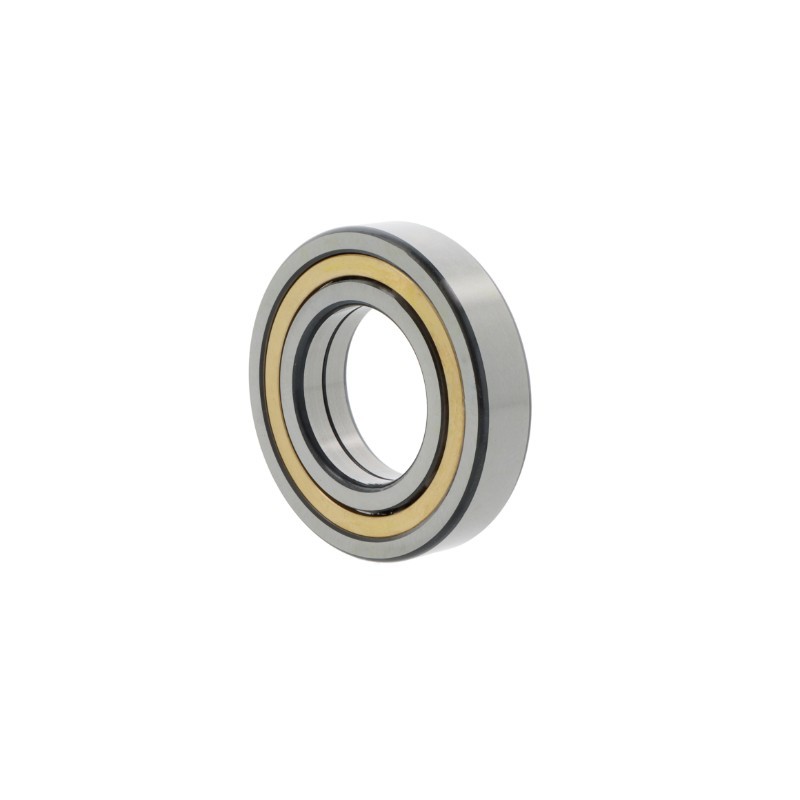
The FAG QJ313-MPA four-point bearing, with a 65 mm bore and a brass cage, provides a space-saving solution for accommodating axial loads in both directions.
The QJ313-MPA four-point bearing belongs to the group of radial rolling bearings and primarily accommodates axial forces in both directions. Thanks to the split inner ring, the design accommodates a large number of rolling elements, which increases the axial load-carrying capacity compared to deep-groove ball bearings. Designed as an open bearing, the bearing mounting requires an external lubricant supply and a suitable housing seal. FAG manufactures this model with a guided brass cage for demanding operating conditions.
Design engineers prefer to use this bearing where alternating or purely axial forces occur within a limited axial installation space. Typical applications include bearing arrangements with a predominant axial load, often in direct combination with a separate radial bearing. When the four-point bearing is used purely as an axial bearing, the outer ring is given radial clearance within the housing to ensure that no unwanted radial forces act on the rolling elements. When arranged appropriately, this design guides shafts precisely in the axial direction.
The two-piece inner ring simplifies assembly considerably. As the components are not self-retaining, the outer ring, together with the ball cage, and the two inner ring halves are mounted separately onto the shaft and housing. The solid brass cage is characterised by high strength and thermal resistance. In conjunction with the standard radial bearing clearance, the bearing covers a wide temperature range from –30 to +150 degrees. Manufacture to tolerance class P0 or ABEC 1 defines standardised mounting dimensions.
This roller bearing accommodates high axial loads in both directions whilst maintaining a compact axial width. The design features a two-piece inner ring and an outer ring without a retaining groove. FAG equips this version with a robust brass cage, which is designed for demanding industrial operating conditions.
With an internal diameter of 65 mm, an external diameter of 140 mm and a width of 33 mm, the bearing complies with standardised series for four-point bearings. Before fitting, check the shaft and housing fits against these nominal diameters.
The split inner ring allows a larger number of balls to be fitted, which increases the axial load-carrying capacity. Furthermore, the split design simplifies assembly: the outer ring with its ball race and the two halves of the inner ring can be fitted independently of one another and positioned precisely within the housing.
Designed for operating temperatures ranging from -30 to +150 degrees, the bearing benefits from the dimensional stability of the rings and the brass cage. When designing the bearing, care must be taken to ensure that the lubricant used is also suitable for the relevant operating temperature.
As this model does not have integrated sealing washers, lubrication is provided via the housing system, usually by means of an oil bath or by relubrication with grease. The surrounding housing structure must provide protection against dirt and moisture by means of shaft seals, labyrinth seals or a housing cover.
Manufactured to standard tolerance P0 or PN, this bearing corresponds to tolerance class ABEC 1 in the US. This class defines standardised dimensional, geometric and running accuracies for general machinery and gearbox construction.
Schaeffler Technologies AG & Co. KG
Industriestraße 1-3, 91074 Herzogenaurach, Germany
info.de@schaeffler.com, https://www.schaeffler.de/de/meta/impressum/