

 Bearings
 Housings/housing Units
 Linear Technology
 V-Belts
 Seals
Seals
FAG
| Scale quantity | Your discount | Unit price |
|---|---|---|
| 10 | 6,42 € | 122,00 € |
| 20 | 12,84 € | 115,58 € |
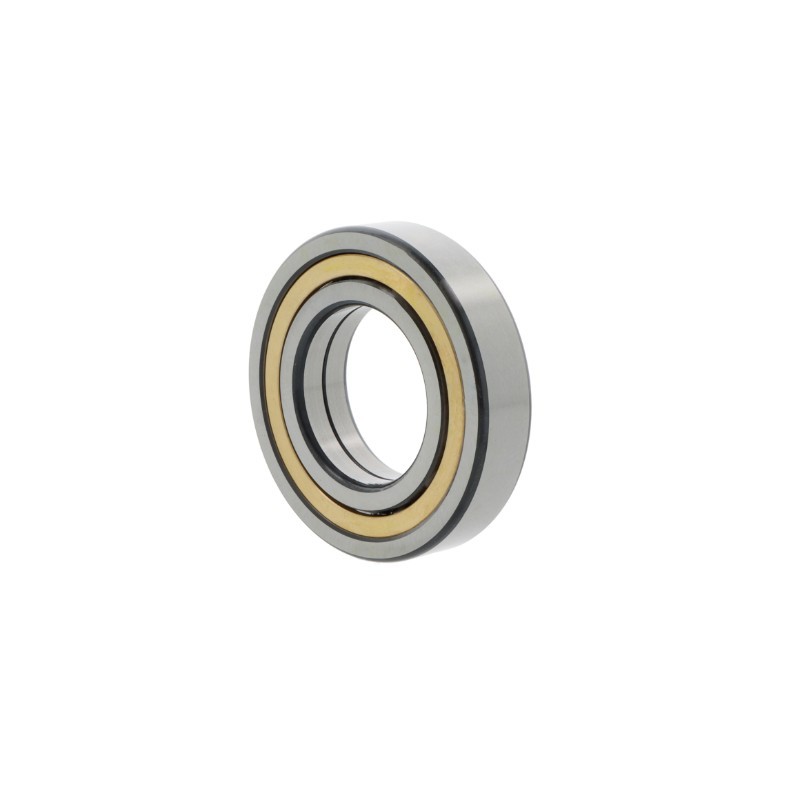
The FAG QJ310-MPA four-point bearing accommodates high axial forces in both directions whilst maintaining compact dimensions of 50 × 110 × 27 mm.
This open four-point contact bearing, the QJ310-MPA, combines a space-saving design with the ability to handle combined loads with a predominantly axial component. FAG manufactures this version with a split inner ring and a guided brass cage. Due to the geometry of the raceways, the rolling elements contact the rings at two points under a purely axial load, whilst radial forces are transmitted via four-point contact. The component features standard radial clearance and the standard tolerance class P0/PN (ABEC 1).
Design engineers primarily use this design where axial forces acting in both directions need to be accommodated within a confined installation space. The component often functions as a pure axial bearing alongside a separate radial bearing. When axially fixed without radial support in the housing, it specifically absorbs thrust forces in both directions. The permissible temperature range of –30 to +150 degrees allows for use in demanding industrial thermal environments.
The split inner ring allows for a higher number of balls and simplifies assembly. As four-point contact ball bearings are not self-retaining, the outer ring, together with the ball cage, and the two inner ring halves can be fitted separately. During installation, the inner ring halves must be clamped axially against each other to achieve the specified contact angle and ensure proper function. As no seals are integrated, the bearing is usually operated in sealed, externally lubricated housings.
A single-row radial ball bearing with a split inner ring, which accommodates axial forces in both directions. With dimensions of 50 mm bore, 110 mm outer diameter and 27 mm width, it requires less installation space than a double-row bearing arrangement.
The brass cage guides the rolling elements steadily along the raceway and keeps them at a consistent distance from one another. Brass is characterised by its strength and good sliding properties, and is suitable for use at elevated operating temperatures.
Standard bearing clearance refers to the defined radial play of the bearing in its as-supplied condition, in accordance with the relevant standard. It is dimensioned such that, after the bearing rings have been pressed into place and subject to normal operating temperatures, a functional operating clearance is maintained.
The component is designed for operating temperatures ranging from -30 to +150 degrees. In addition to the bearing rings, the thermal properties of the lubricant used are also a decisive factor in determining the actual operating limit of the entire bearing assembly.
As an open-bearing design, this component is intended for use in enclosed systems such as oil-lubricated gearbox housings. Designs featuring external seals also allow for relubrication as required and operation at higher circumferential speeds than is possible with contact seals.
The bearing complies with tolerance class P0/PN or ABEC 1. This refers to the standardised accuracy class for dimensional and running surfaces, which is commonly used in general mechanical engineering applications.
Schaeffler Technologies AG & Co. KG
Industriestraße 1-3, 91074 Herzogenaurach, Germany
info.de@schaeffler.com, https://www.schaeffler.de/de/meta/impressum/