

 Bearings
 Housings/housing Units
 Linear Technology
 V-Belts
 Seals
Seals
FAG
| Scale quantity | Your discount | Unit price |
|---|---|---|
| 2 | 36,75 € | 698,19 € |
| 3 | 73,50 € | 661,44 € |
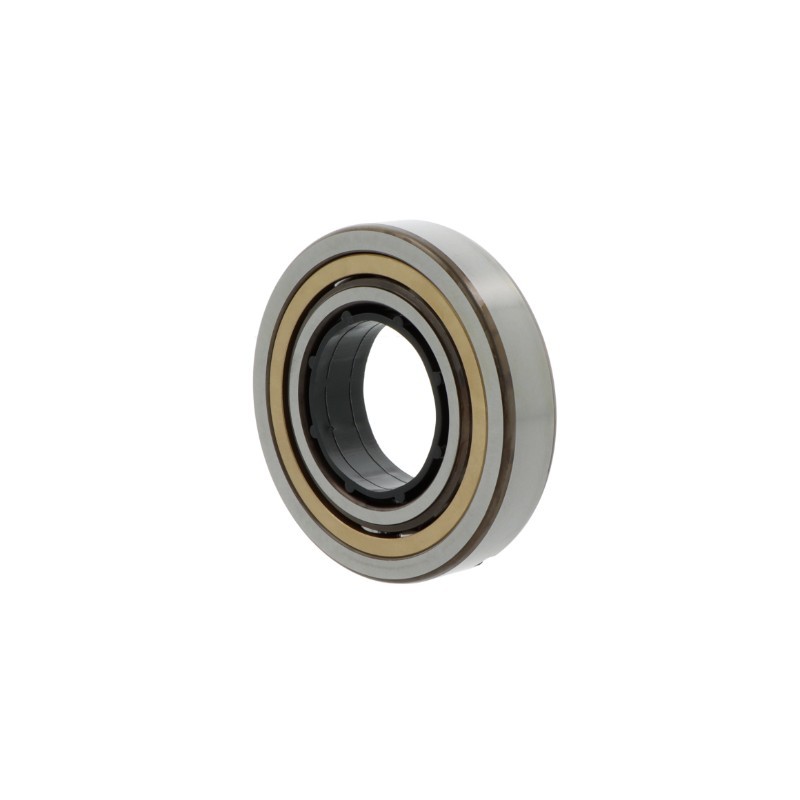
The QJ228 -N2-MPA four-point bearing from FAG, measuring 140 x 250 x 42 mm and featuring a brass cage and retaining grooves, offers a robust solution for axial forces acting in both directions.
The QJ228 -N2-MPA four-point bearing from FAG Rolling Bearings is primarily designed to accommodate high axial forces from both directions whilst requiring minimal axial installation space. Thanks to the specific raceway geometry, the rolling elements make defined contact with the rings under load, which supports precise guidance of the shaft. As an open bearing with a brass cage, this design is suitable for operating temperatures ranging from –30 to +200 degrees Celsius. It is manufactured to standard tolerance P0/PN or ABEC 1 with standard radial clearance.
It is primarily used where high axial forces occur in varying directions and where double-row bearings would require too much axial installation space. Typical applications include gearboxes or combined bearing arrangements in general mechanical engineering, where a separate radial bearing absorbs the transverse forces. As it is designed as a pure or predominantly axial bearing, the construction guides components in the longitudinal direction, provided the outer ring is mounted radially free within the housing.
The two-piece inner ring allows a large number of rolling elements to be accommodated, which increases the axial load-carrying capacity of the bearing arrangement. Furthermore, this design facilitates assembly, as the outer ring and the two halves of the inner ring can be fitted separately onto the shaft and housing. The two retaining grooves in the outer ring, offset by 180 degrees, serve to prevent rotation within the housing. Matching retaining pins engage with these grooves and secure the outer ring against rotating with the shaft under varying load conditions.
As a design capable of withstanding high axial loads, this bearing absorbs forces in both directions. The design features a split inner ring, a brass cage and two retaining grooves in the outer ring. With dimensions of 140 mm bore, 250 mm outside diameter and 42 mm width, it requires less axial installation space than double-row angular contact ball bearings.
The retaining grooves on the outer ring, which are offset by 180 degrees, serve to secure the ring positively in relation to the housing. When retaining pins engage with these recesses, the outer ring is secured against unintentional rotation. This is particularly important when the bearing is fitted with radial clearance as a pure thrust bearing.
The split inner ring allows a maximum number of balls to be fitted during manufacture. This increases the load-carrying capacity for axial loads. A further design benefit is the ease of assembly: the outer ring with its ball race and the separate inner ring halves can be fitted onto the shaft and housing seat in succession.
The design is intended for use in a temperature range of -30 to +200 degrees Celsius. The built-in brass cage retains its dimensional stability even at elevated temperatures. As this is an open bearing without integrated seals, the choice of lubricant and the housing seal must be precisely matched to the prevailing operating temperatures.
This version is manufactured with standard radial bearing clearance and complies with the standard limits of tolerance class P0 or PN (comparable to ABEC 1). The bearing therefore meets the usual requirements for dimensional and concentricity accuracy in mechanical engineering without the need for special fits for tighter tolerance classes.
Schaeffler Technologies AG & Co. KG
Industriestraße 1-3, 91074 Herzogenaurach, Germany
info.de@schaeffler.com, https://www.schaeffler.de/de/meta/impressum/