

 Bearings
 Housings/housing Units
 Linear Technology
 V-Belts
 Seals
Seals
SKF
| Scale quantity | Your discount | Unit price |
|---|---|---|
| 15 | 3,65 € | 69,48 € |
| 30 | 7,31 € | 65,82 € |
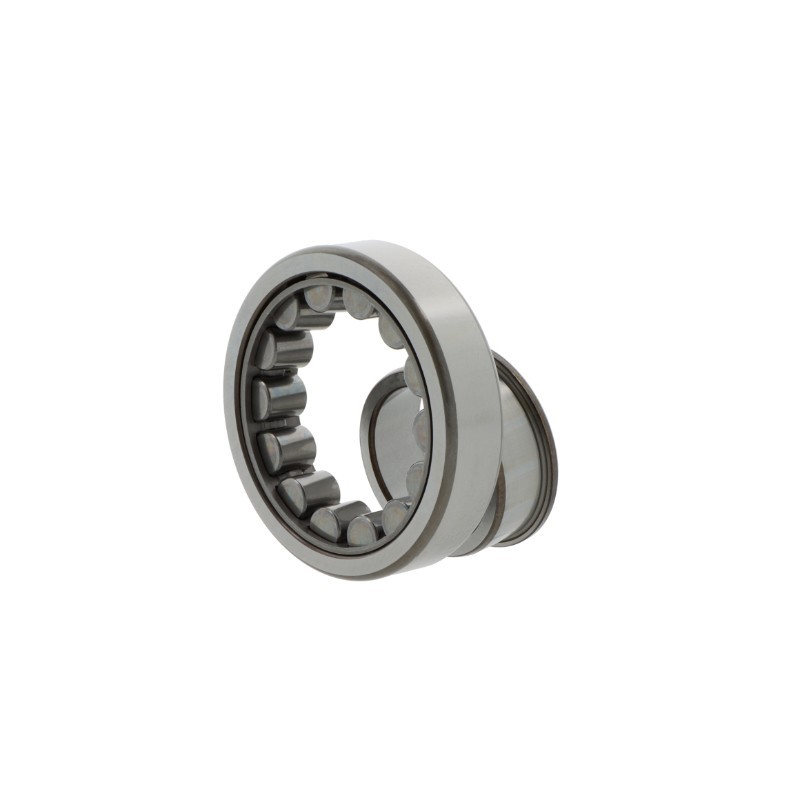
The SKF NJ207 ECJ cylindrical roller bearing, measuring 35x72x17 mm, offers high radial load-carrying capacity and axial guidance in one direction.
The NJ207 ECJ cylindrical roller bearing is a single-row rolling bearing with an optimised internal design for demanding industrial applications. The open bearing has a bore of 35 mm, an outside diameter of 72 mm and a width of 17 mm. Thanks to the line contact of the cylindrical rollers, this SKF design can withstand particularly high radial loads. Maintenance engineers and original equipment manufacturers specifically use this design for applications where, in addition to high transverse forces, axial guidance forces in one direction are also present.
As a support bearing, the bearing guides the shaft axially in one direction whilst allowing displacement in the opposite direction. Typical applications include industrial drives and rotating shaft guides subject to high radial loads. The open cylindrical roller bearing operates within a temperature range of -30 to +150 degrees. As the outer ring has no groove or lubrication bore, grease or oil is supplied directly via the machine’s housing system.
The NJ design is characterised by two fixed flanges on the outer ring and one fixed flange on the inner ring. This allows the inner ring to be removed from one side, which facilitates the separate assembly of the shaft and housing. The integrated sheet steel cage guides the rolling elements at normal radial bearing clearance. Thanks to the increased running accuracy to tolerance class P6 or ABEC 3 with standard dimensional accuracy P0, the bearing ensures smooth running in precisely guided drive shafts.
A single-row roller bearing with a 35 mm bore, 72 mm outer diameter and 17 mm width. As an NJ design, it features two flanges on the outer ring and one flange on the inner ring. This enables it to withstand high radial loads and unilateral axial forces. The sheet steel cage and the optimised internal design make it suitable for use in mechanical engineering.
The NJ design functions as a support bearing with axial displacement in one direction. Whilst two fixed flanges on the outer ring guide the rollers, the single flange on the inner ring supports axial forces on one side. In the opposite direction, the bearing compensates for axial changes in the shaft’s length, which helps to prevent thermal stresses in the drive.
This cylindrical roller bearing combines dimensional accuracy to Class P0 (equivalent to ABEC 1) with finer running accuracy to Class P6 (equivalent to ABEC 3). The external and mounting dimensions comply with standard tolerances, whilst the concentricity is more precise. This helps to reduce vibrations in rotating shafts.
The open bearing is designed for a temperature range of -30 to +150 degrees. As there are no integrated seals, the thermal limit during operation is determined primarily by the lubricant selected. Users select the lubricating oil or grease to be used to suit the machine’s specific operating temperature.
As the outer ring has no groove or lubrication bore, the lubricant enters the bearing from the side. In the case of oil or grease lubrication, the housing design ensures a targeted supply. Open roller bearings require a clean installation environment and external housing seals to protect the rolling element system from dirt and moisture.
The inner ring is designed to be removable from one side. This feature facilitates separate installation: the inner and outer rings can be fitted to the shaft and housing independently of one another. This simplifies assembly and disassembly during maintenance work in industrial plants, particularly in the case of tight fits.
SKF Group
Sven Wingquists Gata 2, 415 50 Gothenburg, Sweden
info@skf.com, https://www.skf.com/uk/footer/site-ownership