

 Bearings
 Housings/housing Units
 Linear Technology
 V-Belts
 Seals
Seals
SKF
| Scale quantity | Your discount | Unit price |
|---|---|---|
| 25 | 1,51 € | 28,67 € |
| 35 | 3,02 € | 27,16 € |
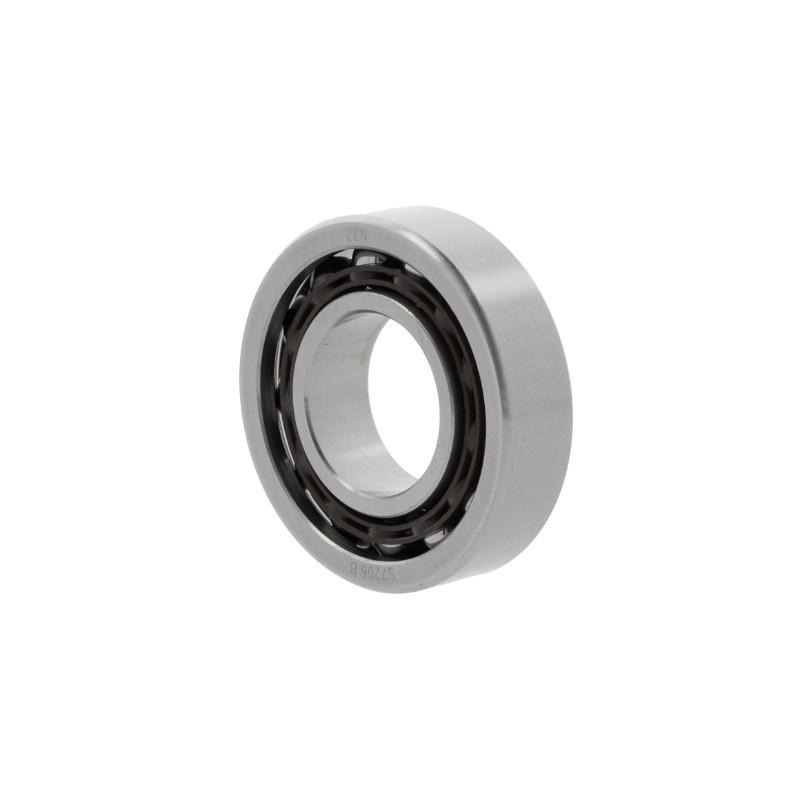
The SKF 7207 BEP angular contact ball bearing combines a 35 mm bore, a 72 mm outer diameter and a 40-degree contact angle for combined radial and single-direction axial loads.
The single-row angular contact ball bearing 7207 BEP from SKF is designed for combined loads where radial forces occur simultaneously with axial forces in one direction. Manufactured from standard 100Cr6 rolling-element bearing steel, the open version has main dimensions of 35 mm inner diameter and 72 mm outer diameter, with a width of 17 mm. The design features standard radial clearance and tolerance class P0/PN or ABEC 1. The component is suitable for an operating temperature range of -20 to +120 degrees Celsius.
This angular contact ball bearing is used for the precise guidance of rotating shafts where single-sided axial forces must primarily be supported. Due to the asymmetrical shoulder design of the bearing rings, the rolling elements transmit loads at an angle to the radial plane. Typical applications include bearing arrangements subject to combined loads and axial thrust.
As single-row angular contact ball bearings can only accommodate axial forces in one direction, in practice they are usually mounted in a pair, with one bearing facing the other.
The 40-degree contact angle determines the force transmission between the inner and outer rings and ensures a high axial load capacity in the direction of action. The integrated polyamide cage guides the rolling elements quietly whilst maintaining a low weight. This combination supports low-vibration operation within the permissible temperature range of -20 to +120 degrees.
Please note during design that this open bearing is supplied without sealing washers. A functioning external seal and a suitable lubricant supply within the housing are required for correct operation.
Angular contact ball bearings have raceways offset at an angle to the bearing axis, with a higher shoulder on one side of the ring. This enables them to accommodate higher unilateral axial forces than standard deep-groove ball bearings, whilst fully maintaining radial guidance accuracy. The 7207 BEP bearing utilises a defined contact angle of 40 degrees for this purpose.
This roller bearing has an inside diameter of 35 mm, an outside diameter of 72 mm and a width across flats of 17 mm. The outer ring is cylindrical in design and has neither a flange nor a ring groove. These standardised dimensions facilitate the direct replacement of existing bearing units of the same size.
A contact angle of 40 degrees defines the line along which the contact forces are transmitted from one raceway to the other via the balls. A larger angle increases the axial load-carrying capacity in the preferred direction. As axial forces are only absorbed on one side, installation usually requires a counter-bearing or a paired arrangement.
Polyamide cages are characterised by their low density, elastic damping properties and smooth running. They reduce friction losses and are suitable for speeds at operating temperatures ranging from -20 to +120 degrees Celsius. Furthermore, the material is resistant to common mineral oil-based greases and oils.
Open roller bearings allow housing lubricants such as oil or gear grease to circulate freely throughout the entire row of rolling elements. They do not feature a sliding sealing element, which reduces the friction torque. Their use requires a clean installation environment or a separate housing seal to protect against dirt and moisture.
The bearing complies with tolerance class P0 or PN, which corresponds to the international ABEC 1 classification. This standard tolerance fully meets the usual dimensional, geometric and concentricity requirements for standard industrial applications in mechanical engineering and ensures a precise fit on cylindrical shafts and in housing bores.
SKF Group
Sven Wingquists Gata 2, 415 50 Gothenburg, Sweden
info@skf.com, https://www.skf.com/uk/footer/site-ownership