

 Bearings
 Housings/housing Units
 Linear Technology
 V-Belts
 Seals
Seals
FAG
| Scale quantity | Your discount | Unit price |
|---|---|---|
| 2 | 29,32 € | 557,05 € |
| 3 | 58,63 € | 527,74 € |
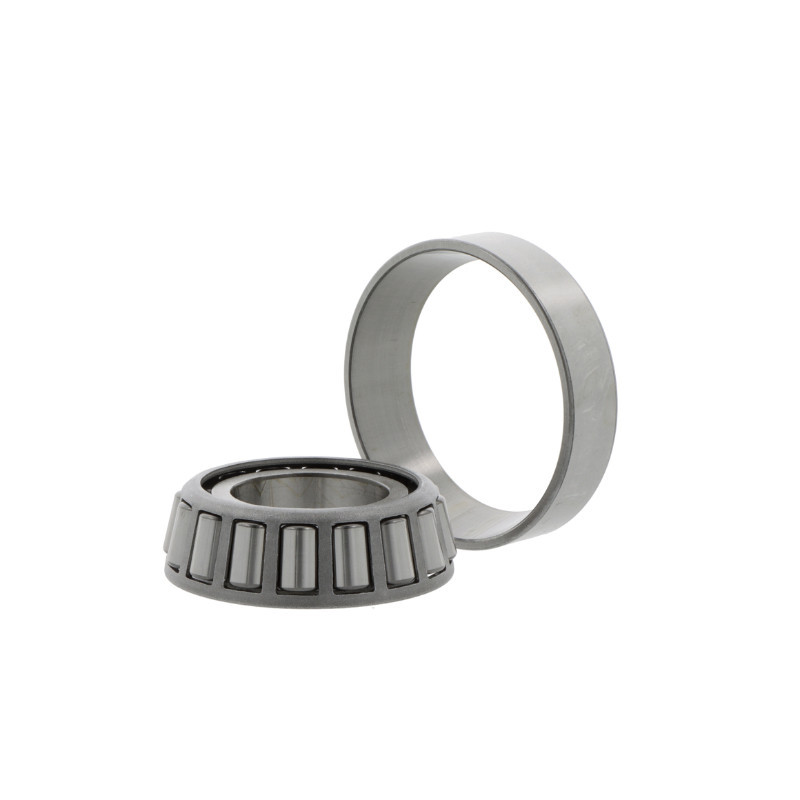
The FAG 30230 single-row tapered roller bearing, with main dimensions of 150 × 270 × 49 mm, offers a heavy-duty solution for combined radial and axial forces.
The FAG 30230 tapered roller bearing is a separable, single-row rolling bearing designed to transmit high radial and unilateral axial forces. The design consists of an inner ring with a roller-guided set of rolling elements and a separate outer ring. Due to the tapered arrangement of the rollers, the intersecting lines of the raceways converge exactly at a single point on the axis of rotation. You receive a complete tapered roller bearing in a standard design, manufactured to the common tolerance class P0 or ABEC 1 for precise operation in demanding industrial environments.
This tapered roller bearing is primarily suitable for heavy-duty applications in general mechanical engineering and gearbox construction, where high radial forces and unilateral axial forces occur simultaneously. Typical applications include gearbox designs and driven shafts subject to high combined loads. As the single-row bearing, by design, can only accommodate axial loads in one direction, designers usually fit it in a mirror-image configuration as a paired set with a second tapered roller bearing. The permissible temperature range is from –30 to +120 degrees Celsius.
Manufacture to tolerance class P0 (equivalent to ABEC 1) defines the exact dimensional and runout tolerances for a low-friction fit on shafts with a diameter of 150 mm and in housings with an external diameter of 270 mm. The integrated sheet steel cage keeps the roller-shaped rolling elements spaced apart and withstands mechanical vibrations during operation. At the same time, the separate mountability of the inner and outer rings allows for a step-by-step fit assembly. When carrying out the final adjustment within the system, ensure that the bearing clearance is set correctly via the mating bearing.
The bearing has an inside diameter of 150 mm, an outside diameter of 270 mm and a total width of 49 mm. These main metric dimensions define the installation space required on the shaft and in the housing seat. Thanks to its standardised design, the roller bearing can be integrated with dimensional precision into corresponding assemblies.
The single-row design accommodates high radial forces as well as axial forces acting in one direction. The tapered raceways generate an internal axial force component under radial load. To counteract these reaction forces and provide axial guidance for the shaft on both sides, the bearing is usually mounted in pairs, with one bearing facing a second bearing.
The outer ring of the bearing is detachable and does not form a single unit with the inner ring. This detachability makes mechanical installation considerably easier, as the inner ring, together with the set of rollers, and the outer ring can be pressed onto the shaft and into the housing bore independently of one another. The axial adjustment of the operating clearance is only carried out when the components are assembled.
The bearing is specified for operating temperatures ranging from -30 to +120 degrees Celsius. Within this temperature range, the rolling bearing components and the integrated sheet steel cage retain their dimensional stability. When selecting a lubricant, users should ensure that the grease or bearing oil used covers this temperature range.
Tolerance class P0, also known as standard tolerance PN or ABEC 1, defines the permissible dimensional and geometric deviations of the bearing rings. It represents the industrial standard for standard applications and ensures reliable concentricity under typical fit conditions. For most industrial drives and gearboxes, this accuracy class provides the required fit accuracy.
The sheet steel cage guides the conical rollers at a uniform distance apart and prevents the rolling elements from coming into contact with one another. The sheet metal construction is characterised by its low weight combined with high strength. It is suitable for the entire temperature range up to +120 degrees Celsius and can also withstand the accelerations encountered during operation.
Schaeffler Technologies AG & Co. KG
Industriestraße 1-3, 91074 Herzogenaurach, Germany
info.de@schaeffler.com, https://www.schaeffler.de/de/meta/impressum/