

 Bearings
 Housings/housing Units
 Linear Technology
 V-Belts
 Seals
Seals
FAG
| Scale quantity | Your discount | Unit price |
|---|---|---|
| 10 | 6,03 € | 114,56 € |
| 20 | 12,06 € | 108,53 € |
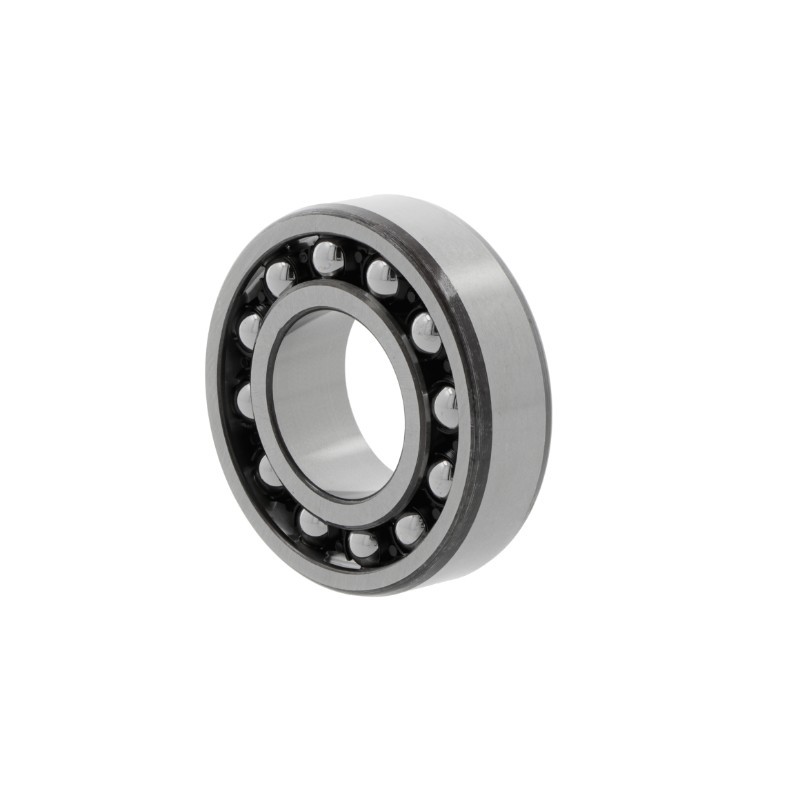
The 1313-TVH self-aligning ball bearing, measuring 65 × 140 × 33 mm, compensates for misalignment and houses two rows of balls in a flexible polyamide cage.
The 1313-TVH self-aligning ball bearing from FAG is a double-row rolling bearing made from standard bearing steel 100Cr6 with a cylindrical bore. Thanks to the common spherical raceway in the outer ring, the inner ring, cage and rows of balls can tilt without impairing function. This self-aligning ball bearing is primarily used where shaft deflection or misalignment between bearing seats occurs. With a bore of 65 mm, an outer diameter of 140 mm and a width of 33 mm, this component provides stable guidance for rotating shafts.
Designs with long shafts tend to experience slight deflection under load, which would place a strain on rigid bearings. The 1313 -TVH self-aligning ball bearing compensates for such static and dynamic angular misalignments directly within the bearing. Typical applications are found in general mechanical engineering, in shaft trains or designs with separate housing components. As this is an open design, you can select the lubricant yourself depending on the application and integrate the bearing into housings with external seals.
The suffix ‘TVH’ denotes a solid polyamide cage that guides the two rows of balls with low friction. The material absorbs shocks and is suitable for an operating temperature range of –30 to +120 degrees Celsius. When designing the bearing, the standard radial clearance must be taken into account, which ensures smooth running with typical fits. With tolerance class P0/PN or ABEC 1, the component meets the requirements of standard industrial applications.
With a bore of 65 mm, an outside diameter of 140 mm and a width of 33 mm, this component has standardised key dimensions for self-aligning ball bearings. Design engineers use these dimensions for load-bearing mountings on medium-diameter shafts. Before fitting, check the available installation space in your bearing seat.
The raceway in the outer ring is hollow-spherical in shape, allowing the inner ring, together with the two rows of balls, to oscillate during operation. This geometry compensates for angular errors caused by shaft deflection or misalignment during housing manufacture. The bearing thereby reduces additional edge loads on the rolling elements and promotes even load distribution.
The abbreviation TVH refers to a solid polyamide cage. This plastic is characterised by good sliding properties and a low weight, which reduces the inertia in the bearing. Polyamide cages absorb shocks elastically and operate smoothly. The permissible temperature range for this cage design is from -30 to +120 degrees Celsius.
As an open version without integrated sealing washers, the component is not pre-filled with grease at the factory. You should lubricate the bearing during assembly using a suitable rolling-element bearing grease or connect it to an existing oil circuit. Ensure that external seals are fitted to the bearing housing to minimise lubricant loss and the ingress of dirt particles.
The standard radial bearing clearance defines the radial clearance between the balls and the raceways when the bearing is in its unmounted state. It corresponds to the standard design and is intended for typical shaft and housing fits under balanced operating temperatures. During installation, this clearance is reduced slightly by the pressing process, leaving a residual gap necessary for operation.
An operating range of -30 to +120 degrees Celsius is specified for this version. These limits take into account the properties of the standard rolling-element bearing steel 100Cr6 and the thermal resistance of the polyamide cage. At temperatures outside this range, you should consider alternative cage and material options to prevent premature wear.
Schaeffler Technologies AG & Co. KG
Industriestraße 1-3, 91074 Herzogenaurach, Germany
info.de@schaeffler.com, https://www.schaeffler.de/de/meta/impressum/