

 Bearings
 Housings/housing Units
 Linear Technology
 V-Belts
 Seals
Seals
SKF
| Scale quantity | Your discount | Unit price |
|---|---|---|
| 10 | 4,53 € | 86,14 € |
| 20 | 9,06 € | 81,61 € |
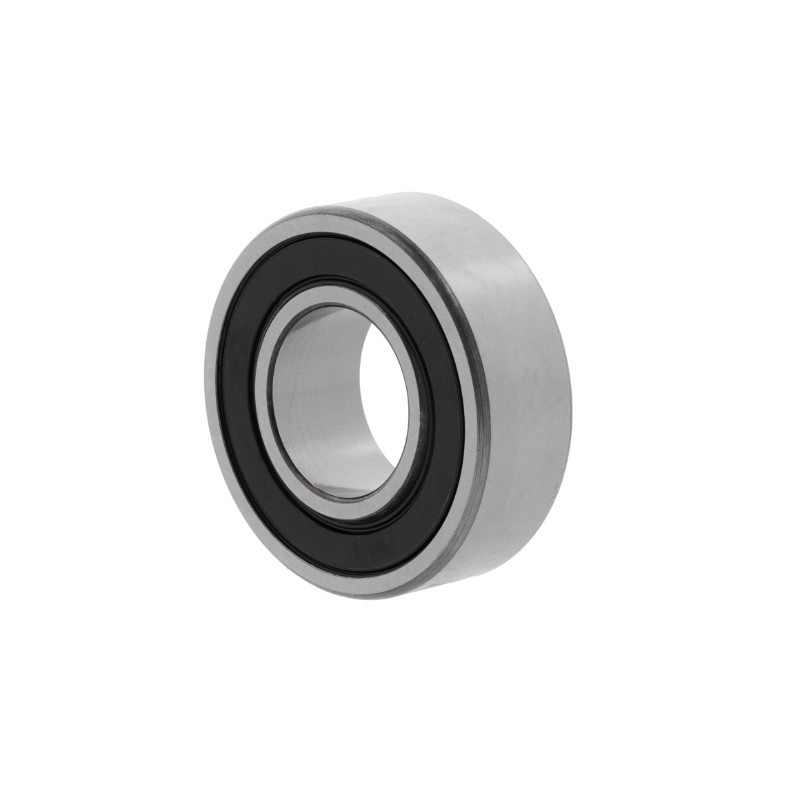
The SKF 2213 E-2RS1KTN9/C3 self-aligning ball bearing, with dimensions of 65 × 120 × 31 mm, compensates for misalignment and protects against the ingress of dirt.
This double-row self-aligning ball bearing 2213 E-2RS1KTN9/C3 from SKF is characterised by its hollow-ball outer ring raceway. This allows the rolling bearing to self-align automatically in the event of shaft misalignment. Manufactured from standard rolling-element bearing steel 100Cr6 and fitted with seals that seal on both sides, this component provides a durable solution for industrial bearing arrangements subject to shaft deflection.
Design engineers primarily use this self-aligning ball bearing where elastic deflection of the shaft or misalignment between bearing seats occurs. The two rows of balls absorb radial loads and compensate for angular misalignment during operation. Thanks to the contact seals, grease remains inside whilst dust and moisture are kept out. For demanding operating environments in general mechanical engineering, the bearing thus offers effective protection for the contact surfaces.
The design with a tapered bore at a ratio of 1:12 simplifies installation using a shrink sleeve or directly onto a tapered shaft seat. This reduces the radial bearing clearance when the inner ring is pushed on axially. For this reason, the bearing is supplied ex-works with a slightly increased C3 bearing clearance to maintain a suitable operating clearance after installation. The polyamide cage guides the rolling elements precisely and is suitable for operating temperatures ranging from –30 to +100 degrees Celsius.
The bearing has an inner diameter of 65 mm at the tapered bore, an outer diameter of 120 mm and a width across flats of 31 mm. These dimensions provide a wide mounting surface on the shaft and enable the bearing to accommodate radial forces.
The increased radial clearance C3 compensates for the expansion of the inner ring that occurs during fitting onto tapered shafts or adapter sleeves. Furthermore, the bearing clearance accommodates temperature-induced expansion during operation without the balls becoming jammed between the raceways.
The designation 2RS1 indicates synthetic rubber sealing rings fitted on both sides. These seals contact the inner ring, retain the factory-applied grease inside the bearing and prevent the ingress of dirt particles or splash water.
The suffix TN9 denotes a polyamide cage. This material is characterised by its low weight and good damping properties, and retains its dimensional stability within the specified temperature range of -30 to +100 degrees Celsius.
A bearing with a tapered bore is usually mounted on a cylindrical shaft using a locking sleeve, or directly onto a tapered shaft journal. It is secured by axial sliding, with the reduction in radial clearance serving as an indicator of a correct fit.
Thanks to the shared hollow spherical raceway in the outer ring, the inner ring and ball cages can move at an angle to the housing axis. This enables the rolling bearing to compensate for misalignment and shaft deflection during operation without any significant increase in friction.
SKF Group
Sven Wingquists Gata 2, 415 50 Gothenburg, Sweden
info@skf.com, https://www.skf.com/uk/footer/site-ownership