

 Bearings
 Housings/housing Units
 Linear Technology
 V-Belts
 Seals
Seals
FAG
| Scale quantity | Your discount | Unit price |
|---|---|---|
| 25 | 2,82 € | 53,57 € |
| 35 | 5,64 € | 50,75 € |
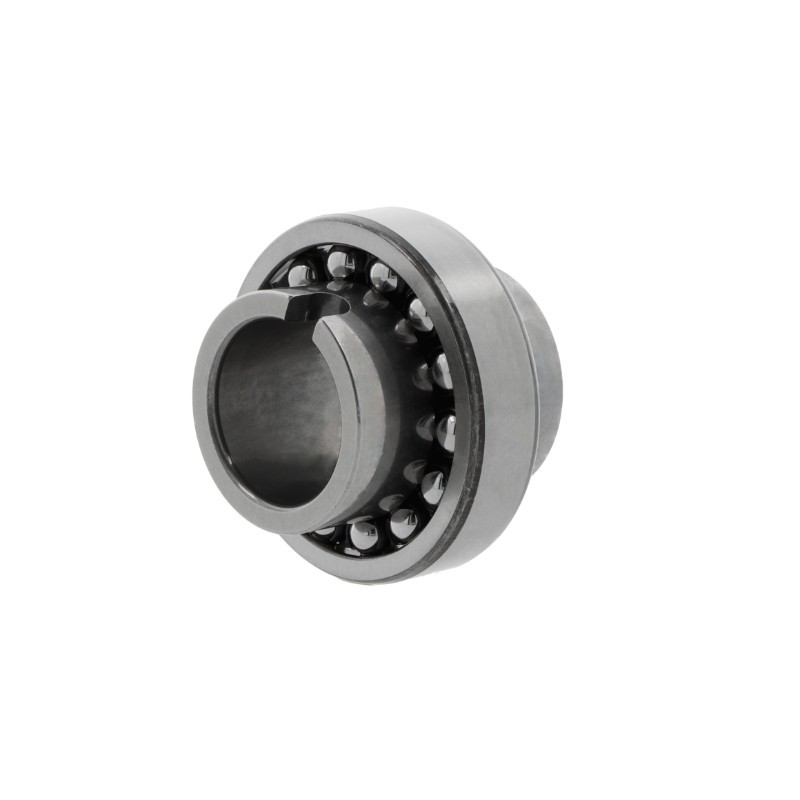
The 11206-TVH self-aligning ball bearing from FAG Rolling Bearings, measuring 30 x 62 x 48 mm and featuring an inner ring widened on both sides, provides a secure fit even when misaligned.
The 11206-TVH self-aligning ball bearing is a double-row rolling bearing made from standard 100Cr6 bearing steel with a standard radial clearance. Thanks to the hollow-spherical outer ring raceway, this bearing automatically compensates for misalignment and shaft deflection during operation. FAG manufactures this version with a lightweight polyamide cage and without integrated sealing washers. Design engineers specifically use this variant for shaft mountings where axial fixation and angular adjustability are required.
The bearing is used when housing seats are not precisely aligned due to manufacturing tolerances, or when long shafts deflect elastically under load. Thanks to the two rows of balls, the assembly absorbs radial loads whilst simultaneously compensating for both static and dynamic angular misalignment. The permissible temperature range is from –30 to +120 degrees. The open component is supplied with grease or lubricating oil directly via the surrounding machine housing, which promotes low-friction movement of the rolling elements.
The inner ring, which is widened on both sides, increases the contact area on the shaft with a 30 mm bore diameter. This design facilitates mounting, reduces the risk of the bearing tilting in its seat and simplifies axial securing during repairs or new installations. With a tolerance class of P0/PN or ABEC 1, this design meets standard industrial accuracy requirements. The integrated polyamide cage guides the balls evenly and reduces the total rotating mass of the bearing assembly.
This double-row self-aligning ball bearing has a cylindrical bore of 30 mm, an outside diameter of 62 mm and a total width of 48 mm. The width is due to the inner ring being widened on both sides, which provides an enlarged contact surface on the shaft.
Two rows of balls run in the outer ring on a common raceway ground to a hollow-spherical profile. Thanks to this spherical shape, the balls and the inner ring can pivot freely within the outer ring within certain limits, enabling the bearing to automatically compensate for misalignment and elastic deflection of the rotating shaft.
The suffix TVH denotes a polyamide cage that maintains a uniform spacing between the rolling elements. Cages made from this material are lightweight, dampen vibrations and are characterised by their elastic running properties, which contribute to the smooth operation of the bearing.
The permissible operating range extends from -30 to +120 degrees. This temperature range is determined by the standard roller bearing steel 100Cr6 and the dimensionally stable polyamide cage, and is suitable for a wide range of industrial applications in general mechanical engineering.
As this open bearing is manufactured without integrated contact seals, the lubricant is supplied externally via the machine housing. Depending on the design chosen, either grease or lubricating oil is used as the lubricant, whilst sealing elements in the housing are intended to prevent the ingress of dirt particles.
The P0/PN tolerance class, also known as ABEC 1, refers to the standardised accuracy class for rolling bearings. It defines binding dimensional limits for bore, outer diameter and concentricity, which are designed for standard applications in mechanical and plant engineering.
Schaeffler Technologies AG & Co. KG
Industriestraße 1-3, 91074 Herzogenaurach, Germany
info.de@schaeffler.com, https://www.schaeffler.de/de/meta/impressum/