

 Bearings
 Housings/housing Units
 Linear Technology
 V-Belts
 Seals
Seals
FAG
| Scale quantity | Your discount | Unit price |
|---|---|---|
| 2 | 20,38 € | 387,13 € |
| 5 | 40,75 € | 366,76 € |
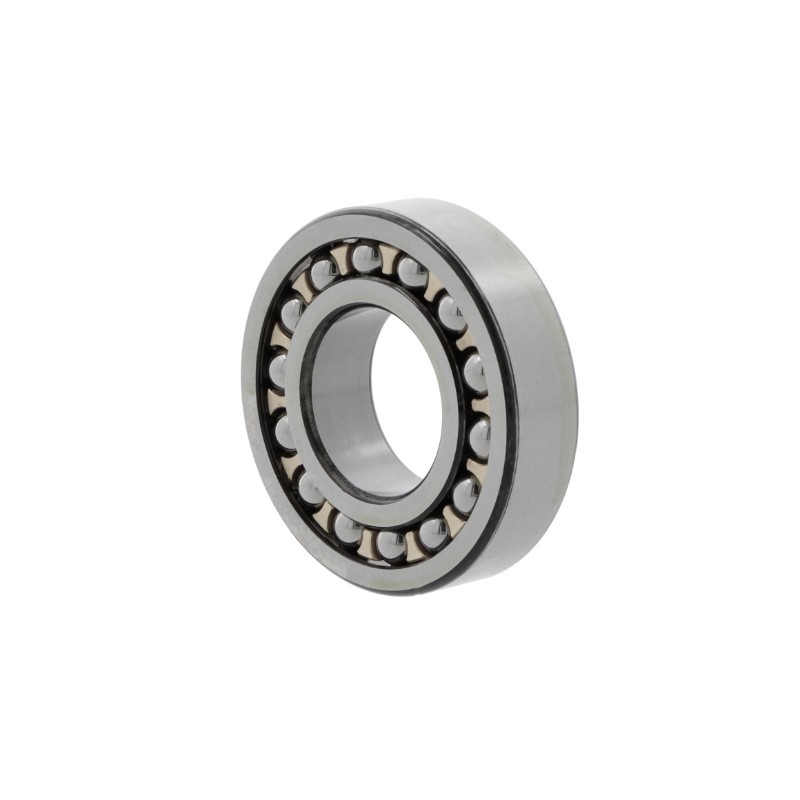
The FAG 1222 -K-M-C3 self-aligning ball bearing, with a 110 mm bore, brass cage and C3 clearance, enables the compensation of misalignment.
The 1222 -K-M-C3 self-aligning ball bearing is a double-row rolling bearing made from standard rolling bearing steel (100Cr6). Thanks to the hollow-spherical raceway in the outer ring, the design automatically compensates for both static and dynamic misalignments between the inner and outer rings. As an open bearing, it can be flexibly integrated into existing lubrication systems. With key dimensions of a 110 mm bore, 200 mm outside diameter and 38 mm width, the bearing accommodates radial forces as well as low axial loads on both sides.
This rolling bearing is suitable for applications involving long or flexible shafts, where deflection or misalignment may occur. Typical applications include shaft guides where it is structurally difficult to maintain precise housing alignment. Thanks to its solid brass cage, the component is designed for higher accelerations and demanding environmental conditions. The permissible temperature range extends from –30 to +150 degrees Celsius, enabling operation under varying thermal loads.
The ‘K’ designation indicates a tapered bore with a taper ratio of 1:12. Installation is carried out directly onto tapered shaft seats or, using clamping and withdrawal sleeves, onto cylindrical shafts. When the bearing is pushed onto the taper, the radial clearance is reduced. The increased C3 bearing clearance compensates for this loss of clearance during assembly as well as for thermal expansion during operation, ensuring that the rolling elements run with the correct operating clearance.
Double-row self-aligning ball bearings of this type feature a common spherical outer ring raceway. This geometry allows the rows of balls to be adjusted angularly, thereby compensating for shaft deflection and misalignment. The FAG version features a solid brass cage, a tapered bore with a taper ratio of 1:12, and the increased radial clearance class C3 for demanding operating conditions.
The bearing has a tapered bore with a nominal diameter of 110 mm, an outer diameter of 200 mm and a width of 38 mm. These standardised dimensions enable a precise fit when replacing components in existing industrial plant. The bearing is manufactured to the ‘Normal’ tolerance class (P0/PN or ABEC 1), which ensures precise concentricity during standard operation.
Bearings with a tapered bore (designation K) are mounted either directly onto a tapered shaft journal or onto cylindrical shafts using suitable mounting or withdrawal sleeves. During axial mounting, the inner ring expands, thereby reducing the bearing clearance. Fitters usually determine the correct mounting position by measuring the reduction in radial clearance using a feeler gauge.
C3 denotes a radial bearing clearance that is slightly greater than normal. For bearings with a tapered bore, this margin is important, as the tight fit on the shaft or sleeve measurably reduces the bearing clearance during installation. Furthermore, the additional clearance prevents the rolling elements from jamming if temperature differences occur between the inner and outer rings during operation.
As an open bearing, this version does not come with factory-fitted sealing washers. You should therefore select the lubricant to suit the requirements of your bearing location; either grease or oil lubrication may be used. The housing environment must protect the bearing from dirt and moisture and allow for relubrication. The permissible operating range extends from -30 to +150 degrees Celsius.
The letter M in the suffix denotes a solid brass cage. Brass cages are characterised by high strength and thermal resilience. They maintain the dimensional stability of the rolling elements even under vibration or rapid changes in rotational speed. Compared with plastic cages, they perform particularly well at consistently higher operating temperatures within the specified limits.
Schaeffler Technologies AG & Co. KG
Industriestraße 1-3, 91074 Herzogenaurach, Germany
info.de@schaeffler.com, https://www.schaeffler.de/de/meta/impressum/