

 Bearings
 Housings/housing Units
 Linear Technology
 V-Belts
 Seals
Seals
SKF
| Scale quantity | Your discount | Unit price |
|---|---|---|
| 25 | 1,76 € | 33,69 € |
| 35 | 3,55 € | 31,90 € |
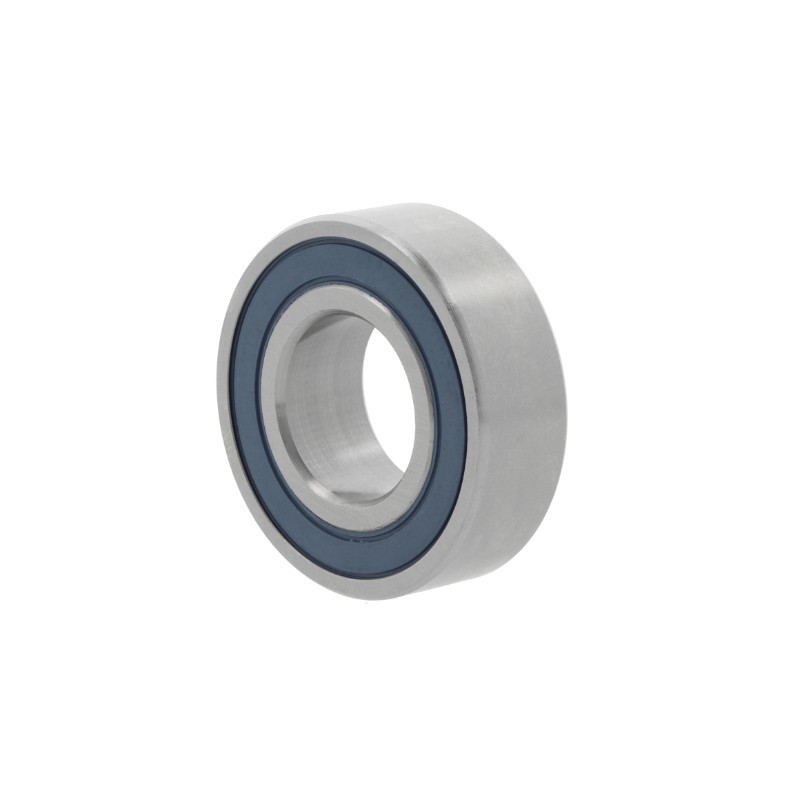
The SKF 2200 E-2RS1TN9 self-aligning ball bearing, measuring 10x30x14 mm, automatically compensates for misalignment and protects against the ingress of dirt.
The SKF 2200 E-2RS1TN9 double-row self-aligning ball bearing absorbs radial forces and automatically compensates for misalignment and shaft deflection. Thanks to the shared hollow-spherical raceway in the outer ring, the inner ring adjusts its angular position during operation. Manufactured from standard rolling-bearing steel (100Cr6), this version has a bore of 10 mm, an outside diameter of 30 mm and a width of 14 mm with standard radial clearance.
Its use is recommended in cases of shaft deflection or misalignment between housing bores. Typical applications can be found in general mechanical engineering, in conveyor components and in assemblies with longer shafts. The double-row bearing supports radial loads and accommodates moderate axial forces in both directions. Thanks to its compact design with an internal diameter of 10 mm, the component is suitable for confined installation spaces.
The factory designation 2RS1 stands for elastomer sealing lips arranged on both sides that make contact with the raceways. This design protects the raceways from dust and moisture and retains the lubricant inside the bearing. The integrated polyamide cage (suffix TN9) is characterised by its low weight and quiet operation. The component is designed for operation within a temperature range of -30 to +100 degrees Celsius.
A self-aligning ball bearing of this type has two rows of balls and a shared spherical raceway in the outer ring. This enables the bearing to automatically compensate for misalignment between the shaft and the housing. The version with sealing washers protects the interior from environmental influences.
This double-row roller bearing has a cylindrical bore of 10 mm, an outer diameter of 30 mm and a width of 14 mm. The tolerances of the inner and outer rings correspond to the standard tolerance classes P0/PN and ABEC 1 respectively.
The suffix 2RS1 denotes a double-sided, contact-type mechanical seal. It mechanically seals the gap between the inner and outer rings. This prevents lubricant from leaking out and protects against the ingress of dirt particles.
The abbreviation TN9 refers to a polyamide cage. This material is characterised by its elastic damping properties and low friction. It ensures quiet operation of the rolling elements at continuous temperatures of up to 100 degrees Celsius.
The bearing is manufactured with standard radial bearing clearance. This factory-set clearance offers a balanced combination of smooth running, rigidity and thermal expansion for standard fit selections on the shaft and housing. A specific clearance class is therefore not specified in the type designation.
Through-hardened standard roller bearing steel (100Cr6) is used for the raceways and balls. This material withstands high overrunning loads, exhibits high wear resistance and contributes to dimensional stability within the specified temperature range of -30 to +100 degrees Celsius.
SKF Group
Sven Wingquists Gata 2, 415 50 Gothenburg, Sweden
info@skf.com, https://www.skf.com/uk/footer/site-ownership