

 Bearings
 Housings/housing Units
 Linear Technology
 V-Belts
 Seals
Seals
SKF
| Scale quantity | Your discount | Unit price |
|---|---|---|
| 2 | 14,74 € | 280,23 € |
| 5 | 29,50 € | 265,47 € |
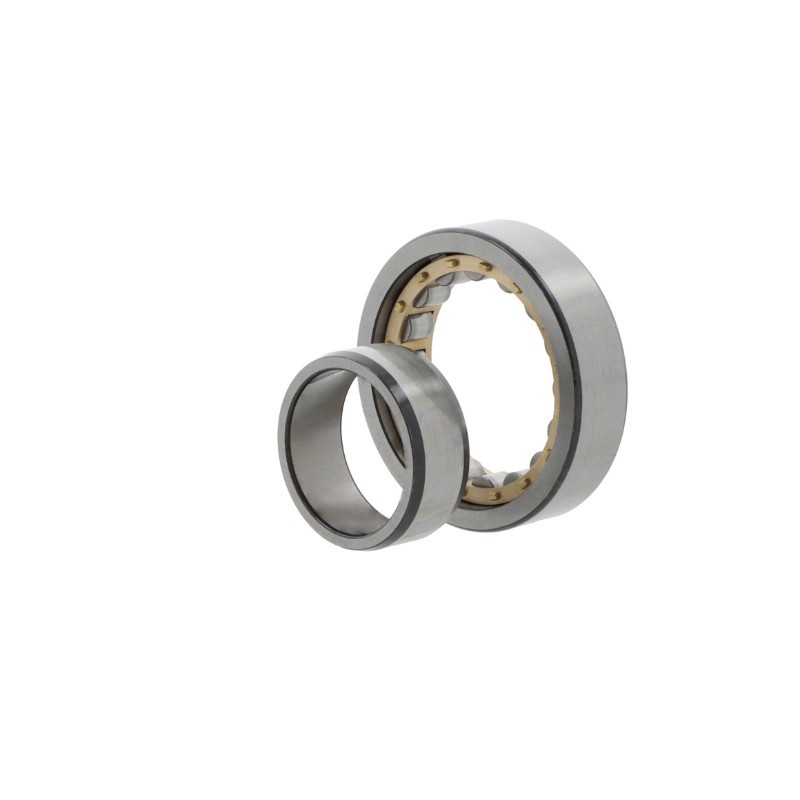
SKF NU313 ECM single-row cylindrical roller bearing with brass cage and removable inner ring (65x140x33 mm) for purely radial loads as a non-locating bearing.
The SKF NU313 ECM cylindrical roller bearing, as a single-row radial roller bearing, withstands high radial forces. With key dimensions of a 65 mm bore diameter, 140 mm outer diameter and 33 mm width, the design is suitable for demanding machine shafts. This version features a brass cage and standard radial clearance. Designed as an open bearing, the component can be specifically lubricated via the surrounding housing.
The NU design features two fixed flanges on the outer ring, whilst the inner ring is flangeless and removable from both sides. Designs make specific use of this feature for the free-end side of a shaft. During operation, the bearing compensates for length changes resulting from thermal expansion axially between the rollers and the raceway. The cylindrical rollers carry purely radial loads, whilst axial forces must be absorbed by separate fixed bearings.
The solid brass cage guides the rollers and withstands mechanical stresses within a temperature range of –30 to +150 degrees. In terms of dimensional accuracy, the roller bearing complies with standard class P0 or ABEC 1, whilst running accuracy is enhanced to P6 or ABEC 3. This reduced radial runout promotes smooth running. The outer ring has no groove and no lubrication bore.
A characteristic feature of this design is the two fixed flanges on the outer ring and the flangeless inner ring. This allows the inner ring to be removed from both sides, which facilitates the separate assembly of the shaft and housing. The bearing functions purely as a non-locating bearing and absorbs only radial forces, whilst compensating for axial shaft expansion without restriction.
The single-row bearing has an inside diameter of 65 mm, an outside diameter of 140 mm and a width of 33 mm. These fixed dimensions determine the required fit on the shaft and in the housing bore. Before installation, it is advisable to check that these mounting dimensions are compatible with the relevant machine design.
The permissible operating range is between -30 and +150 degrees Celsius. Both the bearing rings and the brass cage retain their dimensional stability within this range. For operation, a lubricant must be selected whose thermal specification fully covers the selected operating temperature of the respective bearing location in the housing.
The P6 tolerance class (corresponding to ABEC 3) relates to the concentricity of the bearing rings. It imposes stricter permissible form and running tolerances than the standard P0 tolerance class (ABEC 1). Lower radial runout results in more uniform contact conditions for the cylindrical rollers and contributes to low-vibration operation of the shaft.
A brass cage offers high mechanical strength and withstands high accelerations or vibrations during operation. Furthermore, the material retains its dimensional stability across the entire temperature range up to +150 degrees. The guidance of the cylindrical rollers reduces wear between the rolling elements and the cage pockets under demanding operating conditions.
As the bearing is designed as an open bearing without integrated seals, the lubricant is delivered directly to the raceways via the housing design. The outer ring has neither a lubrication groove nor a bore, so lubricating oil or grease must be supplied from the side. An external housing seal simultaneously prevents the ingress of dirt particles.
SKF Group
Sven Wingquists Gata 2, 415 50 Gothenburg, Sweden
info@skf.com, https://www.skf.com/uk/footer/site-ownership