

 Bearings
 Housings/housing Units
 Linear Technology
 V-Belts
 Seals
Seals
SKF
| Scale quantity | Your discount | Unit price |
|---|---|---|
| 2 | 17,53 € | 333,03 € |
| 5 | 35,06 € | 315,50 € |
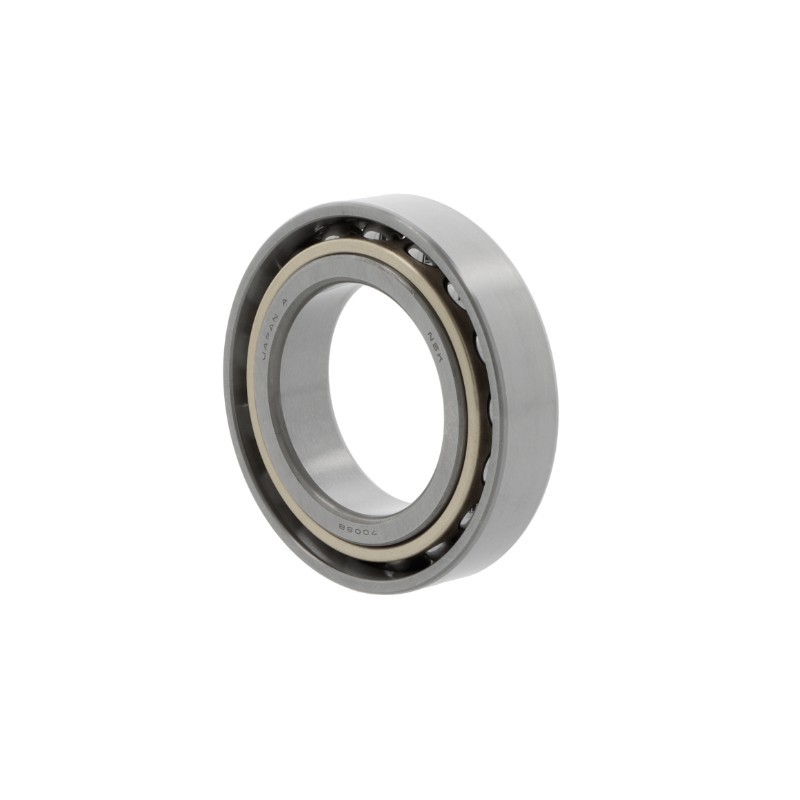
The SKF 7220 BECBM angular contact ball bearing, with a brass cage and a 100 mm bore, accommodates radial and single-direction axial loads during operation.
The single-row angular contact ball bearing 7220 BECBM is designed as an open rolling bearing for combined loads. Manufactured from standard rolling bearing steel 100Cr6 and available in the Explorer version, the component offers high material quality. Thanks to its dimensions – a bore diameter of 100 mm, an outside diameter of 180 mm and a width of 34 mm – the bearing can be integrated into standardised housings. As an open component without an integrated seal, external lubrication within the unit is required.
This rolling bearing primarily absorbs radial forces together with axial forces in one direction. Thanks to the contact angle of 40 degrees, the design transfers axial loads via the rolling elements. Typical applications include bearing arrangements operating at high speeds and under combined forces. As a single angular contact ball bearing can only support axial forces from one side, it is usually fitted in pairs opposite a second rolling bearing, which acts as a counter-guide.
The solid brass cage guides the balls with low friction and is suitable for operating temperatures ranging from –20 to +150 degrees Celsius. Manufacture to tolerance class P6 for dimensional accuracy and P5 for running accuracy ensures smooth operation. The component is designed for installation in sets: in an O or X arrangement, a defined, minimal axial clearance is immediately established within the bearing pair. This simplifies assembly without the need for time-consuming shim fitting.
With an internal diameter of 100 mm, an external diameter of 180 mm and a width of 34 mm, the component complies with standard dimensions. The outer ring is cylindrical in design and has neither a flange nor a groove, which facilitates its integration into standard housing bores.
The contact angle describes the line of force transmission between the raceways and the rolling elements in relation to the radial plane. An angle of 40 degrees ensures that the bearing can accommodate greater axial loads in one direction compared with bearings having smaller contact angles.
The design is optimised for direct assembly into bearing sets. If two of these angular contact ball bearings are fitted in an O or X configuration, the system results in a specified low axial clearance. There is no need for individual adjustment using shims during assembly.
As an open roller bearing, this component is supplied without any seals or cover plates as standard. It must be supplied with lubricating oil or grease via the overarching system. An external housing seal simultaneously prevents the ingress of dirt and the loss of lubricant.
The specification combines P6 dimensional accuracy with P5 running accuracy. This means tighter manufacturing tolerances for concentricity and dimensions compared with standard tolerances. This results in precise shaft guidance and smooth running during operation.
The permissible operating range is between -20 degrees and +150 degrees Celsius. The built-in brass cage retains its strength and dimensional stability within this temperature range, provided that the lubricant used in the system is suitable for these temperatures.
SKF Group
Sven Wingquists Gata 2, 415 50 Gothenburg, Sweden
info@skf.com, https://www.skf.com/uk/footer/site-ownership