

 Bearings
 Housings/housing Units
 Linear Technology
 V-Belts
 Seals
Seals
SKF
| Scale quantity | Your discount | Unit price |
|---|---|---|
| 25 | 1,71 € | 32,54 € |
| 35 | 3,42 € | 30,83 € |
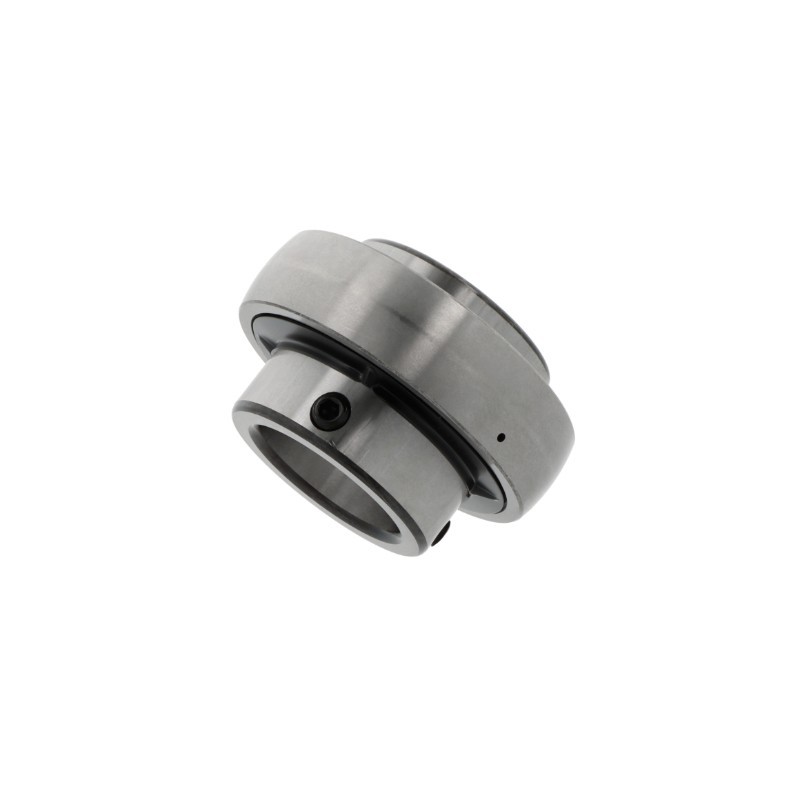
The SKF YET209 clamping bearing, with a 45 mm bore, offers an easy-to-install solution for housing mountings thanks to its eccentric clamping ring and spherical outer ring.
The SKF YET209 clamping bearing serves as a ready-to-fit component for mounted shafts in housing assemblies. With a bore of 45 mm, an outer diameter of 85 mm and a total width of 43.7 mm, the rolling bearing primarily accommodates radial forces. Manufactured from standard roller bearing steel (100Cr6), this design is suitable for a temperature range of –20 to +120 degrees Celsius. Design engineers and maintenance personnel opt for this design when a fixed shaft connection is required alongside straightforward handling.
This bearing is primarily used in housing designs where predominantly radial loads occur. Thanks to its spherical outer ring, the YET209 clamping bearing compensates for misalignment and static angular errors between the housing and the shaft during operation. The double-sided seal helps to keep out contaminants such as dust or moisture and to protect the raceway. Typical applications are found in general mechanical engineering and fixture construction for housing bearings subjected to predominantly radial loads.
Fastening via an eccentric clamping ring enables a time-saving, positive-lock fastening on the shaft without the need for complex interference fits. In conjunction with the inner ring, which is widened on one side, the YET209 clamping bearing reduces the tendency to tilt and promotes smooth running. As the design is relubricable, used grease can be replaced as required during the ongoing maintenance cycle. This helps to extend the service life of the bearing under demanding environmental conditions. When designing the system, the tolerance class P0/PN (ABEC 1) and the permissible temperature range must be taken into account.
The bearing has an inner diameter of 45 mm, an outer diameter of 85 mm and a total width of 43.7 mm. These dimensions refer to the combination of the outer ring and the inner ring, which is widened on one side, together with the eccentric clamping ring. Before installation, check the shaft dimensions and the available installation space in the housing.
The eccentric clamping ring is placed onto the eccentric shoulder of the inner ring and rotated manually in the direction of the shaft’s rotation. This rotational movement causes the ring to lock onto the shaft by friction. A threaded pin is then used to secure the ring against accidental loosening. The system allows for quick and easy installation and removal during maintenance work.
A spherical outer ring has a spherically curved outer surface. When combined with a suitable bearing housing, the component thereby compensates for static misalignment caused by manufacturing tolerances or shaft deflection. This reduces undesirable edge stresses and contributes to an even load distribution across the rolling elements.
The double-sided sliding seal rests directly against the running surfaces of the inner ring with its sealing lips. Its purpose is to make it more difficult for dirt, moisture or dust particles to penetrate the interior of the bearing. At the same time, it helps to ensure that the lubricant remains within the working area, which reduces friction and extends the service life of the components.
The bearing has lubrication holes in the outer ring through which lubricant is fed directly to the rolling elements. A grease nipple on the housing can be used to apply suitable rolling-element grease in order to displace the old lubricant. Regular relubrication is particularly recommended in the event of high dust exposure, damp environments or persistently elevated operating temperatures.
The permissible temperature range extends from -20 to +120 degrees Celsius. The standard rolling-element bearing steel 100Cr6 and the sealing materials used retain their dimensional stability and protective properties within this range. For applications close to the temperature limits, maintenance engineers should take into account the thermal properties of the grease used.
SKF Group
Sven Wingquists Gata 2, 415 50 Gothenburg, Sweden
info@skf.com, https://www.skf.com/uk/footer/site-ownership