

 Bearings
 Housings/housing Units
 Linear Technology
 V-Belts
 Seals
Seals
SKF
| Scale quantity | Your discount | Unit price |
|---|---|---|
| 2 | 25,88 € | 491,66 € |
| 3 | 51,76 € | 465,78 € |
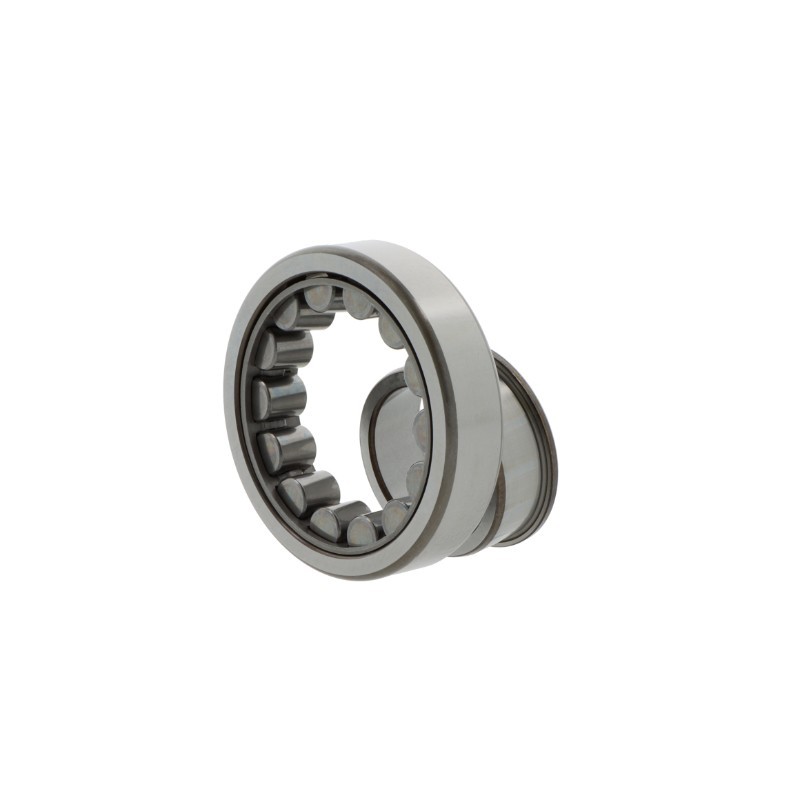
The SKF NJ321 ECJ cylindrical roller bearing accommodates high radial loads and provides single-sided axial support for shafts measuring 105 × 225 × 49 mm.
The SKF NJ321 ECJ cylindrical roller bearing is a single-row roller bearing with an optimised internal design for industrial applications. With a bore of 105 mm, an outer diameter of 225 mm and a width of 49 mm, this bearing transmits high radial loads via the line contact of the rollers. The outer ring is designed without a groove or lubrication bore. The open design without seals allows for direct lubrication via the housing and covers a temperature range from -30 to +150 degrees.
This bearing is used in shaft mountings where high radial forces are combined with single-sided axial guidance. As a support bearing, the NJ design accommodates not only radial loads but also axial forces from one direction. The integrated sheet steel cage maintains an even spacing between the cylindrical rollers. This design features a standard radial clearance and is suitable for standard installation conditions in mechanical engineering.
The NJ design has two fixed flanges on the outer ring and one fixed flange on the inner ring. This allows the inner ring to be removed from one side, which facilitates the separate assembly of both bearing rings. The design allows for axial displacement of the shaft in one direction, whilst the fixed flange edge provides axial support for the shaft. The dimensional accuracy complies with tolerance class P0/PN (ABEC 1), and the running accuracy is to P6 (ABEC 3).
This roller bearing has an inside diameter of 105 mm, an outside diameter of 225 mm and a total width of 49 mm. These dimensions determine the required installation space within the housing and the diameter of the shaft seat.
The NJ design functions as a support bearing. The outer ring has two solid flanges, whilst the inner ring has a single flange. This geometry allows axial forces to be absorbed in one direction, whilst permitting axial displacement of the shaft in the opposite direction.
The bearing is manufactured with standard radial clearance and is suitable for typical fit conditions in mechanical engineering. The dimensional accuracy complies with tolerance class P0/PN (corresponding to ABEC 1), whilst the running accuracy is within the tighter tolerance class P6 (corresponding to ABEC 3).
The cage of this bearing is made of sheet steel. The suffix ‘ECJ’ refers to the optimised internal design and the dimensionally stable window cage made of pressed sheet steel, which guides the cylindrical rollers evenly.
The open bearing is designed for operating temperatures ranging from -30 to +150 degrees. As no integrated seals are fitted, lubrication is provided via the housing system, which is also intended to protect against the ingress of contaminants.
The inner ring can be removed from one side, as its design means it has a fixed flange on only one side. This ability to be dismantled facilitates the separate fitting and removal of the inner and outer rings onto the shaft and housing.
SKF Group
Sven Wingquists Gata 2, 415 50 Gothenburg, Sweden
info@skf.com, https://www.skf.com/uk/footer/site-ownership