

 Bearings
 Housings/housing Units
 Linear Technology
 V-Belts
 Seals
Seals
SKF
| Scale quantity | Your discount | Unit price |
|---|---|---|
| 15 | 4,29 € | 81,45 € |
| 30 | 8,57 € | 77,17 € |
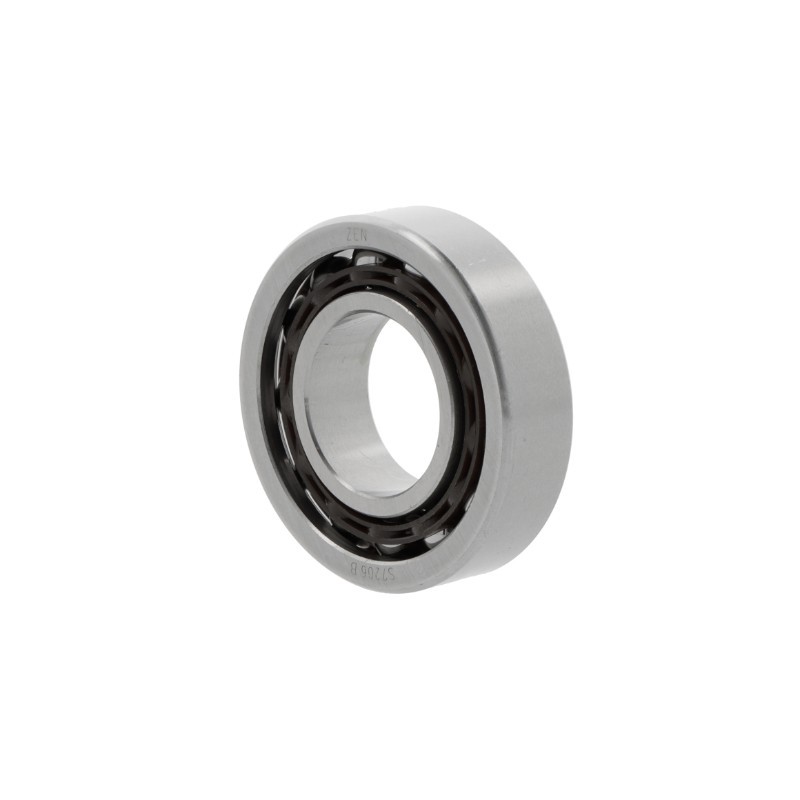
The SKF 7312 BEP angular contact ball bearing, with a 60 mm bore and a 40-degree contact angle, provides a robust bearing solution for unilateral axial and radial forces.
The 7312 BEP angular contact ball bearing is a single-row rolling bearing made from standard bearing steel (100Cr6) with main dimensions of 60x130x31 mm. Thanks to the asymmetrical shoulders on the inner and outer rings, this design specifically accommodates radial forces as well as unidirectional axial forces. SKF manufactures this model in tolerance class P0/PN (ABEC 1) with standard radial clearance. This open component is suitable for oil- or grease-lubricated assemblies in mechanical engineering and can withstand operating temperatures ranging from –20 to +120 degrees.
The 7312 BEP angular contact ball bearing is primarily used when high radial loads, together with unilateral axial forces, act on the shaft. Thanks to its contact angle of 40 degrees, the bearing effectively transfers axial thrust forces to the surrounding structure. This design is suitable for assemblies subject to combined loads.
Typical applications include shaft mountings where defined guiding forces in one direction are required. As this is a standard design without ring grooves, the component can be fitted precisely into cylindrical housings. For alternating axial directions, it is combined with a second angular contact ball bearing mounted in the opposite direction.
The polyamide cage in the BEP design guides the rolling elements with low friction and keeps the weight of the rotating component low. This cage material supports low-vibration operation within the permissible temperature range of -20 to +120 degrees. This design combines thermal load-bearing capacity with good running characteristics.
The open design must be taken into account during design: the bearing has no integrated seals. Consequently, its use requires external sealing of the bearing housing as well as lubrication with oil or grease. The standard tolerance class P0/PN (ABEC 1) facilitates replacement during maintenance work.
This single-row bearing has an inner diameter of 60 mm, an outer diameter of 130 mm and a width across flats of 31 mm. The outer ring is cylindrical in design and has no grooves or flanges. Thanks to its standardised dimensions, this model is suitable for standardised bearing seats in machinery and industrial gearboxes.
A contact angle of 40 degrees enables the bearing to accommodate high axial forces in one direction, combined with radial forces. Force transmission takes place at an angle to the radial plane via the contact points between the rolling elements and the raceways. This gives the bearing a high degree of axial rigidity under unilateral loading.
The polyamide cage guides the rolling elements evenly and is characterised by favourable sliding properties and low mass. Compared with metal cages, the plastic ensures quiet operation and absorbs minor impacts. The material is designed for use in a temperature range of -20 to +120 degrees.
As an open roller bearing, this design does not feature any factory-fitted sealing washers. Lubrication is provided by the lubrication system of the surrounding structure, using either grease or oil. An external housing seal is required to keep out dirt particles and minimise lubricant loss.
The tolerance class P0/PN (corresponding to ABEC 1) denotes standard levels of accuracy in terms of dimensional, geometric and running accuracy in mechanical engineering. Together with the standard radial bearing clearance, this classification ensures that the bearing maintains a defined radial clearance under standard fits and operating temperatures without developing undesirable stresses.
No, due to its design, a single single-row angular contact ball bearing can only support axial forces in one direction. For shafts subject to alternating or axial loads on both sides, you must mount two bearings opposite each other, for example in an O or X configuration. It is only through this paired mounting that a play-free guidance on both sides is achieved.
SKF Group
Sven Wingquists Gata 2, 415 50 Gothenburg, Sweden
info@skf.com, https://www.skf.com/uk/footer/site-ownership