

 Bearings
 Housings/housing Units
 Linear Technology
 V-Belts
 Seals
Seals
SKF
| Scale quantity | Your discount | Unit price |
|---|---|---|
| 2 | 56,04 € | 1.064,73 € |
| 3 | 112,08 € | 1.008,69 € |
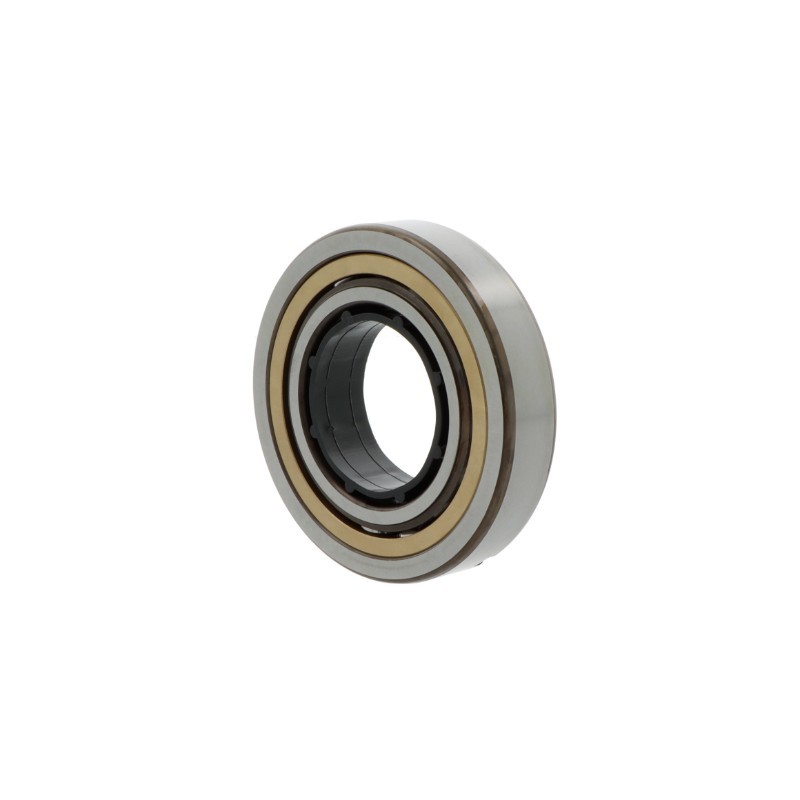
The SKF QJ326 N2MA/C3 four-point bearing, measuring 130 × 280 × 58 mm, accommodates high axial forces in both directions and features retaining grooves in the outer ring.
The SKF QJ326 N2MA/C3 four-point bearing is a separable rolling bearing with a bore diameter of 130 mm, an outer diameter of 280 mm and a width of 58 mm. This design features a split inner ring, allowing the outer ring and ball assembly to be fitted separately from the inner ring halves. This open roller bearing primarily accommodates axial forces in both directions and requires only a small amount of axial installation space. Designed for operating temperatures ranging from -30 to +200 degrees, it complies with tolerance class P0/PN or ABEC 1.
This four-point bearing is primarily used where varying or high axial loads occur with a limited bearing width. Typical applications can be found in industrial gearbox construction and in bearing arrangements where a separate radial bearing absorbs the transverse forces and the four-point bearing serves purely for axial guidance. Thanks to the split inner ring, the design accommodates a large number of rolling elements. As this is an unsealed bearing, the bearing assembly is integrated into the lubrication system of an enclosed housing.
Two retaining grooves in the outer ring, offset by 180 degrees, secure the component in the housing seat via locking pins. This is designed to prevent the outer ring from rotating with the shaft when subjected to an axial load. The version with C3 radial clearance provides additional radial clearance. This clearance serves to compensate for thermal expansion at operating temperatures of up to +200 degrees and to prevent the bearing from becoming stressed. The integrated brass cage guides the balls whilst maintaining dimensional stability and withstands mechanical stresses during operation.
The bore is 130 mm, the external diameter is 280 mm and the width is 58 mm. These dimensions determine the installation space required on the shaft and within the housing bore. Before installation, you should check that the mounting dimensions of the surrounding components match these nominal dimensions.
The retaining grooves serve to prevent the bearing from rotating within the housing. If the bearing is fitted with a slight amount of play in the housing, fitted cylindrical pins engage with these recesses. This keeps the outer ring fixed in the circumferential direction, whilst allowing for axial compensatory movements within the housing seat.
The designation C3 indicates a slightly increased bearing clearance compared with the standard tolerance class. This greater radial clearance prevents the rolling elements from becoming jammed if temperature differences arise between the inner and outer rings during operation, or if tight fits reduce the internal clearance.
A split inner ring allows a larger number of balls to be fitted, which increases the load-carrying capacity under axial loads. Furthermore, this design simplifies assembly, as the outer ring, together with the cage, and the two halves of the inner ring can be positioned on the shaft one after the other.
This roller bearing is specified for use at temperatures ranging from -30 to +200 degrees. Thanks to the temperature-resistant brass cage and dimensionally stable rings, it continues to function correctly even under increased thermal loads. The lubricant used must be suitable for the same temperature range.
As the bearing is manufactured without integrated seals, it requires an external supply of lubricant, either oil or grease. The bearing housing must be designed with external seals to prevent the lubricant from leaking out and to keep out dirt and moisture.
SKF Group
Sven Wingquists Gata 2, 415 50 Gothenburg, Sweden
info@skf.com, https://www.skf.com/uk/footer/site-ownership