

 Bearings
 Housings/housing Units
 Linear Technology
 V-Belts
 Seals
Seals
SKF
| Scale quantity | Your discount | Unit price |
|---|---|---|
| 10 | 4,98 € | 94,67 € |
| 20 | 9,97 € | 89,68 € |
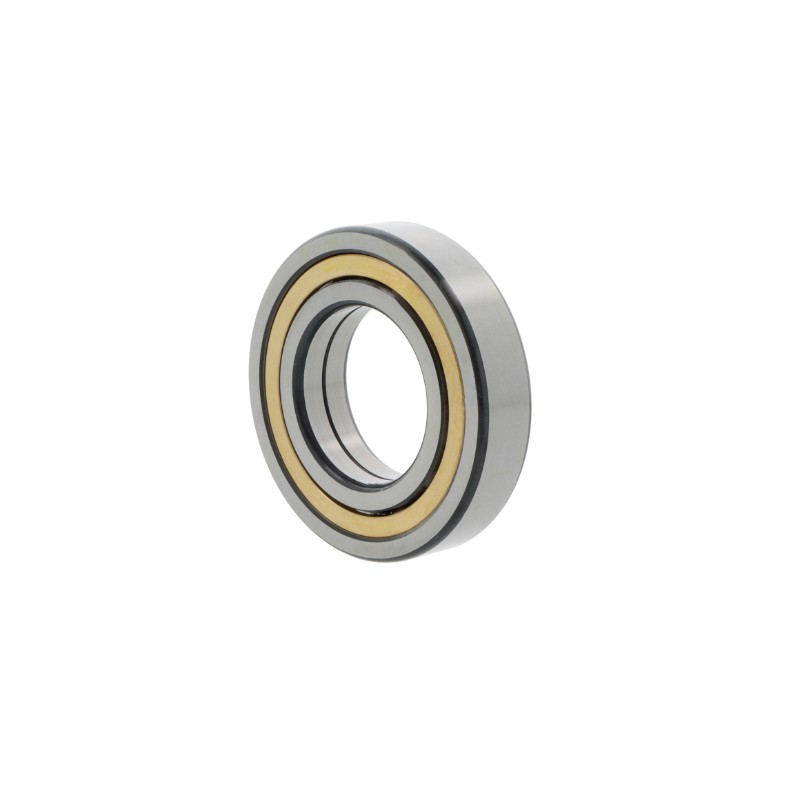
The SKF QJ210 MA four-point bearing accommodates high axial loads in both directions whilst maintaining compact dimensions of 50 × 90 × 20 mm.
The QJ210 MA four-point bearing is a single-row rolling bearing in the SKF Explorer performance class, specifically designed for combined loads with a predominantly axial component. Thanks to its specific raceway cross-section, the bearing transmits axial forces in both directions whilst requiring minimal axial installation space. Designed as an open version without seals, the bearing can be integrated into existing lubrication circuits. The enhanced dimensional accuracy to tolerance class P6 and running accuracy to P5 ensure smooth, low-vibration operation.
Design engineers primarily use the QJ210 MA four-point bearing where axial guidance is required in confined spaces. Typical applications include bearing arrangements subject to alternating axial loads. This design is often fitted as a pure axial bearing with radial housing clearance and combined with a separate radial bearing. As this model is designed without retaining grooves in the outer ring, it is secured in the housing via flat abutment shoulders.
The two-piece inner ring allows for the accommodation of a large number of rolling elements and simplifies assembly. The outer ring, together with the ball and cage, can be slid on separately from the inner ring halves. The solid brass cage (MA) is characterised by high strength and guides the balls along the outer ring. Together with the standard radial bearing clearance, the design covers a permissible operating temperature range of -30 to +150 degrees Celsius.
Thanks to specially shaped raceways with four-point contact and a split inner ring, this design can accommodate high axial forces in both directions, whilst a conventional deep-groove ball bearing primarily carries radial loads. In many applications, this design replaces two angular contact ball bearings mounted opposite each other and requires less axial installation space.
With an internal diameter of 50 mm, an external diameter of 90 mm and a width of 20 mm, this component defines the required installation space on the shaft and housing. Before installation, the mounting dimensions of the surrounding components must be checked against these nominal dimensions.
The suffix ‘MA’ denotes a solid brass cage that is guided on the outer ring. Compared with standard sheet metal cages, brass cages offer increased mechanical strength and dimensional stability under vibration. This design is suitable for the intended operating temperature range of -30 to +150 degrees Celsius.
The split inner ring allows a large number of rolling elements to be fitted into the ball raceway, which enhances the axial load-carrying capacity. Furthermore, this design simplifies installation, as the outer ring, together with the cage and rolling elements, can be fitted separately from the two inner ring halves.
Manufactured to Class P6 dimensional accuracy and Class P5 running accuracy, this component offers tighter manufacturing tolerances than standard bearings with standard tolerances. This precision ensures uniform load transfer, reduces runout errors and promotes smooth running.
As the design is open and has no integrated seals, lubrication is provided by the surrounding system, for example by means of circulating oil or an application-specific grease fill. External housing seals are required to prevent contaminants from entering the raceways.
SKF Group
Sven Wingquists Gata 2, 415 50 Gothenburg, Sweden
info@skf.com, https://www.skf.com/uk/footer/site-ownership