

 Bearings
 Housings/housing Units
 Linear Technology
 V-Belts
 Seals
Seals
FAG
| Scale quantity | Your discount | Unit price |
|---|---|---|
| 15 | 4,13 € | 78,48 € |
| 30 | 8,26 € | 74,35 € |
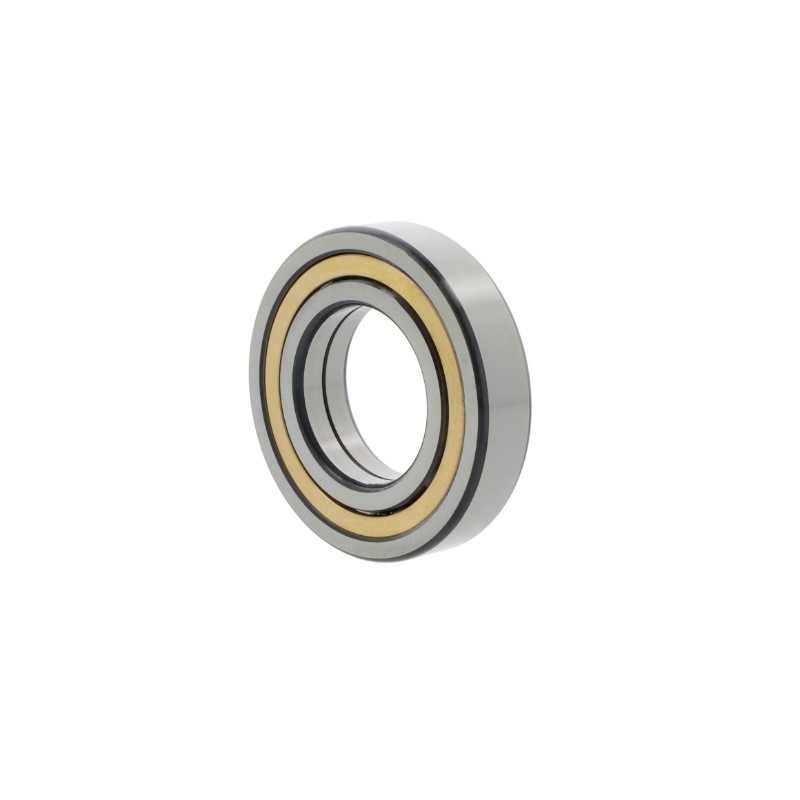
The FAG QJ308-MPA four-point bearing, measuring 40 × 90 × 23 mm, accommodates high axial forces in both directions whilst requiring minimal axial installation space.
The FAG QJ308-MPA four-point bearing is a single-row angular contact ball bearing with a split inner ring, which accommodates axial forces acting from both directions. With a bore of 40 mm, an outside diameter of 90 mm and a width of 23 mm, this rolling bearing requires less axial installation space than a double-row bearing arrangement. Designed as an open bearing, it can be lubricated directly via the surrounding system. Its use is particularly recommended where axial guidance accuracy is required.
This bearing is primarily suitable for applications involving predominantly or purely axial loads in alternating directions. It is frequently used in gearbox and general mechanical engineering as an axial bearing, with the outer ring being given radial clearance within the housing to prevent radial forces. As the outer ring has no groove, the component can be fitted into through-bores in the housing. When combined with separate radial bearings, this model provides precise axial guidance for rotating shafts.
The two-piece inner ring allows a large number of balls to be fitted, which structurally enhances the axial load-carrying capacity. Furthermore, this non-self-retaining design facilitates assembly, as you can assemble the outer ring together with the ball cage and the two inner ring halves separately. The guided brass cage maintains a uniform spacing between the rolling elements. Designed with standard radial bearing clearance, this model is suitable for operating temperatures ranging from -30 to +150 degrees.
As a single-row radial ball bearing, this model features modified raceways that accommodate axial forces in both directions. Thanks to its split inner ring, it is narrower in the axial direction than double-row angular contact ball bearings and can be assembled separately as outer and inner ring components.
With a bore of 40 mm, an outside diameter of 90 mm and a width of 23 mm, the bearing determines the installation space on the shaft and within the housing bore. These standardised key dimensions facilitate design selection in mechanical engineering.
The two-piece design of the inner ring allows more balls to be fitted into the bearing than would be possible with a one-piece inner ring. This increases the axial load capacity. Furthermore, the fact that the inner ring is split makes it easier to fit the outer ring, ball cage and inner rings separately.
The FAG QJ308-MPA four-point bearing is specified for a temperature range of -30 to +150 degrees. The brass cage used in the bearing retains its dimensional stability and mechanical strength within this temperature range.
The open design, which does not feature integrated sealing washers, allows for flexible integration into the lubrication system of the overall plant, for example in the case of circulating oil lubrication or an external grease supply. Furthermore, the absence of seals makes cleaning and relubrication easier during maintenance work.
P0, or ABEC 1, denotes the standard normal tolerance for rolling bearings. It defines the permissible deviations for bore diameter, outer diameter, flatness and concentricity, and covers the accuracy requirements of general mechanical engineering.
Schaeffler Technologies AG & Co. KG
Industriestraße 1-3, 91074 Herzogenaurach, Germany
info.de@schaeffler.com, https://www.schaeffler.de/de/meta/impressum/