

 Bearings
 Housings/housing Units
 Linear Technology
 V-Belts
 Seals
Seals
FAG
| Scale quantity | Your discount | Unit price |
|---|---|---|
| 15 | 3,33 € | 63,39 € |
| 30 | 6,68 € | 60,04 € |
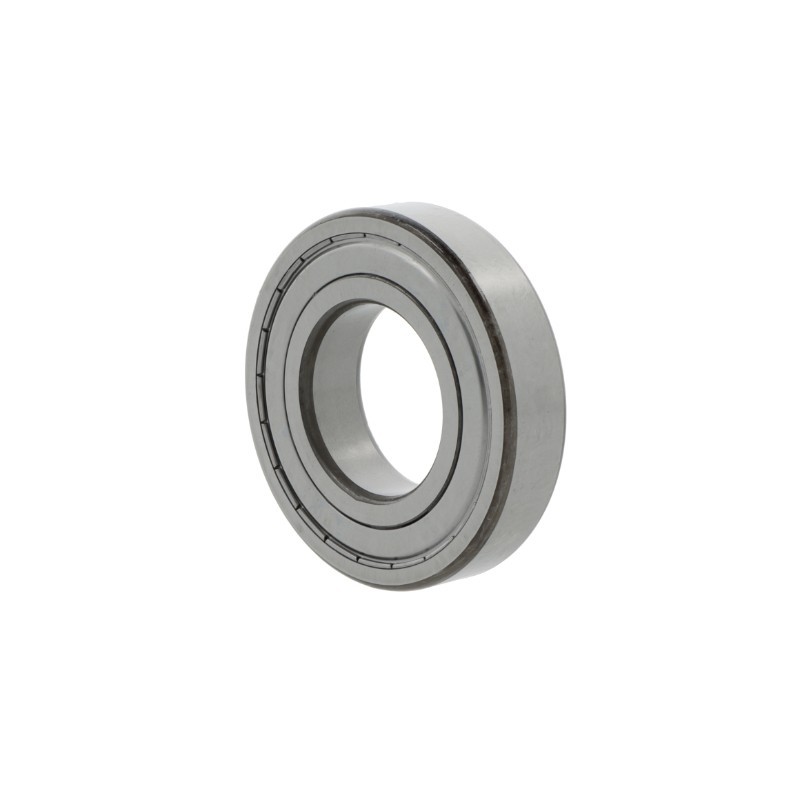
The single-row deep-groove ball bearing 6018 -2Z from FAG Wälzlager, measuring 90x140x24 mm, offers contact-free protection against dirt particles at normal speeds.
The 6018 -2Z deep groove ball bearing from FAG Wälzlager is a versatile radial roller bearing made from standard 100Cr6 bearing steel. With a bore of 90 mm, an outer diameter of 140 mm and a narrow width of 24 mm, this single-row design primarily accommodates radial forces as well as moderate axial forces in both directions. The cover plates on both sides, made of sheet steel, protect the raceways from contamination. This makes the component suitable for demanding industrial drives and repairs in mechanical engineering.
Design engineers and maintenance technicians prefer to use the 6018-2Z deep-groove ball bearing in rotating systems operating at medium to high speeds, where there is no direct contact with splashing water. Typical applications include electric drives as well as general industrial and gearbox applications with predominantly radial loads. The symmetrical raceways, without a flange or groove on the outer ring, allow for straightforward installation in cylindrical housing bores. Thanks to the robust sheet steel cage and the wide temperature range of –30 to +120 degrees, the roller bearing operates reliably even under fluctuating thermal conditions.
The double-sided cover with metal end plates (designation 2Z or ZZ) forms a non-contact gap seal against the inner ring. Unlike abrasive rubber seals, this does not generate any additional friction, meaning the bearing retains its full speed capacity and generates less heat during operation. Dust and solid particles are effectively kept out, whilst the lubricant remains inside the bearing. Combined with the standard radial bearing clearance and the standard tolerance class P0/PN, you receive a dimensionally accurate bearing for a precise fit in shaft seats.
With an internal diameter of 90 mm, an external diameter of 140 mm and a width of 24 mm, the roller bearing has standardised key dimensions. These dimensions enable it to be fitted precisely onto shafts with a diameter of 90 mm. Manufactured to tolerance class P0 (ABEC 1), the bearing is suitable for precise cylindrical bearing seats in industrial plant engineering.
The designation -2Z denotes two cover plates made of profiled sheet steel, fitted on both sides. They form a tight sealing gap with the inner ring, which repels coarse dirt particles and minimises lubricant loss. As the cover plates operate without contact, they do not generate any additional frictional torque. The bearing therefore retains its smooth running action and is less prone to heat build-up during high-speed rotation.
The permissible operating range is between -30 and +120 degrees. Both the 100Cr6 roller bearing steel used and the sheet steel cage and metal end plates retain their dimensional stability within this range. However, for applications involving extreme thermal loads exceeding 120 degrees, users should select special high-temperature variants with an adjusted bearing clearance.
With standard radial bearing clearance, the bearing has a defined radial clearance between the rolling elements and the raceways when unloaded. This standard design is intended for typical transition or sliding fits, in which the inner and outer rings heat up only moderately during operation. Where there are extreme temperature differences between the shaft and the housing, it is advisable to use a correspondingly increased bearing clearance as an alternative.
The rings and balls are made from standard roller bearing steel (100Cr6). This case-hardened chrome steel offers high wear resistance and fatigue resistance under rolling loads. The design is complemented by a lightweight sheet steel cage which guides the rolling elements. This model does not feature electrical insulation, which is why the bearing should be protected against the passage of electrical current.
Cover plates (-2Z) are made of metal and do not come into contact with the inner ring, meaning that neither frictional heat nor speed losses occur. Their primary purpose is to provide protection against solid particles. Contact seals, on the other hand, rub against the mating surface. This enables them to seal more effectively against moisture and fine dust, but it does limit the permissible maximum speed of the rolling bearing.
Schaeffler Technologies AG & Co. KG
Industriestraße 1-3, 91074 Herzogenaurach, Germany
info.de@schaeffler.com, https://www.schaeffler.de/de/meta/impressum/