

 Bearings
 Housings/housing Units
 Linear Technology
 V-Belts
 Seals
Seals
FAG
| Scale quantity | Your discount | Unit price |
|---|---|---|
| 50 | 5% | 3,23 € |
| 100 | 10% | 3,05 € |
| 250 | 15% | 2,88 € |
| 500 | 20% | 2,70 € |
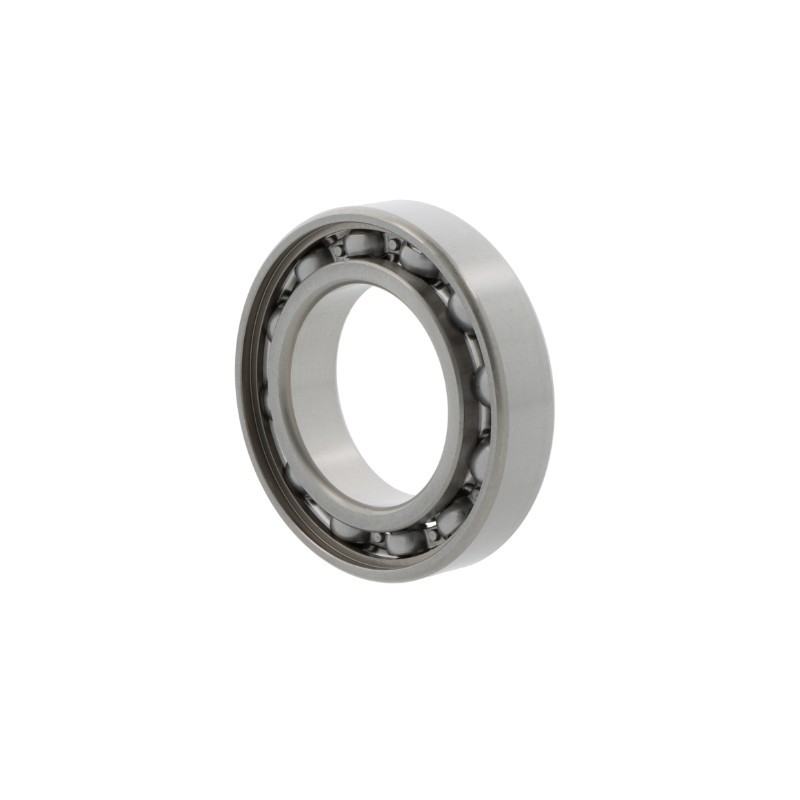
The FAG 627 single-row deep-groove ball bearing, with its compact dimensions of 7 × 22 × 7 mm, accommodates radial loads and axial forces in both directions.
The 627 deep-groove ball bearing is a compact rolling bearing, manufactured from standard rolling bearing steel 100Cr6. Thanks to its defined key dimensions – a 7 mm bore, 22 mm outside diameter and 7 mm width – this design is particularly suitable for small shaft diameters and confined installation spaces. The single-row design primarily accommodates radial forces as well as axial forces in both directions. A sheet steel cage guides the spherical rolling elements evenly within the raceway system and keeps friction to a minimum.
The FAG 627 deep groove ball bearing is primarily used in compact mechanical assemblies with limited installation space. The design primarily accommodates radial loads and supports additional axial forces in both directions. Due to its open design without seals, the bearing is particularly suitable for oil-lubricated systems or protected housing chambers in which the lubricant can circulate freely and dirt can be kept out.
As an open rolling bearing, this design has no integrated sealing elements such as cover plates or sealing discs. This means there is no frictional resistance caused by rubbing sealing lips, which enables smooth start-up and reduced heat generation. Without housing protection, dust, foreign particles or moisture can reach the raceways unhindered. Designs incorporating this bearing therefore require external sealing and a continuous supply of lubricant. The component is designed for a temperature range of -30 to +120 degrees.
The bearing has an inside diameter of 7 mm, an outside diameter of 22 mm and a width of 7 mm. The outer ring is cylindrical in design and has no flange or groove, which means the component can be fitted flush into a mounting bore. The standardised dimensions facilitate standardised installation in assemblies.
Open bearings operate without sliding seals, which means there is no additional frictional resistance at the sealing edges. This results in minimal operating heat build-up and a low starting torque. A prerequisite for their use is a clean installation environment or an enclosed machine housing that protects the raceways from contamination and ensures a steady supply of oil or grease.
The standard radial bearing clearance refers to the factory-set clearance between the rolling elements and the raceways when the bearing is in its unassembled state. This standard value is designed to suit typical fit conditions and normal operating temperatures. This enables the bearing to compensate for moderate thermal expansion during operation without causing harmful radial stress in the bearing system.
The permissible temperature range is between -30 and +120 degrees. This operating window is limited by the material properties of standard roller bearing steel and the sheet steel cage. When designing the bearing arrangement, care must be taken to ensure that the selected lubricant – whether grease or oil – is suitable for the relevant ambient thermal conditions.
Both the bearing rings and the rolling elements are made from standard 100Cr6 rolling-bearing steel, which offers high fatigue strength. The cage, which guides and spaces the balls, is made from pressed sheet steel. This combination of materials provides mechanical stability for use in technical assemblies subject to radial and axial loads.
Classification in tolerance class P0 corresponds to standard class PN or ABEC 1. It specifies the permissible limit deviations for bore, outer diameter and concentricity. For standardised industrial applications, this accuracy grade offers sufficient dimensional stability and ensures the interchangeability of rolling bearing components.
Schaeffler Technologies AG & Co. KG
Industriestraße 1-3, 91074 Herzogenaurach, Germany
info.de@schaeffler.com, https://www.schaeffler.de/de/meta/impressum/