

 Bearings
 Housings/housing Units
 Linear Technology
 V-Belts
 Seals
Seals
FAG
| Scale quantity | Your discount | Unit price |
|---|---|---|
| 10 | 9,67 € | 183,90 € |
| 20 | 19,35 € | 174,22 € |
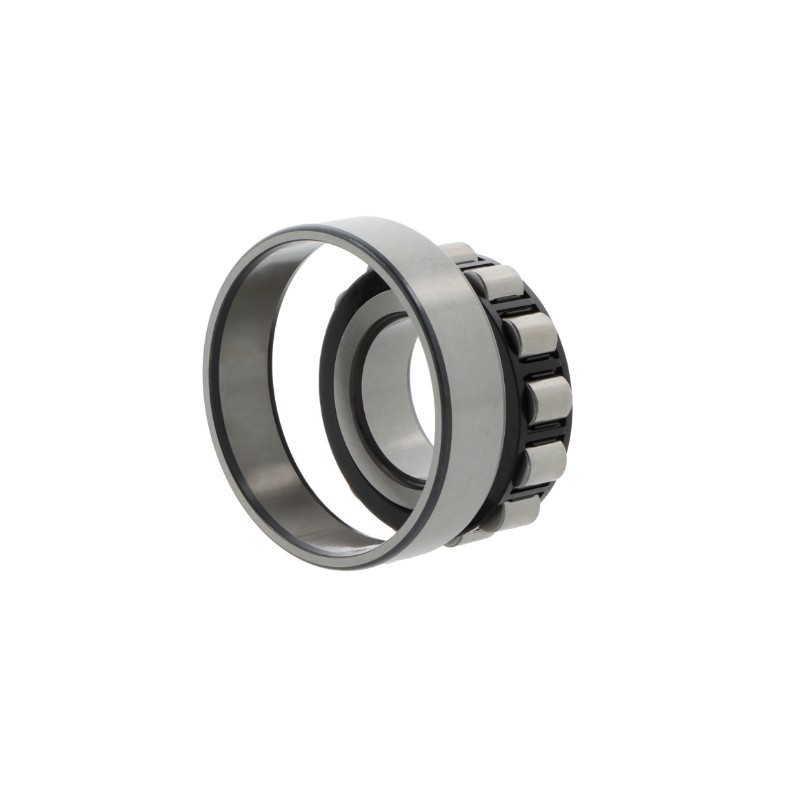
The FAG N313 -E-XL-TVP2 cylindrical roller bearing, with dimensions of 65 × 140 × 33 mm, is designed as a separable support bearing for high radial loads.
The single-row cylindrical roller bearing N313 -E-XL-TVP2 is designed to withstand high forces as a radial rolling bearing. With a bore of 65 mm, an outer diameter of 140 mm and a width of 33 mm, this bearing is suitable for demanding industrial applications. This FAG rolling bearing is designed as an open bearing. Thanks to the line contact between the rollers and raceways, the design withstands radial loads and ensures smooth running of machine shafts.
This design primarily accommodates radial loads and compensates for axial changes in shaft length. The N design features two fixed flanges on the inner ring, whilst the outer ring is flangeless and removable from both sides. As a result, the component functions purely as a non-locating bearing. Typical applications include bearing arrangements where the shaft expands due to thermal effects. As axial displacement occurs stress-free within the bearing, the design helps to prevent forced forces on adjacent components.
The integrated TVP2 polyamide cage ensures low-friction operation; it reduces the weight of the rolling element guidance and responds elastically to dynamic loads. The permissible temperature range is between –30 and +120 degrees Celsius. As this is an open design without a groove or lubrication bore in the outer ring, external sealing and a lubricant supply must be provided. With standard radial bearing clearance and tolerance class P0 or ABEC 1, the roller bearing complies with the standards for industrial use.
With an internal diameter of 65 mm, an external diameter of 140 mm and a width of 33 mm, the roller bearing complies with standardised dimensions. These dimensions allow for a precise fit when mounted in corresponding housing bores and on suitable shaft sections. Before installation, it is advisable to check the available installation space at the respective bearing location.
In the N design, the inner ring guides the cylindrical rollers between two fixed flanges, whilst the outer ring has no flanges and can be removed from either side. As a result, the bearing does not absorb any axial forces, but compensates for changes in length caused by thermal expansion of the shaft without resistance. In the bearing arrangement, this design typically serves as a pure non-locating bearing.
A polyamide cage reduces the weight of the rotating components and promotes smooth running during operation. The material elastically absorbs impact loads and helps to minimise friction within the rolling element set. This type of cage is designed for a permissible temperature range of -30 to +120 degrees Celsius.
As an open design, the bearing has no integrated seals. There are neither lubrication grooves nor lubrication holes on the outer ring. Lubricant is supplied either directly during initial assembly or continuously via the surrounding housing system. Suitable external seals in the housing design prevent the ingress of contaminants.
The roller bearing is manufactured with standard radial clearance and to tolerance class P0 or ABEC 1. This combination ensures precise shaft guidance for standard fits and typical operating temperatures. The bearing clearance is dimensioned such that no thermal stress occurs in the bearing under normal operating conditions.
The fact that the bearing can be disassembled from both sides considerably simplifies the assembly and disassembly of complex assemblies. The inner ring, together with the set of rollers, can be fitted onto the shaft or into the housing separately from the flangeless outer ring. During assembly, the components fit together axially, which reduces the risk of damage to the raceways and roller elements.
Schaeffler Technologies AG & Co. KG
Industriestraße 1-3, 91074 Herzogenaurach, Germany
info.de@schaeffler.com, https://www.schaeffler.de/de/meta/impressum/