

 Bearings
 Housings/housing Units
 Linear Technology
 V-Belts
 Seals
Seals
FAG
| Scale quantity | Your discount | Unit price |
|---|---|---|
| 25 | 1,31 € | 24,80 € |
| 35 | 2,62 € | 23,49 € |
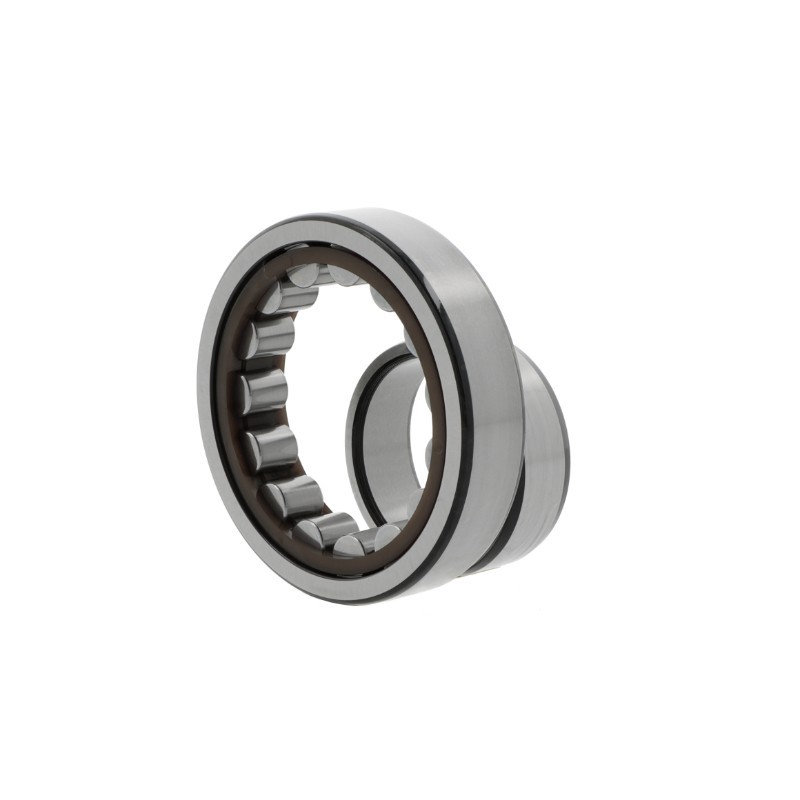
The FAG NU205 -E-XL-TVP2 cylindrical roller bearing, with a 25 mm bore and a polyamide cage, offers high radial load-carrying capacity as a separable idler bearing.
The FAG NU205 -E-XL-TVP2 cylindrical roller bearing is a single-row rolling bearing designed primarily for radial loads in mechanical engineering. As an open, non-locating bearing, this design allows for the compensation of shaft length changes due to thermal expansion. The main dimensions – an internal diameter of 25 mm, an external diameter of 52 mm and a width of 15 mm – comply with standardised mounting dimensions. Thanks to its manufacture to tolerance class P0 or ABEC 1, the bearing is suitable for precisely guided rotary movements in low-maintenance assemblies.
This design is used in bearing arrangements that are intended to accommodate high radial forces and allow for axial displacement. As the inner ring is designed to be removable from both sides, the bearing does not accommodate axial forces and functions purely as a non-locating bearing. The design is primarily installed where axial shaft expansion needs to be compensated for. Thanks to the flangeless inner ring, the component compensates for thermal length changes in the shaft directly between the cylindrical rollers and the inner raceway without any binding.
The integrated polyamide cage guides the rollers quietly and is characterised by the guide’s low weight. The bearing is designed for a temperature range of –30 to +120 degrees. With standard radial bearing clearance, this design ensures smooth running under normal operating conditions. As this is an open bearing without an integrated seal and without a lubrication bore in the outer ring, lubrication and sealing are provided by the surrounding housing system.
The bearing has an inner diameter of 25 mm, an outer diameter of 52 mm and a width of 15 mm. These standardised dimensions allow for direct replacement in suitable housings and on corresponding shafts. With these compact dimensions, the single-row component absorbs radial forces in confined spaces.
The NU design denotes a non-locating bearing in which the outer ring has two fixed flanges, whilst the inner ring is manufactured without flanges. This allows the inner ring to be removed from both sides, facilitating the separate assembly of the shaft and housing. Furthermore, this design allows for the unrestricted compensation of axial shaft expansion during operation.
The suffix TVP2 indicates a polyamide cage. This material is characterised by low friction, low inertia and elastic damping properties. The polyamide cage guides the cylindrical rollers precisely and quietly, which promotes smooth bearing operation, particularly during dynamic speed changes and high accelerations.
The permissible operating temperature range is between -30 and +120 degrees. This range allows for use in cool environments as well as in industrial units where heat is generated during operation. When designing the bearing arrangement, the choice of lubricant and the housing temperatures should be coordinated to ensure they remain within this specified range.
As an open bearing, the component has neither sealing washers nor cover washers. This allows the lubricant to reach the rollers and raceways unhindered. Protection against dust and moisture, as well as the retention of the lubricant within the bearing area, is provided by an external seal in the surrounding housing structure.
The bearing is manufactured to tolerance class P0, which corresponds to the standard tolerance PN and the US classification ABEC 1. This class defines the permissible dimensional and runout tolerances for normal industrial applications. It ensures reliable fitting accuracy for standardised shaft and housing seats without any additional special requirements regarding manufacturing accuracy.
Schaeffler Technologies AG & Co. KG
Industriestraße 1-3, 91074 Herzogenaurach, Germany
info.de@schaeffler.com, https://www.schaeffler.de/de/meta/impressum/