

 Bearings
 Housings/housing Units
 Linear Technology
 V-Belts
 Seals
Seals
SKF
| Scale quantity | Your discount | Unit price |
|---|---|---|
| 2 | 73,01 € | 1.387,04 € |
| 3 | 146,01 € | 1.314,04 € |
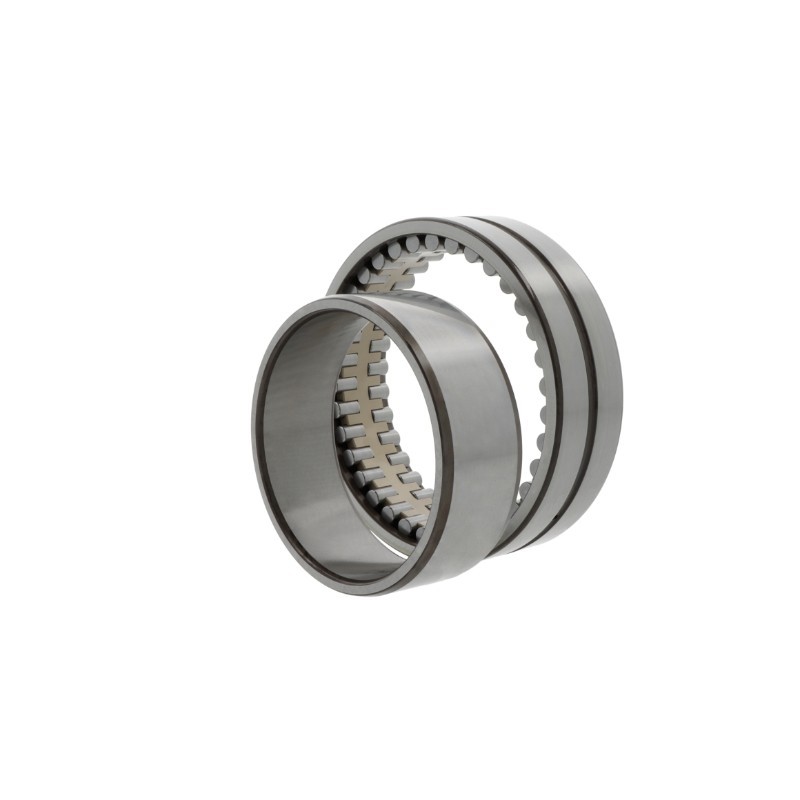
The SKF NNU4934 BK/SPW33 cylindrical roller bearing, with a 170 mm bore, brass cage and tolerance class SP, provides high-precision radial support.
The NNU4934 BK/SPW33 cylindrical roller bearing is a double-row non-locating bearing designed for demanding industrial applications involving very high radial loads. SKF manufactures this version with a tapered bore with a taper ratio of 1:12 and an open design. With dimensions of 170 mm bore diameter, 230 mm outer diameter and 60 mm width, this roller bearing can accommodate large radial forces. The solid brass cage guides the two rows of rollers and retains its dimensional stability at temperatures between –30 and +150 degrees Celsius.
This double-row floating bearing is primarily used in applications where designs require high radial stiffness and running accuracy. As a floating bearing, the bearing assembly compensates for thermal length changes in the shaft during operation without any constraint, as the inner ring can be removed from both sides. Typical applications are found in precision engineering, in bearing arrangements subject to high radial loads and requiring precise shaft guidance. The lubrication groove integrated into the outer ring, together with the lubrication holes, simplifies the continuous supply of lubricant to the contact zones during operation.
Tolerance class SP designates this bearing as a high-precision version with tightly defined dimensional and running tolerances. In combination with the significantly reduced radial bearing clearance, a play-free or specifically preloaded bearing arrangement can be achieved. Thanks to the tapered bore with a 1:12 ratio, the bearing is mounted on a tapered shaft seat. The radial operating clearance can be adjusted during assembly via the axial displacement.
The cylindrical roller bearing has a bore of 170 mm, an outer diameter of 230 mm and a width of 60 mm. As a double-row design, these dimensions offer high radial load-carrying capacity within a compact installation space and are suitable for heavily loaded bearing arrangements.
The abbreviation SP stands for Special Precision and indicates a high-precision tolerance class. The manufacturing tolerances for concentricity, bore diameter and outer ring width are specified more tightly than for standard tolerances. This supports designs that require high guidance accuracy and minimal dimensional deviations.
A tapered inner ring bore with a taper ratio of 1:12 allows the radial bearing clearance to be adjusted during assembly. By sliding the inner ring axially onto the tapered seat to a defined extent, the ring expands. This allows the internal bearing clearance to be reduced to the desired operating condition.
The designation W33 denotes a ring-shaped groove and lubrication holes in the outer ring. This feature allows lubricant to be applied directly radially between the two rows of rollers. As a result, the lubricant is distributed evenly across both rings of rolling elements and lubricates the raceways during operation.
The permissible operating range is from -30 to +150 degrees Celsius. As a true floating bearing, the NNU design allows for axial displacement between the rollers and the raceways of the removable inner ring. Thermal linear expansion of the shaft therefore does not lead to internal axial stresses in the bearing system.
The solid brass cage separates the rollers in both rows and guides the rolling elements evenly along their path. Brass offers high strength and good sliding properties, ensuring stability within the rolling element set in the event of impact loads, vibrations or rapid changes in rotational speed.
SKF Group
Sven Wingquists Gata 2, 415 50 Gothenburg, Sweden
info@skf.com, https://www.skf.com/uk/footer/site-ownership