

 Bearings
 Housings/housing Units
 Linear Technology
 V-Belts
 Seals
Seals
FAG
| Scale quantity | Your discount | Unit price |
|---|---|---|
| 2 | 65,12 € | 1.237,31 € |
| 3 | 130,25 € | 1.172,18 € |
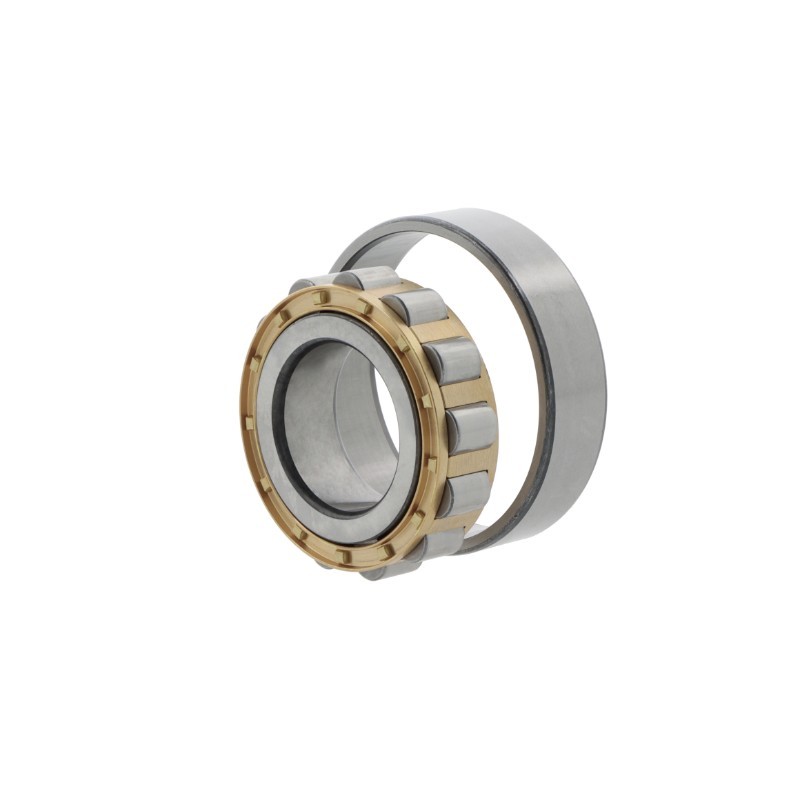
The FAG N1930 -K-M-SP cylindrical roller bearing, with dimensions of 150 × 210 × 28 mm, a tapered bore and tolerance class SP, provides precise guidance for demanding free-running applications.
The FAG N1930 -K-M-SP cylindrical roller bearing is a single-row precision roller bearing designed for high radial loads. Thanks to its open design without integrated seals, the bearing can be integrated directly into existing lubrication circuits. FAG equips this version with a guided brass cage and a significantly reduced radial clearance. As the outer ring is flangeless on both sides and removable, the unit functions purely as a non-locating bearing.
This idler bearing is designed for bearing arrangements where thermally induced changes in shaft length must be compensated for without constraint. It is primarily used in precision bearing arrangements with high requirements for guidance accuracy and concentricity. The rollers transmit radial loads exclusively, whilst axial displacements occur with low friction within the bearing. Furthermore, the detachable outer ring facilitates the separate assembly of the inner and outer rings in machine housings with tight tolerances.
The tapered bore with a ratio of 1:12 allows the remaining operating clearance to be precisely adjusted during axial pressing onto the shaft seat. In combination with the significantly reduced radial bearing clearance, this serves to create a clearance-free or specifically preloaded bearing system. Tolerance class SP stands for super-precision, with particularly tight running and dimensional tolerances. The brass cage is designed to ensure precise guidance of the rollers, even during rapid speed changes and at operating temperatures ranging from –30 to +150 degrees.
The bearing has an internal diameter of 150 mm at the tapered bore, an external diameter of 210 mm and a width of 28 mm. These key dimensions determine the required installation space on the shaft and within the housing.
The abbreviation K denotes a tapered bore with a taper ratio of 1:12. By axially sliding the inner ring onto a suitable tapered shaft seat, the bearing clearance can be precisely adjusted during assembly.
The designation ‘SP’ stands for ‘Special Precision’ and defines a tolerance class offering enhanced accuracy. This version is characterised by very tight tolerances in terms of concentricity, dimensional accuracy and axial run-out of the rings.
In the N design, the inner ring guides the cylindrical rollers between two fixed flanges, whilst the outer ring has no flanges. This allows the outer ring to move axially relative to the set of rollers, thereby compensating for thermal expansion of the shaft.
The open bearing is designed for an operating temperature range of -30 to +150 degrees. The actual operating limits are determined by the lubricant selected and the thermal resistance of the surrounding sealing elements.
The brass cage offers high mechanical strength and good run-on properties. It guides the rolling elements with minimal vibration and is suitable for applications involving frequent acceleration or increased thermal stress.
Schaeffler Technologies AG & Co. KG
Industriestraße 1-3, 91074 Herzogenaurach, Germany
info.de@schaeffler.com, https://www.schaeffler.de/de/meta/impressum/