

 Bearings
 Housings/housing Units
 Linear Technology
 V-Belts
 Seals
Seals
SKF
| Scale quantity | Your discount | Unit price |
|---|---|---|
| 10 | 7,87 € | 149,44 € |
| 20 | 15,73 € | 141,58 € |
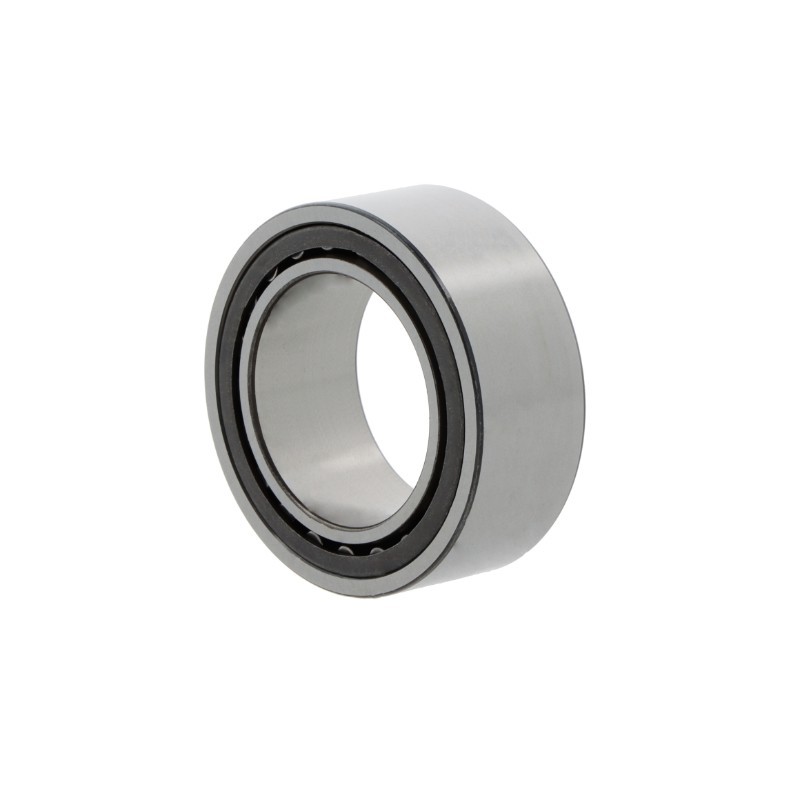
The SKF NUP215 ECP cylindrical roller bearing acts as a fixed bearing to support shafts axially and accommodates high radial loads with dimensions of 75x130x25 mm.
The single-row NUP215 ECP cylindrical roller bearing from SKF, as an open rolling bearing, withstands high radial loads. Thanks to the NUP design, the component locks the shaft in both axial directions and thus acts as a compact fixed bearing. With key dimensions of a 75 mm bore, 130 mm outside diameter and 25 mm width, this design is suitable for demanding shaft support applications. The optimised internal design of the Explorer series ensures smooth running.
Design engineers select this fixed bearing design when rotating shafts must withstand not only heavy radial loads but also axial forces on both sides. The inner ring has a fixed flange and a loose flange disc, whilst the outer ring has two fixed flanges. Typical applications include shaft bearings in general mechanical engineering with axial support on both sides. The open bearing allows targeted lubrication with oil or grease directly via the housing design. The permissible temperature range extends from –30 to +120 degrees.
At SKF, the ECP suffix denotes an optimised internal design combined with a lightweight polyamide cage. This cage reduces the weight of the rotating components and promotes low-friction rolling of the cylindrical rollers. With standard radial clearance and dimensional accuracy to tolerance class Normal (P0 or ABEC 1), as well as increased running accuracy P6, the rolling bearing fits precisely into existing designs. During assembly, care must be taken to ensure the lubricant is applied cleanly.
As a single-row roller bearing in a fixed-mount design with a 75 mm bore, 130 mm outer diameter and 25 mm width, this version provides axial support for shafts on both sides. Two fixed flanges on the outer ring, together with one fixed flange and a flange disc on the inner ring, enable the bearing to accommodate axial loads. The polyamide cage and the Explorer design contribute to smooth running characteristics.
The NUP design transforms a cylindrical roller bearing into a fully-fledged fixed bearing. Whilst cylindrical roller bearings primarily support high radial loads, the flanges on both bearing rings allow the shaft to be guided axially in both directions. The bearing thus limits axial displacement of the shaft within the housing and, in many installation scenarios, eliminates the need for an additional thrust bearing.
At SKF, the designation ‘ECP’ stands for an optimised internal design combined with a polyamide cage. This design improves contact between the rollers and raceways. The lightweight polyamide cage guides the rollers with low friction, dampens operating noise and is designed for operating temperatures ranging from -30 to +120 degrees.
This bearing has a standard radial clearance for typical fit conditions and standard operating conditions. Dimensional accuracy complies with classes P0 and ABEC 1, whilst running accuracy is classified within the tighter tolerance class P6 or ABEC 3. This combination ensures precise concentricity in industrial applications.
As this model is manufactured as an open bearing without integrated seals, lubrication is provided via the housing design. Depending on the operating conditions, industrial oils or greases are suitable. As the outer ring has no lubrication groove or bore, apply the lubricant to the side of the rolling elements and the cage and into the bearing.
The permissible operating temperature range for the bearing is between -30 and +120 degrees Celsius. This range is largely determined by the polyamide cage and the materials used for the bearing components. When designing the bearing installation, it is advisable to check that the lubricant used, as well as any external seals, are suitable for these operating temperatures.
SKF Group
Sven Wingquists Gata 2, 415 50 Gothenburg, Sweden
info@skf.com, https://www.skf.com/uk/footer/site-ownership