

 Bearings
 Housings/housing Units
 Linear Technology
 V-Belts
 Seals
Seals
SKF
| Scale quantity | Your discount | Unit price |
|---|---|---|
| 2 | 91,25 € | 1.733,66 € |
| 3 | 182,50 € | 1.642,41 € |
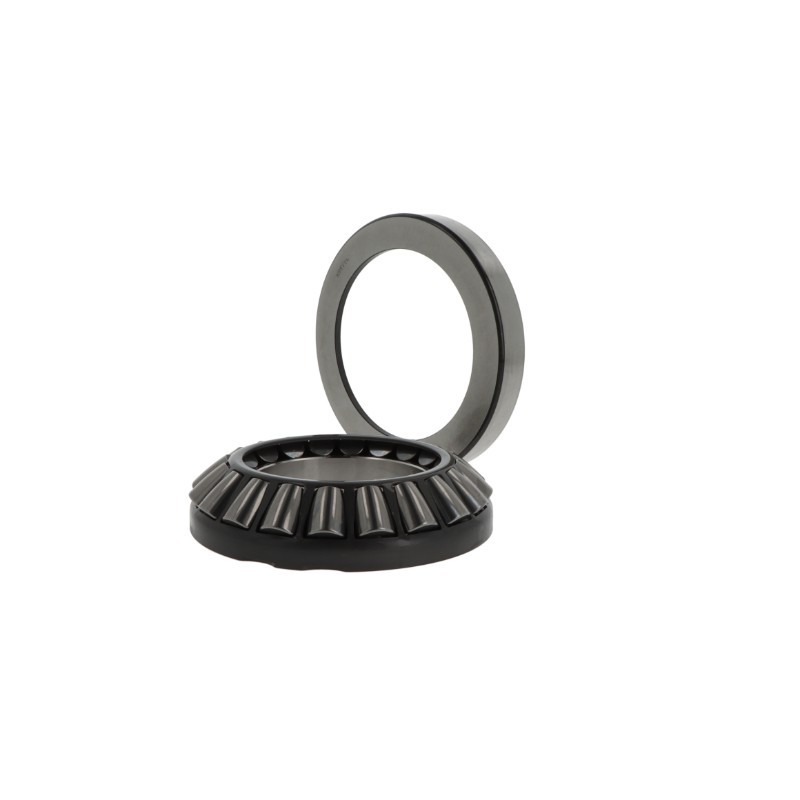
The SKF 29340 E axial self-aligning roller bearing, measuring 200 × 340 × 85 mm, accommodates high unilateral axial loads and compensates for misalignment.
The 29340 E axial self-aligning roller bearing is a heavy-duty rolling bearing designed for demanding industrial applications. The design combines barrel-shaped rollers with spherical raceways in the housing disc. Thanks to this geometry, the bearing transmits heavy axial forces in one direction whilst simultaneously accommodating both static and dynamic misalignments of the shaft. Manufactured from standard 100Cr6 rolling-element bearing steel in the SKF Explorer design, this component features optimised internal contact surfaces.
This type of bearing is primarily used in heavy-duty drivetrains and industrial gearboxes where significant axial thrust forces occur. As the roller arrangement is designed to be angularly adjustable, the bearing compensates for misalignment and deflection of the shaft under load without causing adverse edge loading. Typical applications include vertical shaft lines and heavily loaded large gearboxes, where, in addition to the dominant axial forces, moderate radial loads may also act on the bearing location.
The integrated sheet steel cage guides the rolling elements whilst being lightweight and facilitates unobstructed access of lubricant to the roller end faces. Together with the rolling bearing steel, the bearing unit covers a temperature range from –30 to +200 degrees. Manufacturing is carried out to the standard tolerance P0/PN (corresponding to ABEC 1). When designing the connecting components, it must be taken into account that the bearing is designed for single-sided loading and requires a minimum axial load during operation.
With an internal diameter of 200 mm, an external diameter of 340 mm and a height of 85 mm, the bearing complies with the standardised nominal dimensions for large axial roller bearings.
Yes, thanks to the angled contact geometry of the rollers, the single-acting bearing can accommodate not only dominant axial forces but also a certain proportion of radial forces. However, purely radial loads without a simultaneous axial force are not permitted.
The Explorer version features bearings with a refined surface finish on the raceways and rollers. This design modification improves the formation of the lubricating film, reduces internal friction and increases fatigue strength under continuous load.
The permissible operating range is from -30 to +200 degrees. The integrated sheet steel cage and the material composition, made from standard roller bearing steel 100Cr6, remain dimensionally stable within this range, provided that the lubricant used is approved for these values.
Manufacturing is carried out to the standard tolerance class P0 or PN, which corresponds to class ABEC 1 in the US system. This tolerance grade meets the standard requirements of general heavy machinery manufacturing.
Axial-thrust roller bearings always require a minimum axial force to maintain positive contact between the rollers and the raceways. If this preload is absent, slippage may occur, leading to sliding movements and increased wear on the raceways.
SKF Group
Sven Wingquists Gata 2, 415 50 Gothenburg, Sweden
info@skf.com, https://www.skf.com/uk/footer/site-ownership