

 Bearings
 Housings/housing Units
 Linear Technology
 V-Belts
 Seals
Seals
SKF
| Scale quantity | Your discount | Unit price |
|---|---|---|
| 2 | 84,97 € | 1.614,37 € |
| 3 | 169,93 € | 1.529,41 € |
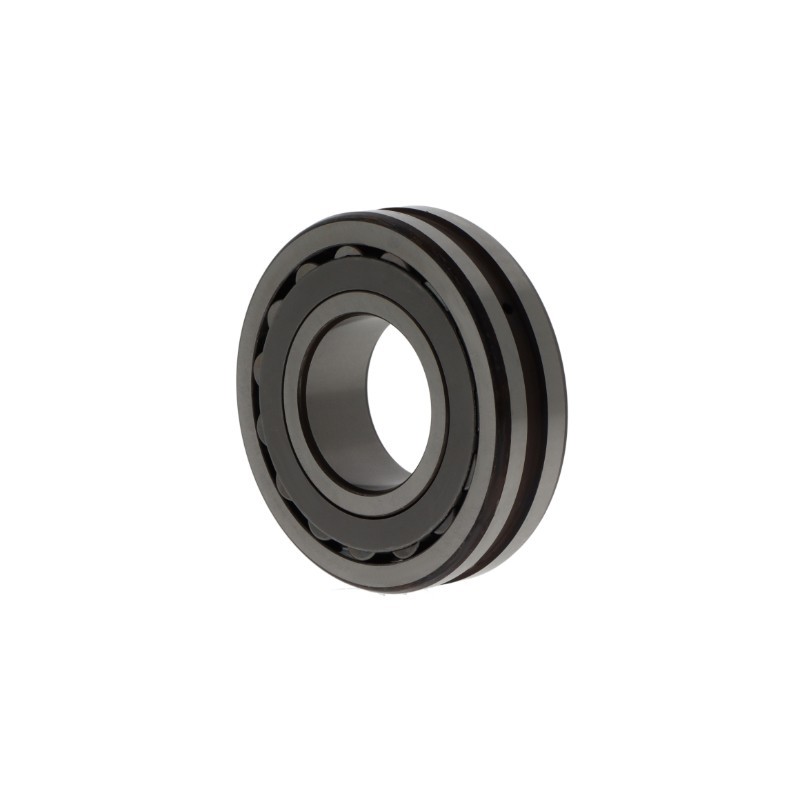
The SKF 23140 CCK/C4W33 self-aligning roller bearing, with a 200 mm bore and an outer diameter of 340 mm, provides angular misalignment capability for heavy radial loads.
The SKF 23140 CCK/C4W33 self-aligning roller bearing is an open roller bearing made from standard 100Cr6 bearing steel for demanding industrial applications. With a width of 112 mm and a double-row roller arrangement, the design automatically compensates for misalignment and shaft deflection. Fitted with a dimensionally stable sheet steel cage, the bearing is designed for operating temperatures ranging from -30 to +200 degrees. The integrated lubrication groove, complete with lubrication holes in the outer ring, facilitates targeted relubrication whilst the bearing is in operation.
This self-aligning roller bearing is specifically designed for applications involving high radial forces and combined axial loads. Thanks to the hollow-spherical raceway in the outer ring, the bearing accommodates dynamic misalignments of the shaft without generating impermissible edge stresses on the roller bodies. The design accommodates elastic shaft deflection and misalignment between the housing seats. This makes the bearing unit suitable for mounting positions with static or dynamic misalignment.
The designation CCK refers to a tapered bore with a taper ratio of 1:12, which allows the bearing to be mounted directly onto tapered shaft seats or using mounting and withdrawal sleeves. When pushed onto the tapered seat, the inner ring expands, which measurably reduces the radial bearing clearance. The significantly increased C4 bearing clearance class compensates for this installation shrinkage and provides sufficient residual clearance to accommodate thermal expansion under high loads. Whilst the dimensional accuracy complies with the standard tolerance PN, the increased running accuracy of class P5 contributes to high concentricity.
The spherical roller bearing has a bore diameter of 200 mm, an outer diameter of 340 mm and a total width of 112 mm. These dimensions correspond to the standardised dimensions for this size. The bore has a taper of 1:12, which must be taken into account when selecting the shaft fit or sleeve.
The designation CC refers to the internal design featuring window-like sheet steel cages and an inner ring without a guide ring. The appended K denotes the tapered bore shape with a 1:12 taper. The designation W33 refers to the design of the outer ring: it features a circumferential lubrication groove with lubrication holes through which lubricant can be applied directly between the roller sets.
The radial clearance class C4 denotes a significantly increased bearing clearance in the initial state compared with standard clearance. This is necessary because the tight fit on a tapered seat expands the inner ring, thereby reducing bearing clearance. Furthermore, the C4 clearance compensates for greater temperature differences between the rotating inner ring and the stationary outer ring, ensuring that the bearing does not become stressed when it heats up.
As an open roller bearing, this design has no integrated sealing washers. Relubrication is carried out via the W33 lubrication groove in the outer ring using grease or oil. As dirt particles and moisture can penetrate unhindered in open bearings, the bearing housing requires external sealing via the surrounding bearing housing.
Manufactured from 100Cr6 roller bearing steel and fitted with sheet steel cages, the bearing is suitable for operation in a temperature range from -30 to +200 degrees. It is therefore suitable for industrial environments with significant heat generation, provided that the selected lubricant is specified for the relevant temperature range.
This roller bearing combines the PN dimensional tolerance with the increased running accuracy of P5. Whilst the mounting dimensions, such as the bore and outer ring, comply with standard tolerances, the bearing has tighter concentricity tolerances. This ensures smooth shaft rotation with minimal deviations.
SKF Group
Sven Wingquists Gata 2, 415 50 Gothenburg, Sweden
info@skf.com, https://www.skf.com/uk/footer/site-ownership