

 Bearings
 Housings/housing Units
 Linear Technology
 V-Belts
 Seals
Seals
SKF
| Scale quantity | Your discount | Unit price |
|---|---|---|
| 25 | 2,50 € | 47,54 € |
| 35 | 5,00 € | 45,04 € |
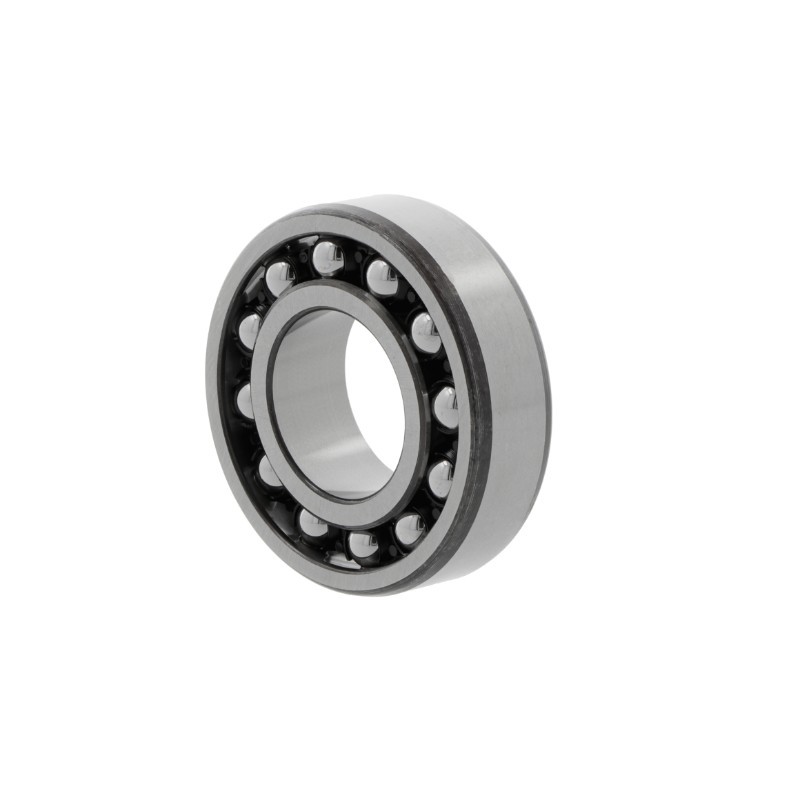
The SKF 2209 EKTN9/C3 double-row self-aligning ball bearing, measuring 45x85x23 mm, compensates for misalignment and shaft deflection during operation.
The 2209 EKTN9/C3 self-aligning ball bearing is manufactured by SKF and belongs to the group of self-aligning rolling bearings. The shared hollow-spherical raceway in the outer ring allows the two rows of balls to adjust freely. As a result, this bearing compensates for angular misalignment between the shaft and housing without a significant increase in friction. It is manufactured from 100Cr6 rolling-bearing steel to tolerance class P0/PN or ABEC 1. The open design allows lubricant to be supplied directly via the surrounding machine housing.
Design engineers primarily use this double-row bearing where shaft deflection or misalignment between the bearing seats occurs. Typical applications include longer shaft runs and industrial plant with shafts prone to deflection. As the outer ring accommodates misalignment within defined limits, no harmful edge stresses occur. The open design without integrated sealing washers is suitable for oil- or grease-lubricated systems that require regular maintenance intervals and are protected against contamination by external seals.
The combination of a tapered bore with a 1:12 taper and increased C3 bearing clearance simplifies mounting on mounting or withdrawal sleeves. During axial mounting, the inner ring expands, thereby reducing the radial clearance. The C3 bearing clearance, which is slightly increased at the factory, serves to compensate for this reduction in clearance and to maintain sufficient operating clearance even when the bearing heats up during operation. The polyamide cage guides the balls within a temperature range of -30 to +120 degrees Celsius.
This roller bearing has an internal diameter of 45 mm at the tapered bore, an external diameter of 85 mm and a total width of 23 mm. These dimensions allow it to be fitted into appropriately sized bearing housings.
The suffix code specifies key design features: ‘K’ denotes a tapered inner ring bore with a taper ratio of 1:12. ‘TN9’ stands for a polyamide cage, whilst ‘C3’ indicates a radial clearance that is slightly greater than that of the standard version.
When the inner ring is pressed onto a tapered shaft or adapter sleeve, the ring expands due to its design. The C3 bearing clearance ensures that, after assembly and following operational heating, there remains sufficient clearance for the rolling elements to run freely and without jamming.
As this component is manufactured as an open bearing without integrated contact seals, lubrication is provided via the housing design using roller bearing grease or gear oil. Depending on the ambient conditions, users must fit an external housing seal to keep the lubricant within the bearing chamber and prevent contamination.
The permissible temperature range is from -30 to +120 degrees Celsius. This range is largely determined by the polyamide cage and the standard roller bearing steel used, and covers typical operating conditions in general mechanical and plant engineering.
The outer ring features a continuous raceway ground to a hollow-spherical profile. Both rows of balls, together with the inner ring, can tilt freely within this hollow sphere. The bearing thereby automatically compensates for misalignment, fitting inaccuracies or dynamic shaft deflection.
SKF Group
Sven Wingquists Gata 2, 415 50 Gothenburg, Sweden
info@skf.com, https://www.skf.com/uk/footer/site-ownership