

 Bearings
 Housings/housing Units
 Linear Technology
 V-Belts
 Seals
Seals
SKF
| Scale quantity | Your discount | Unit price |
|---|---|---|
| 15 | 5,14 € | 97,77 € |
| 30 | 10,29 € | 92,62 € |
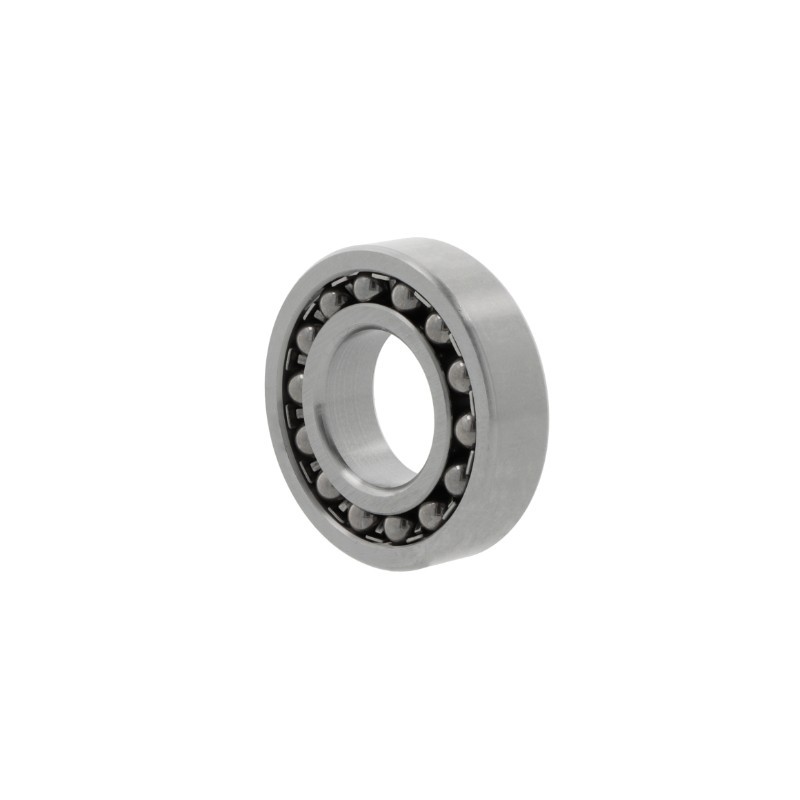
The SKF 2310 self-aligning ball bearing, measuring 50x110x40 mm, compensates for misalignment and accommodates radial and low axial loads.
The 2310 self-aligning ball bearing is a double-row rolling bearing with a common hollow-spherical raceway in the outer ring. This design enables the two rows of balls to automatically compensate for misalignment and shaft deflection during operation. Manufactured from standard rolling-bearing steel (100Cr6), this open bearing features a dimensionally stable sheet steel cage. With a bore of 50 mm, an outer diameter of 110 mm and a width of 40 mm, the SKF version covers an operating temperature range from –30 to +150 degrees Celsius.
The 2310 self-aligning ball bearing is primarily used in applications involving shaft deflection under load or where there are manufacturing-related misalignments between the bearing locations. Typical applications include shaft support arrangements over longer spans and in separately mounted housing configurations. The double-row bearing primarily accommodates radial forces and handles low axial loads in both directions. The angularly adjustable design of the raceways reduces additional internal stresses should components shift slightly during operation.
As an open model without integrated seals, the 2310 self-aligning ball bearing requires a clean housing environment and external sealing elements, such as shaft seals, to prevent the ingress of contaminants. Grease or lubricating oil can be applied directly to the rolling elements from the outside, allowing for the selection of an application-specific lubricant. With tolerance class P0/PN (ABEC 1) and standard radial clearance, the component fits into standardised machine fits.
The bearing has an inside diameter of 50 mm, an outside diameter of 110 mm and a width of 40 mm. These dimensions correspond to the standardised design for double-row self-aligning ball bearings with a cylindrical bore.
The outer ring has a continuous, hollow-spherical raceway on which the two rows of balls can move freely. As a result, when the shaft bends or becomes misaligned within the housing, the inner ring, cage and balls pivot out of their central position without causing impermissible edge pressures on the rolling elements.
The standard radial bearing clearance refers to the standard internal clearance between the balls and raceways when the bearing is in its unassembled state. This design is suitable for standard shaft and housing fits, as well as moderate operating temperatures, without causing undesirable stress in the rolling elements due to press fits.
With components made from standard roller bearing steel (100Cr6) and a sheet steel cage, the bearing is designed for operating temperatures ranging from -30 to +150 degrees Celsius. In practical use, the usable temperature range depends on the thermal stability of the selected external lubricant.
Open roller bearings are not pre-filled with grease by the manufacturer. The bearing must be lubricated with grease or oil prior to commissioning or via lubrication points on the housing. The type of lubricant selected and the operating conditions determine the required relubrication intervals.
Tolerance class P0 (also known as PN or ABEC 1) specifies the standard dimensional and running accuracy for industrial roller bearings. It defines mandatory tolerance limits for bore, outer diameter and concentricity, which are designed for standard industrial applications.
SKF Group
Sven Wingquists Gata 2, 415 50 Gothenburg, Sweden
info@skf.com, https://www.skf.com/uk/footer/site-ownership