

 Bearings
 Housings/housing Units
 Linear Technology
 V-Belts
 Seals
Seals
SKF
| Scale quantity | Your discount | Unit price |
|---|---|---|
| 15 | 4,88 € | 92,81 € |
| 30 | 9,77 € | 87,92 € |
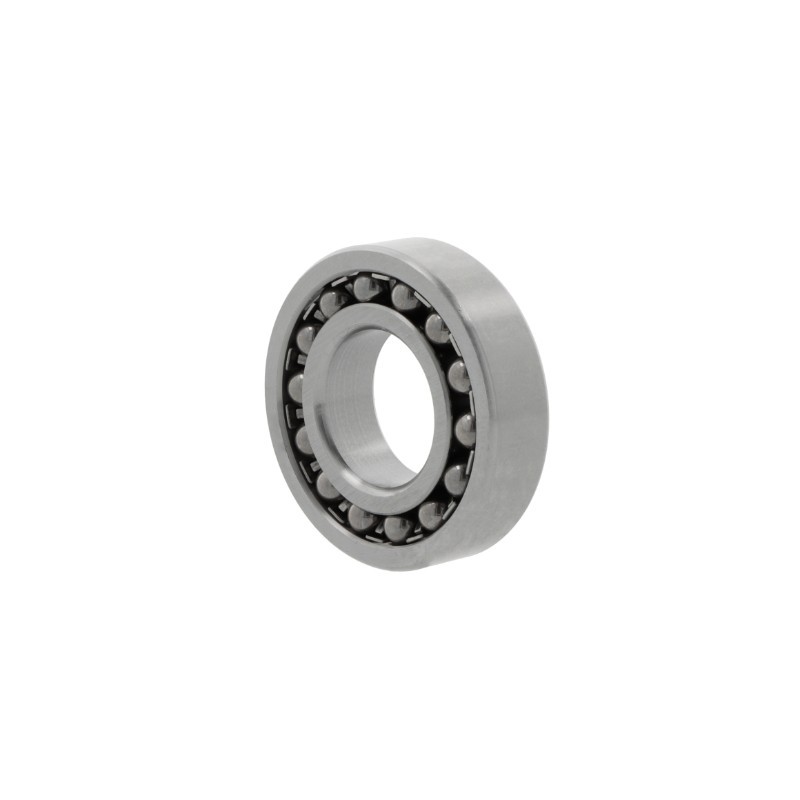
The SKF 2214 double-row self-aligning ball bearing compensates for misalignment caused by shaft deflection and measures 70 x 125 x 31 mm.
The 2214 self-aligning ball bearing is a double-row rolling bearing made from standard 100Cr6 bearing steel, specifically designed for applications involving shaft deflection or misalignment. The continuous, hollow-spherical raceway in the outer ring allows the ball sets to pivot relative to the housing. Fitted with a sheet steel cage and manufactured to tolerance class P0 (ABEC 1), this design is suitable for demanding industrial drive trains and bearing arrangements.
Typical applications for this design can be found wherever long shafts are prone to elastic deflection or where it is difficult to maintain precise alignment between two separate housings. Thanks to the spherical outer ring raceway, the double-row bearing automatically compensates for such angular misalignments without excessive edge stresses occurring on the rolling elements. This effectively prevents premature wear on shafts and housing bearings.
The integrated sheet steel cage precisely maintains the spacing between the rolling elements and retains its dimensional stability even under thermal loads in the range from –30 to +150 degrees. As an open bearing, this variant can be integrated into centralised lubrication systems or supplied with a suitable lubricant as required. Furthermore, the standard radial bearing clearance, in combination with the standard design of the inner ring, ensures balanced operational behaviour with typical fit specifications on 70 mm shafts.
The connection dimensions comprise an internal diameter of 70 mm, an external diameter of 125 mm and a total width of 31 mm. These standardised dimensions allow for straightforward replacement in existing assemblies or the precise design of new shaft constructions.
Unlike rigid radial bearings, the outer ring has a single, spherical ball raceway. The two rows of balls in the inner ring can move freely within this hollow spherical segment. In the event of elastic deflection of the shaft or manufacturing tolerances in the housing, the inner ring tilts without any harmful forced stresses arising.
As it is designed without integrated sealing washers, lubricant reaches the raceways and the sheet steel cage directly, which helps to minimise friction losses. However, their use requires the surrounding bearing housing to be structurally sealed to prevent the ingress of contaminants or the leakage of grease.
Manufactured from standard 100Cr6 rolling-element bearing steel and fitted with a sheet steel cage, the bearing is designed for operating temperatures between -30 and +150 degrees. In addition to the bearing material, the temperature resistance of the lubricant used in the housing is also a key factor in determining thermal suitability during operation.
Standard bearing clearance (also referred to as CN) describes the radial clearance specified by the manufacturer when the bearing is in its unmounted state. This clearance is dimensioned such that, after the inner ring has been pressed onto the 70 mm shaft and following operational heating, there remains sufficient clearance to ensure low-friction operation.
Manufacturing is carried out to tolerance class P0 or standard tolerance (comparable to ABEC 1). This level of precision meets the practical requirements for dimensional, geometric and running accuracy in mechanical and plant engineering, and ensures a precise fit within the housing and on the shaft.
SKF Group
Sven Wingquists Gata 2, 415 50 Gothenburg, Sweden
info@skf.com, https://www.skf.com/uk/footer/site-ownership