

 Bearings
 Housings/housing Units
 Linear Technology
 V-Belts
 Seals
Seals
SKF
| Scale quantity | Your discount | Unit price |
|---|---|---|
| 10 | 10,26 € | 195,00 € |
| 20 | 20,53 € | 184,73 € |
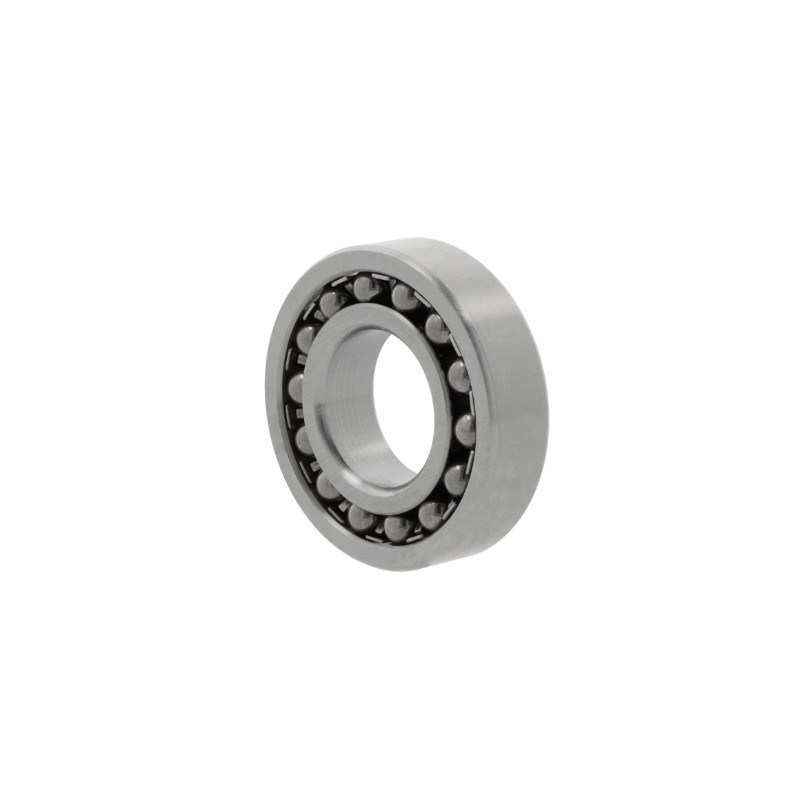
The SKF 2313 self-aligning ball bearing compensates for misalignment with two rows of balls and accommodates radial loads with dimensions of 65x140x48 mm.
The SKF 2313 self-aligning ball bearing is a double-row rolling bearing made from 100Cr6 bearing steel, designed for rotational movements with static or dynamic misalignment. The shared hollow-spherical raceway in the outer ring allows the bearing to adjust its angular misalignment during operation. With an inner diameter of 65 mm, an outer diameter of 140 mm and a width of 48 mm, this bearing series accommodates radial loads. The rolling bearing is manufactured to the standard tolerance class P0 or ABEC 1 and has a standard radial clearance suitable for common fit conditions in mechanical engineering.
In designs with large bearing spacings or flexible housing structures, mechanical loads frequently cause the rotating shaft to deflect. The double-row self-aligning ball bearing compensates for such angular misalignments between the shaft and the housing bore without the need for additional clamping forces. The rolling elements roll unhindered on the spherical outer ring raceway, thereby preventing harmful edge stresses. This feature promotes smooth running in machines and drive systems where misalignment cannot be completely ruled out due to design constraints. The cylindrical inner ring allows for direct mounting onto the shaft.
In the open design, the 2313 self-aligning ball bearing is supplied without integrated seals. This allows the lubrication type – grease or oil – to be specifically tailored to the respective operating requirements and rotational speeds. The guided sheet steel cage maintains the balls at a defined distance and minimises friction between the rolling elements. Together with the bearing rings made from standard rolling-element bearing steel, the bearing is designed for a temperature range of -30 to +150 degrees Celsius. In the case of open bearings, the housing environment should be structurally sealed to prevent foreign particles or moisture from entering the raceways.
Two rows of balls roll in grooved tracks on the inner ring and utilise a continuous hollow-spherical outer ring raceway. This design allows the inner ring, together with the ball cages, to tilt within the housing. The bearing automatically compensates for shaft deflection and misalignment between the bearing positions, and reduces harmful edge stresses at the rolling element contact points.
This double-row bearing has a cylindrical bore of 65 mm for the shaft seat. The outer diameter is 140 mm, with a height or width of 48 mm. Manufactured from standard roller bearing steel (100Cr6), its running and dimensional accuracy comply with the standard tolerance class P0/PN or ABEC 1.
The open design does not use fixed sealing washers, allowing greases or oils to reach the rolling elements directly. Design engineers prefer to integrate such bearings into housings with their own seals or into circulating oil circuits. Furthermore, the open design generates minimal friction, which is advantageous for applications with high requirements for smooth running.
Normal bearing clearance (also referred to as CN) denotes the factory-set radial clearance between the balls and raceways when the bearing is in its unassembled state. This clearance accommodates temperature-induced expansion of the shaft as well as the slight constriction that occurs when the inner ring is pressed onto the shaft. For standard fits and standard operating temperatures, this bearing clearance class provides a balanced relationship between guidance accuracy and smooth running.
The 2313 self-aligning ball bearing is approved for operating temperatures ranging from -30 to +150 degrees Celsius. Both the rings, made from 100Cr6 rolling-bearing steel, and the pressed sheet-steel cage retain their mechanical dimensional stability within this temperature range. When commissioning the bearing, ensure that the selected lubricant also fully covers this temperature range.
The sheet steel cage maintains an even distance between the two rows of rolling elements and prevents them from coming into contact with one another. This reduces internal friction and heat build-up during rotation. Compared with plastic cages, the steel version is resistant to the chemical effects of mineral lubricants and offers high mechanical strength across the entire permissible temperature range.
SKF Group
Sven Wingquists Gata 2, 415 50 Gothenburg, Sweden
info@skf.com, https://www.skf.com/uk/footer/site-ownership