

 Bearings
 Housings/housing Units
 Linear Technology
 V-Belts
 Seals
Seals
DIVERS
| Scale quantity | Your discount | Unit price |
|---|---|---|
| 50 | 0,15 € | 3,02 € |
| 100 | 0,31 € | 2,86 € |
| 250 | 0,48 € | 2,69 € |
| 500 | 0,63 € | 2,54 € |
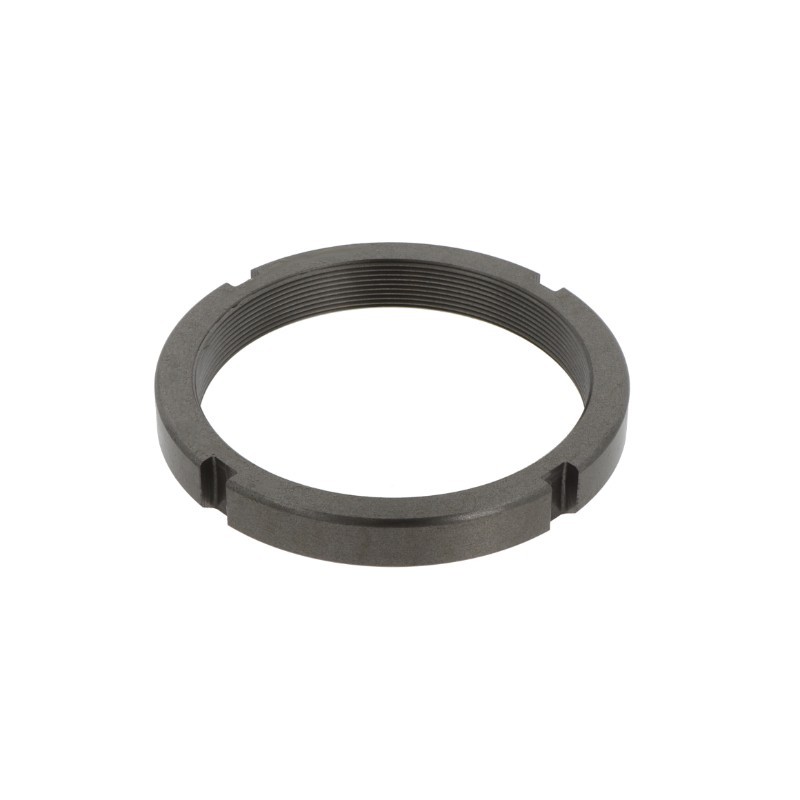
The KM1 slotted nut, made from roller bearing steel and measuring 12 × 22 × 4 mm, secures bearings axially on shafts or clamping sleeves.
The KM1 nut allows you to fix rolling bearing components precisely in the axial direction. The fastening element is made from conventional standard rolling bearing steel (100Cr6), which ensures high mechanical strength during assembly and in operation. Design engineers and maintenance technicians rely on this standardised groove nut to position inner rings in a form-fit manner against shaft shoulders or on tapered bearing seats.
The main area of application for this grooved nut is the axial fixation and preloading of rolling bearings in shaft assemblies where components must be held in their intended position. Thanks to the grooves machined into its circumference, the nut can be tightened in a controlled manner using a suitable hook spanner. This facilitates both the initial installation and the scheduled replacement of bearings during maintenance.
When fitting the KM1 slotted nut, which has a 12 mm bore and an external diameter of 22 mm, reliable screw locking is essential. A suitable locking plate is usually used for this purpose. Its inner tab engages with the shaft groove, whilst one of the outer tabs is bent into one of the recesses on the outer circumference of the nut. It is important to ensure the threads are clean and to adhere to the component-specific tightening torques.
The slotted nut has an internal diameter of 12 mm, an external diameter of 22 mm and a width of 4 mm. These compact dimensions comply with the standardised industrial dimensions for shaft nuts of this size.
The component is made from standard roller bearing steel (100Cr6). This material is characterised by high strength and good compressive strength, ensuring that the thread flanks retain their shape even under dynamic axial loading.
To ensure correct installation, screw the nut onto the relevant shaft thread and tighten it using a suitable hook spanner. Power is transmitted via the grooves located on the outer circumference, which prevents damage to the component.
A specially designed locking plate is usually used for this purpose. Once tightened, its outer flap is bent to fit snugly into one of the circumferential grooves in the nut, ensuring that vibrations do not cause it to come loose.
This component is used to secure rolling bearings axially on shafts or clamping sleeves. It absorbs axial forces and holds the inner rings of the bearings in their intended operating position to prevent unwanted movement within the bearing seat.