

 Bearings
 Housings/housing Units
 Linear Technology
 V-Belts
 Seals
Seals
FAG
| Scale quantity | Your discount | Unit price |
|---|---|---|
| 2 | 56,33 € | 1.070,30 € |
| 3 | 112,67 € | 1.013,96 € |
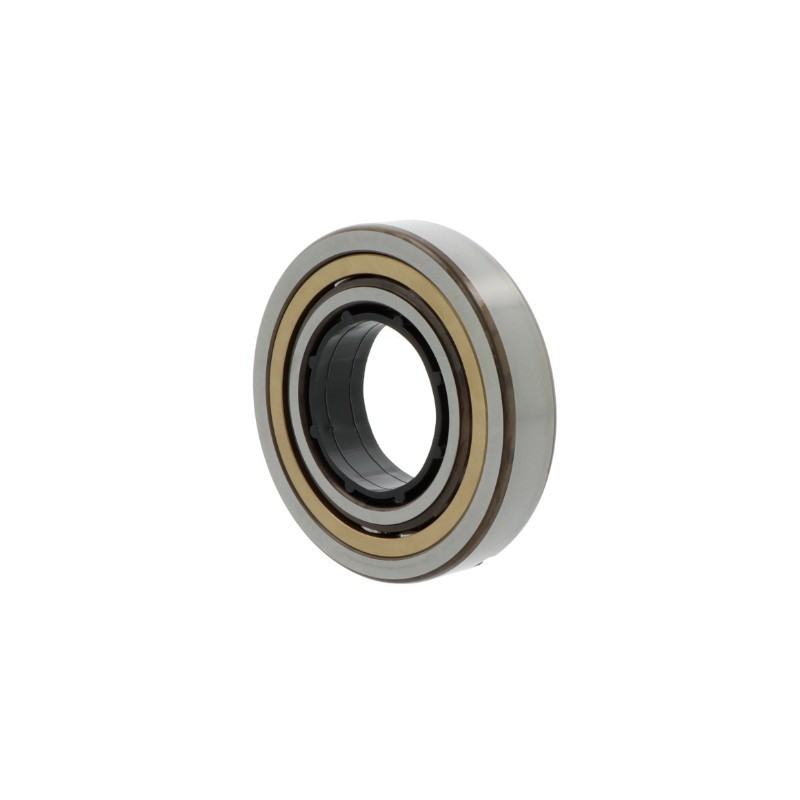
The FAG QJ326 -N2-MPA four-point bearing, measuring 130 × 280 × 58 mm, accommodates high axial forces in both directions whilst saving space.
The QJ326 -N2-MPA four-point bearing is a single-row radial ball bearing with a split inner ring, designed specifically for alternating or purely axial loads. Thanks to the steep contact angle, the design transmits considerable forces whilst maintaining a compact profile. The manufacturer, FAG, fits this version with a robust brass cage. As an open bearing, the bearing assembly can be flexibly integrated into existing lubrication systems and operates within a temperature range of -30 to +200 degrees.
This design is primarily used where axial forces occur in both directions and there is insufficient installation space for two separate angular contact ball bearings. This design is often used purely as an axial bearing, combined with a separate radial bearing. A prerequisite for this is radial clearance in the housing seat, to ensure that no impermissible radial forces act on the rolling elements. Typical applications include bearing arrangements subject to high axial loads and with limited axial installation space.
The split inner ring allows a large number of balls to be accommodated and makes it considerably easier to install the outer ring, cage and inner ring halves separately. In the case of the N2 suffix, the outer ring has two retaining grooves offset by 180 degrees. Keyways or pins on the housing side engage with these grooves. They counteract unwanted rotation of the outer ring within the housing, particularly in radially unsupported bearing arrangements. The bearings are manufactured to tolerance class P0/PN or ABEC 1 with standard radial clearance.
A four-point contact bearing is essentially similar in design to an angular contact ball bearing, but features split rings and specially ground raceways. This enables the balls to support axial loads in both directions. The QJ326 -N2-MPA variant features a split inner ring and a brass cage, designed for demanding operating conditions.
The suffix N2 refers to two retaining grooves in the outer ring, offset by 180 degrees. These recesses serve to prevent rotation within the housing. When corresponding pins engage with the grooves, the outer ring remains fixed in place, which is particularly important when the bearing is subjected to axial loads and is mounted with radial clearance.
The bearing has an internal diameter of 130 mm at the bore, an external diameter of 280 mm and a width of 58 mm. These standardised mounting dimensions allow for precise integration into the relevant machine housings.
The bearing is designed for operating temperatures between -30 and +200 degrees. As this is an open bearing without integrated seals, the actual thermal operating limit is determined primarily by the external lubricant selected.
Standard radial bearing clearance refers to the internal clearance between the rolling elements and the raceways when the bearing is new, without any additional expansion. In four-point contact bearings, this clearance, together with the contact angle, determines the operating behaviour under axial load. The tolerances correspond to the standard tolerance class P0 or ABEC 1.
The open design, which does not feature any ablative cover or sealing discs, allows for the unimpeded flow of lubricating oil or the use of application-specific greases. Furthermore, the absence of contact seals reduces friction and allows for straightforward relubrication via the surrounding housing system.
Schaeffler Technologies AG & Co. KG
Industriestraße 1-3, 91074 Herzogenaurach, Germany
info.de@schaeffler.com, https://www.schaeffler.de/de/meta/impressum/