

 Bearings
 Housings/housing Units
 Linear Technology
 V-Belts
 Seals
Seals
FAG
| Scale quantity | Your discount | Unit price |
|---|---|---|
| 2 | 11,96 € | 227,12 € |
| 5 | 23,92 € | 215,16 € |
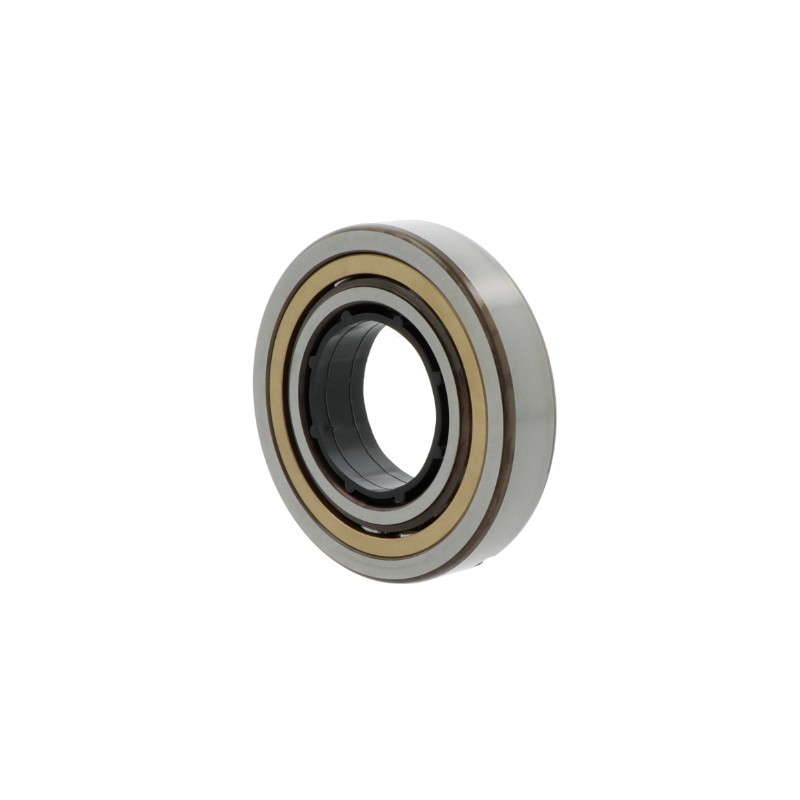
The FAG QJ216 -N2-MPA four-point bearing, measuring 80 × 140 × 26 mm, accommodates high axial loads in both directions.
The QJ216 -N2-MPA four-point bearing is a special single-row angular contact ball bearing designed to accommodate axial loads in both directions whilst maintaining a compact axial width. The rolling bearing is manufactured by FAG Wälzlager and features a split inner ring and a robust brass cage. Thanks to its design featuring an 80 mm bore, 140 mm outer diameter and 26 mm width, this construction saves axial installation space. As an open bearing, it can be integrated directly into existing lubrication systems and supports operating temperatures from -30 to +150 degrees.
This rolling bearing is suitable for designs in which predominantly axial forces occur in both directions. It is frequently used in combination with a separate radial bearing that absorbs the transverse loads. In the case of purely axial guidance, the outer ring can be given radial clearance within the housing so that it remains free from transverse forces. The compact width of 26 mm allows installation in places where double-row angular contact ball bearings would require too much axial space.
This design features two retaining grooves in the outer ring, offset by 180 degrees. These grooves enable the bearing to be secured in the housing using locking pins, which prevents the outer ring from moving unintentionally. The split inner ring simplifies assembly, as the outer ring with the ball race and the two inner ring halves can be fitted separately. The guided brass cage provides the rolling element ring with mechanical stability at varying speeds. With a tolerance class of P0 or ABEC 1, the bearing meets standard precision requirements.
A four-point contact bearing has split raceways and, compared to a deep-groove ball bearing, can accommodate higher axial forces in two directions. The raceway geometry ensures that the rolling elements make axial contact at a certain contact angle. As a result, a single four-point bearing can often replace a combination of two individual bearings mounted opposite each other when subjected to axial loads.
With an internal diameter of 80 mm, an external diameter of 140 mm and a width of 26 mm, the bearing offers standardised key dimensions for installation in housings and on shafts. Before assembly, it is advisable to check the dimensions of the connecting parts to ensure an even load distribution across the entire component.
The suffix N2 denotes two retaining grooves on one end face of the outer ring, offset by 180 degrees from one another. Housing pins engage with these recesses, securing the outer ring against rotation in the bearing seat by means of a positive fit. This design is particularly recommended when the four-point bearing is mounted as a pure thrust bearing with radial housing clearance.
The split inner ring allows a greater number of rolling elements to be fitted into the bearing, which enhances the axial load-carrying capacity. Furthermore, this two-piece design makes assembly easier. The outer ring, together with the ball set, and the two inner ring halves can be fitted one after the other, rather than having to press the component in as a single unit.
The permissible temperature range for this bearing is from -30 to +150 degrees Celsius. The design, featuring a brass cage, retains its dimensional stability even under thermal stress. As this is an open bearing without integrated sliding seals, the actual operating limit depends largely on the lubricant selected and the external sealing arrangement.
Brass cages are characterised by their strength, ability to operate under emergency conditions and vibration damping properties. The suffix ‘MPA’ denotes a brass cage which guides the rolling element ring even during rapid changes in speed and varying axial load directions. Furthermore, brass is characterised by high thermal resistance in continuous operation.
Schaeffler Technologies AG & Co. KG
Industriestraße 1-3, 91074 Herzogenaurach, Germany
info.de@schaeffler.com, https://www.schaeffler.de/de/meta/impressum/