

 Bearings
 Housings/housing Units
 Linear Technology
 V-Belts
 Seals
Seals
SKF
| Scale quantity | Your discount | Unit price |
|---|---|---|
| 2 | 27,01 € | 513,24 € |
| 3 | 54,03 € | 486,22 € |
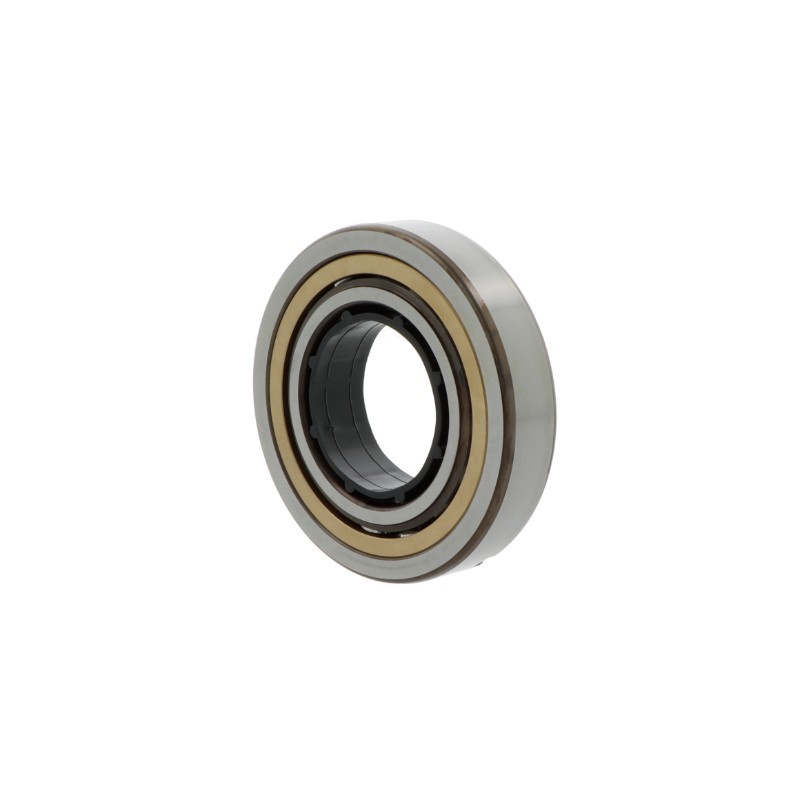
The SKF QJ220 N2MA four-point bearing, measuring 100 × 180 × 34 mm, accommodates high, fluctuating axial loads whilst maintaining a compact axial design.
The QJ220 N2MA four-point bearing is a single-row radial ball bearing from the QJ series with a 100 mm bore, 180 mm outer diameter and 34 mm width. SKF’s Explorer design is specifically engineered to accommodate high axial loads in both directions. The two-piece inner ring provides space for a large number of rolling elements, which enhances the axial load-carrying capacity. The design transmits axial forces in a dimensionally stable and controlled manner within a confined installation space.
The four-point bearing is primarily used where alternating axial forces need to be supported within a limited axial installation space. This design is often used as a pure axial bearing in combination with a separate radial bearing. The increased dimensional accuracy to tolerance class P6 and the running accuracy to P5 ensure smooth running characteristics under demanding operating conditions. However, this design is not intended for bearing arrangements subject to purely radial main loads.
The solid brass cage guides the balls at operating temperatures ranging from –30 to +150 degrees. The bearing can be secured in the housing using dowel pins via the two retaining grooves in the outer ring, which are offset by 180 degrees. This prevents the outer ring from rotating unintentionally. As this is an open bearing without a seal, users must select the lubricant and housing seal to suit the specific environmental conditions. The component has a standard radial bearing clearance.
With a bore diameter of 100 mm, an external diameter of 180 mm and a width of 34 mm, the bearing is capable of withstanding high axial forces in confined spaces. When designing the bearing mounting, the appropriate mounting dimensions of the mounting shoulders must be taken into account.
The two grooves on the outer ring, offset by 180 degrees, are designed to ensure a positive fit within the housing. When fitted with suitable retaining pins, they prevent the outer ring from rotating, particularly when the four-point bearing is mounted as a pure axial bearing with radial clearance in the housing.
The two-piece inner ring allows a larger number of rolling elements to be fitted. As a result, the roller bearing achieves a high axial load-carrying capacity in both load directions. Furthermore, the two inner ring halves and the outer ring can be fitted separately from the ball cages, which simplifies installation and removal.
As the bearing is of an open design without sealing washers, the lubricant reaches the raceways directly. The bearing assembly therefore requires external housing protection against dirt and moisture. The selected grease or lubricating oil must be suitable for a temperature range of -30 to +150 degrees.
This classification indicates a tighter manufacturing tolerance than the standard specification. Dimensional accuracy complies with Class P6, whilst running accuracy is manufactured to Class P5. These precision grades reduce runout error and contribute to low-vibration operation at higher speeds.
The solid brass cage guides the rolling elements under demanding operating conditions. Brass offers good sliding properties, high mechanical strength and can withstand high accelerations. Furthermore, the material is suitable for the specified temperature range of -30 to +150 degrees.
SKF Group
Sven Wingquists Gata 2, 415 50 Gothenburg, Sweden
info@skf.com, https://www.skf.com/uk/footer/site-ownership