

 Bearings
 Housings/housing Units
 Linear Technology
 V-Belts
 Seals
Seals
SKF
| Scale quantity | Your discount | Unit price |
|---|---|---|
| 2 | 31,71 € | 602,45 € |
| 3 | 63,43 € | 570,73 € |
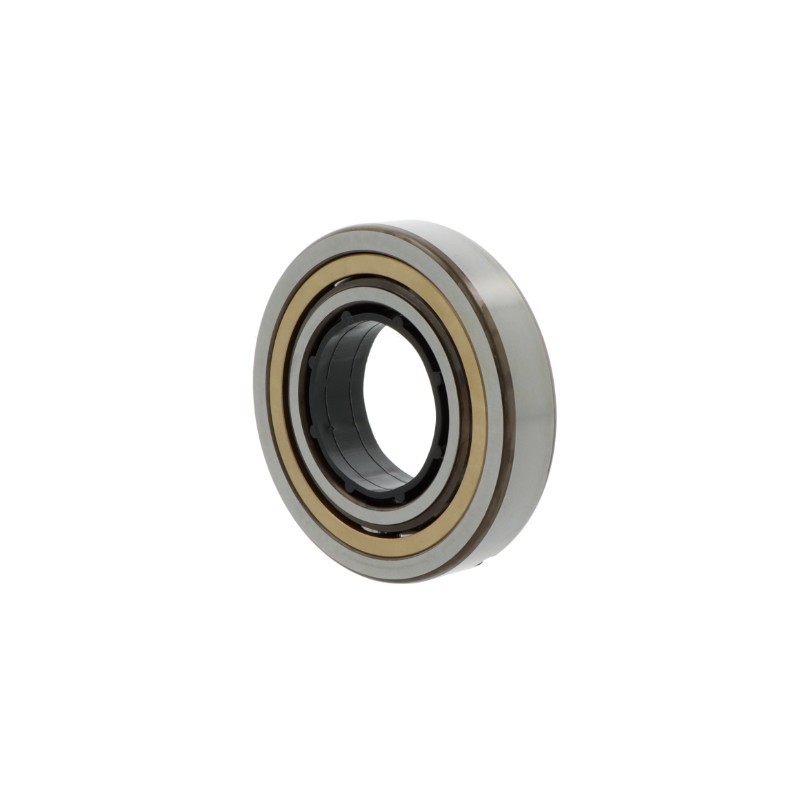
The SKF QJ222 N2MA four-point bearing, with dimensions of 110 × 200 × 38 mm and a split inner ring, provides precise axial guidance in both directions.
The QJ222 N2MA four-point bearing is a rolling bearing in the SKF Explorer performance class. It primarily accommodates axial forces in both directions and requires only a small amount of axial installation space. The design features a split inner ring and a guided brass cage. As it is an open bearing, the lubricant can be selected to suit the specific operating environment. With standard radial clearance and increased precision, the component operates within a temperature range of -30 to +150 degrees.
The bearing is primarily used where varying axial loads need to be accommodated within limited axial installation space. The four-point bearing is often used as a pure axial bearing in combination with a separate radial bearing. In such bearing arrangements, it supports the shaft in both axial directions. Thanks to its SKF Explorer design, the bearing features optimised contact geometries of the raceways.
The two-piece inner ring allows for the accommodation of a large number of rolling elements, which increases the axial load capacity. Furthermore, the separable design simplifies assembly, as the outer ring together with the ball cage and the inner ring halves can be fitted separately. Two retaining grooves in the outer ring, offset by 180 degrees, serve to secure the outer ring against rotation in the housing using suitable retaining elements. Dimensional accuracy to tolerance class P6 and running accuracy to P5 contribute to low-vibration operation.
This roller bearing has a contact angle that enables it to withstand high axial loads in both directions. Thanks to the split inner ring, the design accommodates a particularly large number of balls. The solid brass cage ensures stability under demanding operating conditions and improves the guidance quality of the rolling elements.
The two retaining grooves on the outer ring, offset by 180 degrees, serve to prevent rotation within the bearing housing by means of a positive fit. When suitable keyways or pins engage with these grooves, this prevents the outer ring from shifting within its housing seat, which is particularly important when load directions vary.
With an internal diameter of 110 mm, an external diameter of 200 mm and a width of 38 mm, the component complies with standardised key dimensions. These dimensions enable it to be fitted precisely onto suitable shafts and into the corresponding housing bores.
The P6 classification defines a tighter dimensional tolerance for bores and outer diameters than the standard specification. The P5 class describes an even finer running accuracy for the bearing rings. This combination promotes low-vibration operation and reduces runout errors during operation.
As the bearing is designed without integrated sealing washers, lubrication is provided by the surrounding unit, for example by means of an oil bath, oil circulation or externally applied grease. The design allows for use in a temperature range of -30 to +150 degrees.
The split inner ring is required by the design in order to allow the outer ring to be fitted with the maximum number of balls. Furthermore, this design facilitates the separate fitting of the rings onto the shaft and into the housing; however, it requires both halves of the inner ring to be clamped axially during installation.
SKF Group
Sven Wingquists Gata 2, 415 50 Gothenburg, Sweden
info@skf.com, https://www.skf.com/uk/footer/site-ownership