

 Bearings
 Housings/housing Units
 Linear Technology
 V-Belts
 Seals
Seals
SKF
| Scale quantity | Your discount | Unit price |
|---|---|---|
| 2 | 27,11 € | 515,04 € |
| 3 | 54,22 € | 487,93 € |
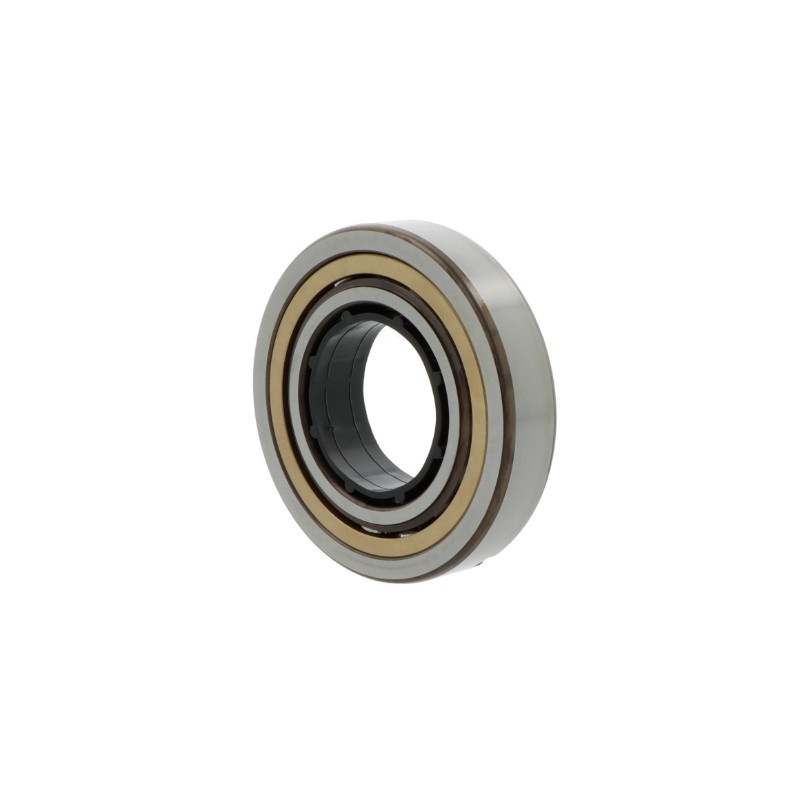
The SKF QJ317 N2MA four-point bearing, measuring 85 × 180 × 41 mm, accommodates high axial forces in both directions whilst requiring minimal axial installation space.
The QJ317 N2MA four-point bearing belongs to the group of radial angular contact ball bearings and is characterised by its split inner ring. This design primarily accommodates axial forces in both directions, yet requires less axial installation space than two separate angular contact ball bearings. Designed as an open bearing in SKF Explorer quality with standard radial clearance and a brass cage, the design operates within a temperature range of -30 to +150 degrees.
Design engineers primarily use this bearing where high axial loads occur in alternating directions and installation space is limited. It is often used as a pure axial bearing for high axial loads, combined with a separate radial bearing. If the outer ring is radially unsupported in the housing, the bearing transmits only axial forces. As a result, the four-point contact is limited to two contact points at a time under purely axial loads, which reduces friction and heat generation during continuous operation.
The split inner ring allows for the accommodation of a large number of rolling elements and simplifies assembly, as the outer ring and the two halves of the inner ring can be fitted separately. The suffix N2MA denotes two retaining grooves in the outer ring, offset by 180 degrees, as well as a solid brass cage. The retaining grooves serve to secure the outer ring against rotation within the housing by means of dowel pins. With a tolerance class of P6 for dimensional accuracy and P5 for running accuracy, the bearing meets high standards for concentricity and fit accuracy.
This single-row radial angular contact ball bearing has a split inner ring and can accommodate high axial loads in both directions. The N2MA version features two retaining grooves in the outer ring and a guided brass cage. With a bore of 85 mm, an outer diameter of 180 mm and a width of 41 mm, it combines high load-carrying capacity with a compact axial width.
The bearing has an internal diameter of 85 mm, an external diameter of 180 mm and a width of 41 mm. It is an open bearing without integrated sealing washers, designed for use in a lubricated housing and utilising external seals provided by the surrounding structure.
The two grooves on the outer ring, offset by 180 degrees, prevent the bearing outer ring from rotating uncontrollably within the housing. In conjunction with housing pins, they hold the outer ring in position. This is particularly important when the four-point bearing is mounted as a pure thrust bearing with radial clearance in the housing.
The designation P6 specifies a tighter dimensional tolerance for the bore and outer diameter than the standard tolerance. Class P5 indicates increased running accuracy. This combination ensures smooth running, precise shaft guidance and even load distribution during operation.
The open bearing is designed for operating temperatures ranging from -30 to +150 degrees. The integrated brass cage retains its mechanical stability throughout this entire range. To ensure safe operation, it is necessary to select a lubricant whose temperature suitability and viscosity are matched to the specific operating temperature of the system.
The two-piece inner ring allows more rolling elements to be fitted into the bearing, which increases the axial load-carrying capacity. Furthermore, this design simplifies assembly: the outer ring with ball race and the two inner ring halves can be fitted one after the other, which makes assembly and maintenance work on the shaft easier.
SKF Group
Sven Wingquists Gata 2, 415 50 Gothenburg, Sweden
info@skf.com, https://www.skf.com/uk/footer/site-ownership