

 Bearings
 Housings/housing Units
 Linear Technology
 V-Belts
 Seals
Seals
FAG
| Scale quantity | Your discount | Unit price |
|---|---|---|
| 2 | 12,19 € | 231,70 € |
| 5 | 24,40 € | 219,50 € |
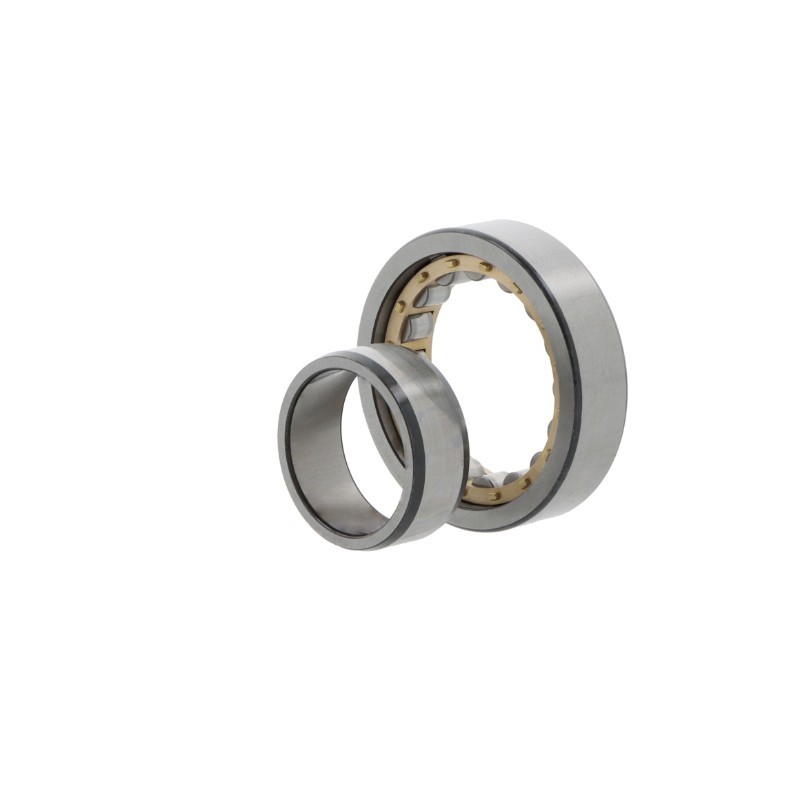
The FAG NU314 -E-M1A cylindrical roller bearing, as an open idler bearing, accommodates high radial loads and guides cylindrical rollers within a solid brass cage with an external guide.
The single-row cylindrical roller bearing NU314 -E-M1A is designed for applications where purely radial loads are encountered. With a bore of 70 mm, an outside diameter of 150 mm and a width of 35 mm, this roller bearing is suitable for demanding industrial applications. The manufacturer, FAG, produces this model in tolerance class P0/PN (ABEC 1) and fits it with standard radial clearance.
This cylindrical roller bearing functions purely as a non-locating bearing and is used in bearing arrangements where thermally induced changes in length need to be compensated for. Due to the NU design, the outer ring has two fixed flanges, whilst the inner ring is flangeless. This allows the inner ring to be removed from both sides, which compensates for axial displacement of the shaft relative to the housing directly within the bearing. This separable design also simplifies the assembly of both bearing rings.
The solid brass cage with external guidance (M1A) keeps the cylindrical rollers spaced apart and withstands high accelerations and vibrations. As this is an open bearing without an integrated seal, designers coordinate the lubricant supply via the housing. The component operates within a temperature range of -30 to +150 degrees, making it suitable for a wide variety of thermal operating conditions.
The NU design features two fixed flanges on the outer ring and a flangeless inner ring. This design acts purely as a non-locating bearing, allowing axial thermal expansion of the shaft to be compensated for freely within the bearing. Furthermore, the inner ring, which can be removed from either side, makes it easier to fit and remove the bearing assembly.
The bearing has an internal diameter of 70 mm, an external diameter of 150 mm and a width of 35 mm. These standardised key dimensions allow for direct replacement in existing assemblies in accordance with standard specifications.
The suffix M1A denotes a solid brass cage that is guided on the outer ring flange. Brass cages offer high strength under dynamic loads, impact forces or vibrations and are suitable for demanding mechanical operating conditions.
The standard radial bearing clearance refers to the internal radial clearance of the rollers between the inner and outer rings prior to installation. It is designed for standard fit selections and operating conditions in which there are no extreme temperature differences between the shaft and the housing.
The permissible operating temperature range is between -30 and +150 degrees. As the bearing is manufactured without a seal, the actual operating limit depends largely on the thermal resistance of the external lubricant used.
As an open bearing, this version does not have any integrated sealing washers. The bearing housing therefore requires external sealing within the housing to prevent the ingress of dirt particles and to prevent the lubricant from escaping.
Schaeffler Technologies AG & Co. KG
Industriestraße 1-3, 91074 Herzogenaurach, Germany
info.de@schaeffler.com, https://www.schaeffler.de/de/meta/impressum/