

 Bearings
 Housings/housing Units
 Linear Technology
 V-Belts
 Seals
Seals
SKF
| Scale quantity | Your discount | Unit price |
|---|---|---|
| 2 | 50,49 € | 959,36 € |
| 3 | 100,98 € | 908,87 € |
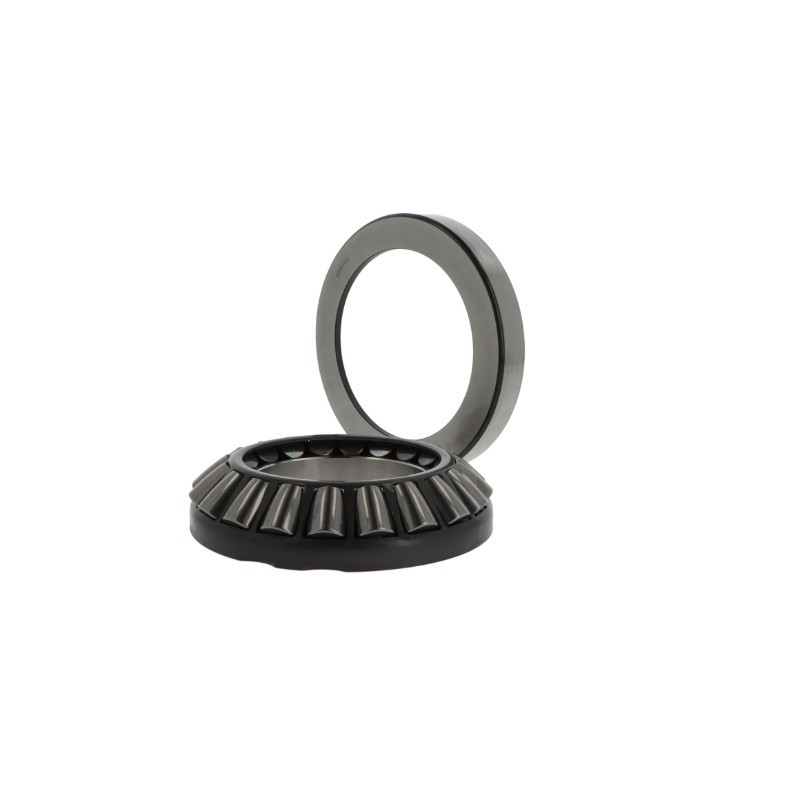
The SKF 29422 E axial self-aligning roller bearing, with dimensions of 110 × 230 × 73 mm, can accommodate high axial loads and compensates for misalignment through angular movement.
The 29422 E axial self-aligning roller bearing is designed as a single-acting rolling bearing for severe operating conditions. The design features barrel-shaped rollers on a spherical raceway in the housing disc, enabling the bearing to automatically compensate for angular misalignment between the shaft and the housing. Manufactured from standard 100Cr6 rolling bearing steel and fitted with a sheet steel cage, the bearing operates within a temperature range of -30 to +200 degrees. The SKF Explorer version features an optimised internal geometry.
Design engineers and maintenance personnel primarily use this bearing type where heavy axial forces act in one direction whilst shaft deflection occurs simultaneously. Thanks to the sets of rollers arranged at an angle to the bearing axis, the bearing can handle moderate radial loads in addition to dominant axial forces. Typical applications include vertical shaft lines and heavy-duty industrial gearboxes, where shock loads and elastic deformations of the connecting structure require an angularly adjustable bearing arrangement.
As this roller bearing operates as a single-direction bearing, it absorbs axial forces in one direction only. During design and installation, care must be taken to ensure the correct orientation of the shaft and housing rings. The components are not self-retaining, which facilitates the separate installation of the rings and the roller cage. As the bearing is manufactured to standard tolerances (P0/PN or ABEC 1), standardised fits on the shaft and housing are sufficient. During operation, the component requires a minimum axial load to prevent slippage of the rolling elements.
The component combines the ability to withstand high axial forces with the capacity to compensate for misalignment between the shaft and the housing. Its barrel-shaped rollers run on a spherical housing raceway, which allows for static and dynamic misalignment during operation.
The main dimensions are a bore diameter of 110 mm, an external diameter of 230 mm and a height of 73 mm. These standardised dimensions allow for direct installation in appropriately sized housings and shaft seats in industrial mechanical engineering.
The integrated sheet steel cage guides and evenly spaces the rolling elements along their raceway. It is lightweight, resistant to lubricants and withstands the bearing’s permissible temperature range of -30 to +200 degrees.
Single-direction bearings can only absorb axial forces from a specified direction. If alternating or opposing thrust forces occur during operation, a corresponding counter-bearing must be fitted on the shaft to prevent the rolling elements from lifting off.
This model is manufactured to tolerance class P0/PN, which corresponds to the ABEC 1 classification. This is the standard tolerance commonly used for industrial roller bearings, which ensures dimensional and concentricity accuracy for standard fits.
To ensure that the rollers run smoothly along the raceways without slipping, the bearing requires a constant axial preload during operation. If this contact pressure is lacking, harmful slippage may occur, which accelerates wear on the rollers and raceways.
SKF Group
Sven Wingquists Gata 2, 415 50 Gothenburg, Sweden
info@skf.com, https://www.skf.com/uk/footer/site-ownership