

 Bearings
 Housings/housing Units
 Linear Technology
 V-Belts
 Seals
Seals
SKF
| Scale quantity | Your discount | Unit price |
|---|---|---|
| 15 | 5,25 € | 99,62 € |
| 30 | 10,48 € | 94,39 € |
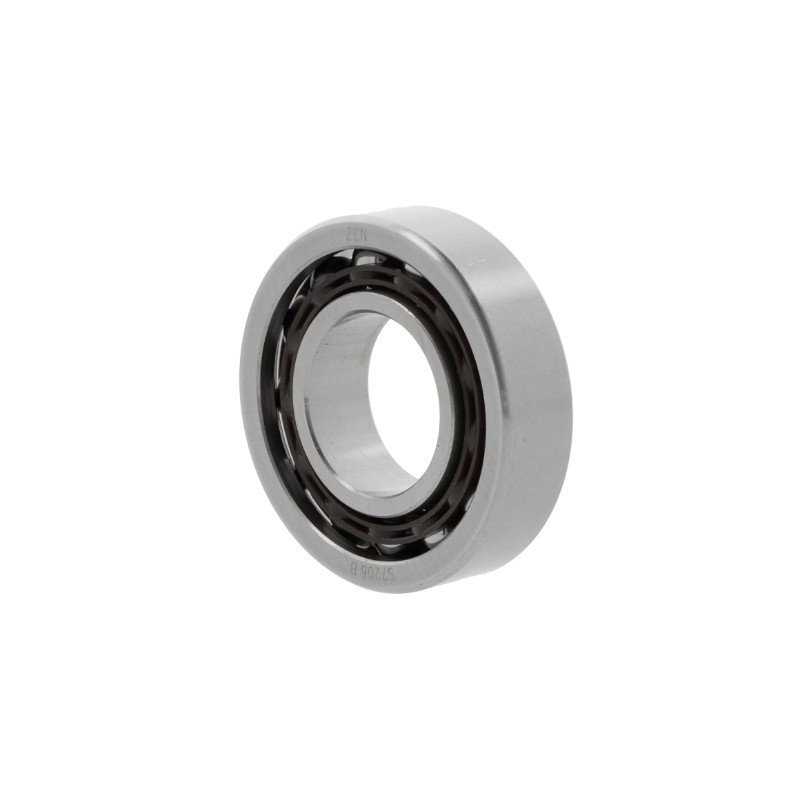
SKF single-row angular contact ball bearing 7214 BECBP with a 70 mm bore, 125 mm outside diameter and a 40-degree contact angle for combined loads.
The 7214 BECBP angular contact ball bearing accommodates both radial forces and single-direction axial forces simultaneously. Thanks to its 40-degree contact angle, this single-row bearing effectively distributes axial loads across the rings. Manufactured from standard 100Cr6 rolling-element bearing steel and featuring SKF’s Explorer design, it provides the basis for smooth running and dimensionally stable operation in demanding industrial applications.
Design engineers and maintenance personnel primarily use this rolling bearing where axial guidance and radial load-carrying capacity are required. The bearing is designed for applications involving combined loads. As a single-row bearing can only accommodate axial forces in one direction, it is often mounted in pairs in an O or X arrangement with a mating bearing.
The contact angle of 40 degrees facilitates the absorption of axial forces compared to bearings with a shallower contact angle. The integrated polyamide cage ensures low-noise guidance of the balls and is suitable for operating temperatures ranging from -20 to +120 degrees. When fitted in pairs in an O or X arrangement, a small amount of axial play occurs due to the design.
In addition, this design offers dimensional accuracy to tolerance class P6 and running accuracy to P5. As an open bearing, protection against contamination is provided by the surrounding housing structure, tailored to the specific lubricant selected.
The bearing has an inside diameter of 70 mm, an outside diameter of 125 mm and a width of 24 mm. The outer ring is cylindrical, with no groove or flange.
A contact angle of 40 degrees means that the line of contact between the rolling elements and the raceways runs at an angle to the radial plane. As a result, the bearing can accommodate unidirectional axial forces together with radial forces.
The permissible operating range is between -20 and +120 degrees. This temperature range is primarily determined by the polyamide cage used, which remains dimensionally stable and elastic within these limits.
These designations define the manufacturing accuracy: dimensional accuracy complies with Class P6, whilst running accuracy is manufactured to Class P5. This enables tight-tolerance concentricity characteristics.
This model is an open bearing with no integrated cover or sealing washers. For use in dusty or damp environments, an external seal must therefore be fitted to the machine housing.
When assembled as a bearing pair in an O or X configuration, this type of bearing is designed to have a small amount of axial clearance. This makes it easier to set the correct operating clearance compared with a rigid counter-bearing.
SKF Group
Sven Wingquists Gata 2, 415 50 Gothenburg, Sweden
info@skf.com, https://www.skf.com/uk/footer/site-ownership