

 Bearings
 Housings/housing Units
 Linear Technology
 V-Belts
 Seals
Seals
SKF
| Scale quantity | Your discount | Unit price |
|---|---|---|
| 25 | 1,77 € | 33,54 € |
| 35 | 3,53 € | 31,78 € |
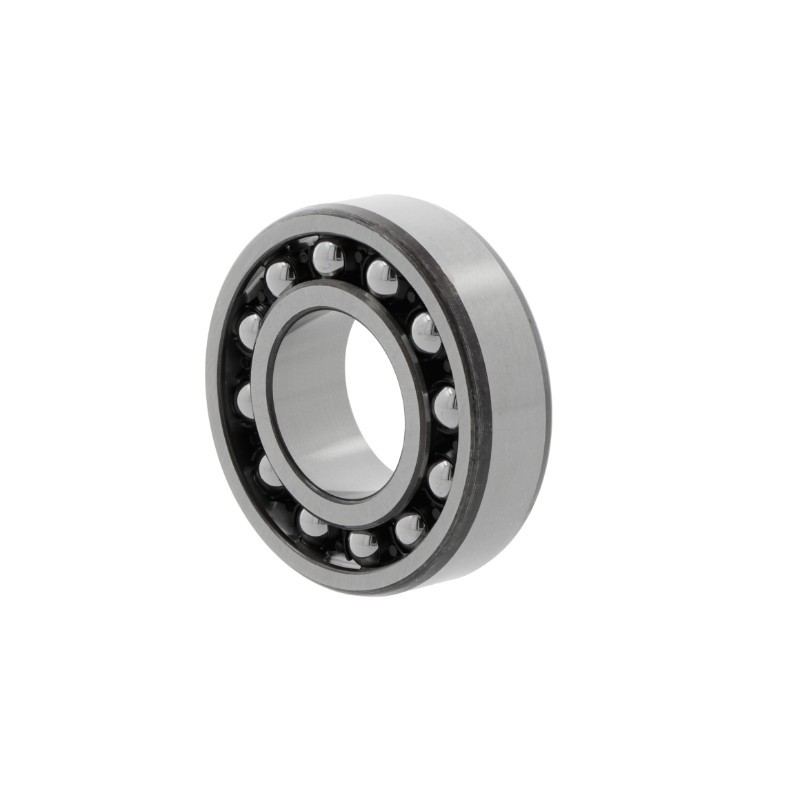
The SKF 2208 EKTN9/C3 self-aligning ball bearing, with its hollow-spherical outer ring raceway, compensates for angular misalignment and has dimensions of 40x80x23 mm.
This double-row self-aligning ball bearing, type 2208 EKTN9/C3, belongs to the group of self-aligning rolling bearings. The balls run in two grooves in the inner ring and a common spherical raceway in the outer ring. The component is made from 100Cr6 standard roller bearing steel and has the standard tolerance P0/PN or ABEC 1. It is suitable for operating temperatures ranging from –30 to +120 degrees Celsius.
This bearing design is intended for applications where misalignment or elastic shaft deflection occurs. The spherical raceway in the outer ring allows for angular misalignment between the inner and outer rings during operation without causing excessive edge stresses. Typical applications include bearing arrangements with long shafts or designs where alignment inaccuracies resulting from manufacturing and assembly processes need to be compensated for. As an open bearing, the lubrication supply can be flexibly adapted to the respective requirements via the surrounding housing system.
The combination of a tapered bore with a 1:12 ratio and increased C3 bearing clearance facilitates mounting on cylindrical shafts using a clamping or withdrawal sleeve. When the inner ring is pushed onto the shaft, the bearing clearance is measurably reduced. The increased initial clearance helps to ensure that sufficient operating clearance remains after tightening and during operation-related heating. The integrated polyamide cage guides the rolling elements elastically and reliably dampens vibrations during operation.
The bearing has a bore diameter of 40 mm, an outside diameter of 80 mm and a width of 23 mm. These dimensions refer to the standard dimensions of this double-row bearing.
The designation ‘K’ stands for a tapered bore with a standardised taper ratio of 1:12. This design allows for mounting on stepped tapered seats or, using clamping sleeves, on smooth shafts.
C3 denotes a slightly increased radial bearing clearance compared with the standard version. As the inner ring is expanded during fitting onto a tapered seat, the radial clearance is reduced. The C3 clearance prevents the rolling elements from jamming after installation.
The suffix TN9 denotes a polyamide cage. This plastic cage is characterised by its low weight, elastic properties and noise-damping characteristics, and is suitable for operating temperatures ranging from -30 to +120 degrees Celsius.
No, this is an open bearing without integrated sealing washers. To protect against dirt and retain the lubricant, suitable external seals must be fitted to the bearing housing.
The outer ring has a continuous hollow spherical raceway, the centre of curvature of which lies on the bearing axis. This allows the balls, together with the inner ring, to adjust freely within design limits in order to compensate for misalignment of the bearing units.
SKF Group
Sven Wingquists Gata 2, 415 50 Gothenburg, Sweden
info@skf.com, https://www.skf.com/uk/footer/site-ownership