

 Bearings
 Housings/housing Units
 Linear Technology
 V-Belts
 Seals
Seals
SKF
| Scale quantity | Your discount | Unit price |
|---|---|---|
| 2 | 34,56 € | 656,48 € |
| 3 | 69,12 € | 621,92 € |
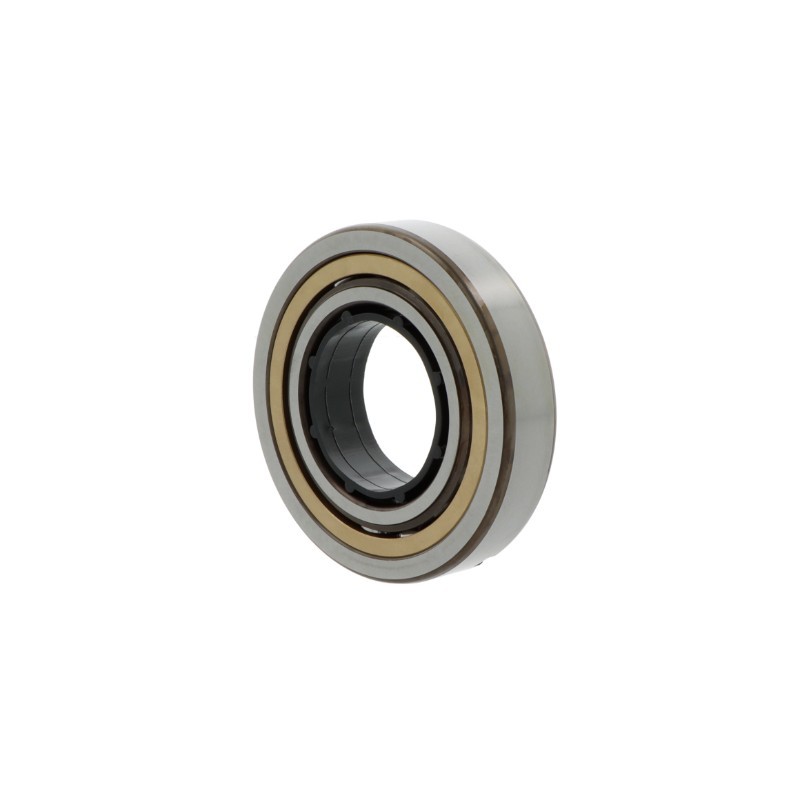
The SKF QJ319 N2MA four-point bearing (95x200x45 mm) accommodates axial forces in both directions whilst requiring minimal axial installation space.
The SKF QJ319 N2MA four-point bearing is a single-row radial ball bearing with a split inner ring, designed to accommodate high axial loads in both directions. With key dimensions of a 95 mm bore, 200 mm outer diameter and 45 mm width, this rolling bearing requires less axial installation space than a double-row bearing arrangement. As an open bearing in the Explorer design, it features a brass cage. Designs subject to alternating axial loads benefit from the compact design of this bearing type.
This bearing is particularly suitable for bearing locations where high axial loads occur in varying directions. The four-point bearing often functions as a pure axial bearing in combination with a separate radial bearing. Thanks to the split inner ring, the row of balls absorbs high forces whilst the shaft remains axially fixed. The open design without an integrated seal allows direct connection to existing lubrication systems within the housing.
The designation N2MA indicates two retaining grooves in the outer ring, offset by 180 degrees, as well as a brass cage. The grooves accommodate customer-supplied retaining pins, which are designed to prevent the outer ring from rotating within the housing. Thanks to the split inner ring, the inner ring halves and the outer ring can be fitted separately with the ball races. With tolerance class P6 for dimensional accuracy and P5 for running accuracy, the bearing is suitable for designs with increased requirements for concentricity and guidance accuracy.
With an internal diameter of 95 mm, an external diameter of 200 mm and a width of 45 mm, the roller bearing complies with standardised main dimensions. These mounting dimensions allow it to be fitted into prepared bearing seats. Before fitting, it is advisable to check that the shaft fit and the housing bore comply with the specified tolerances.
The division of the inner ring allows a greater number of rolling elements to be accommodated, which enhances the axial load-carrying capacity. Furthermore, this two-piece design simplifies assembly, as the outer ring, together with the cage and balls, can be fitted onto the shaft separately from the inner ring halves.
The two grooves, offset by 180 degrees, enable the outer ring to be locked in place within the bearing housing. Pass pins in the housing engage positively with the recesses and prevent the ring from rotating when torque fluctuates.
This marking indicates dimensional accuracy to Class P6 and running accuracy to Class P5. Compared with standard tolerances, these classes exhibit lower runout deviations and tighter dimensional tolerances. This ensures smooth running and precise shaft guidance.
The permissible operating range is between -30 and +150 degrees Celsius. As this is an unsealed bearing, the lubricant used is the main factor determining the thermal operating limit. The brass cage retains its dimensional stability even at elevated temperatures.
As an open bearing without an integrated seal, the bearing housing requires a supply of lubricant via the casing or must be filled with grease prior to commissioning. The choice between oil and grease lubrication depends on the speed, operating temperature and ambient conditions of the bearing in question.
SKF Group
Sven Wingquists Gata 2, 415 50 Gothenburg, Sweden
info@skf.com, https://www.skf.com/uk/footer/site-ownership