

 Bearings
 Housings/housing Units
 Linear Technology
 V-Belts
 Seals
Seals
FAG
| Scale quantity | Your discount | Unit price |
|---|---|---|
| 2 | 30,64 € | 582,07 € |
| 3 | 61,28 € | 551,43 € |
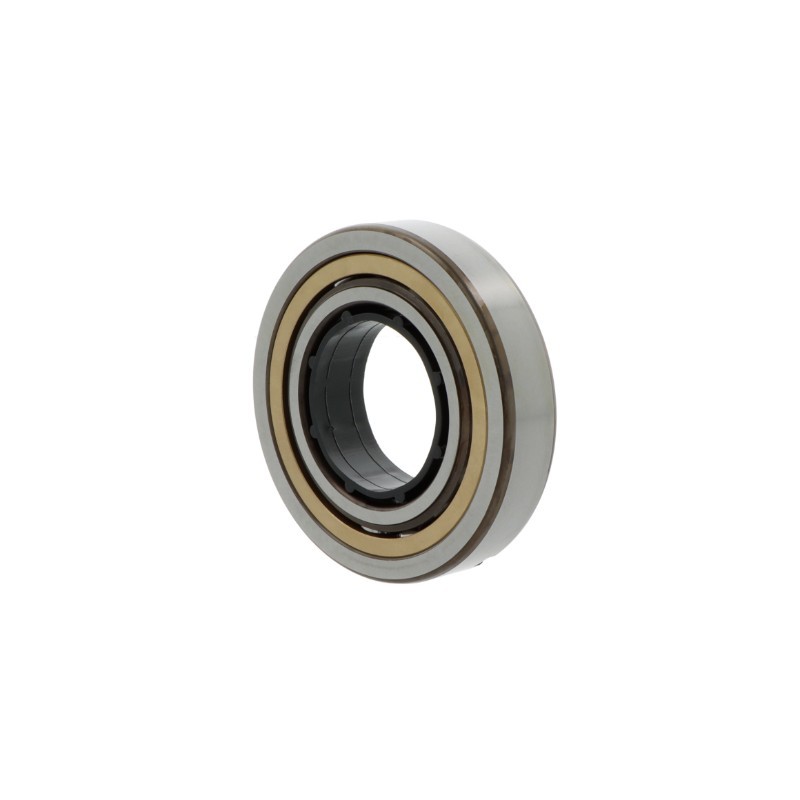
FAG QJ226 -N2-MPA four-point bearing with a 130 mm bore, brass cage and split inner ring for axial guidance on both sides.
The FAG QJ226 -N2-MPA four-point bearing is a single-row radial ball bearing whose raceways are specially designed to accommodate axial forces in both directions. With key dimensions of a 130 mm bore, 230 mm outer diameter and 40 mm width, this rolling bearing requires less installation space in the axial direction than double-row designs. The open bearing features standard radial clearance and a tolerance class of P0/PN or ABEC 1, and is suitable for operating temperatures ranging from -30 to +150 degrees.
Design engineers primarily use this four-point bearing where predominantly axial forces need to be transmitted within limited axial installation space. Typical applications are found in industrial drives with varying load directions. The bearing often functions purely as an axial bearing in combination with a separate radial bearing. Thanks to the split inner ring, the design accommodates a large number of balls. This contributes to stable axial guidance under varying load directions during operation.
The design is characterised by two retaining grooves in the outer ring, offset by 180 degrees, and a split inner ring. The grooves serve to secure the outer ring against unwanted rotation within the housing using retaining pins. This proves useful when the bearing is mounted with radial clearance. Due to the split inner ring design, the bearing is not self-retaining. This facilitates installation, as the outer ring, together with the ball cage and the inner ring halves, can be fitted separately. The guided brass cage ensures the smooth running of the rolling elements.
Thanks to its special raceway geometry, the bearing can accommodate axial loads in both directions, yet requires only the axial installation space of a single-row bearing. It features a split inner ring, a brass cage and two retaining grooves in the outer ring to prevent rotation within the housing.
This roller bearing has a bore of 130 mm, an outer diameter of 230 mm and a width of 40 mm. It complies with the standard tolerance class P0/PN or ABEC 1 and is manufactured with standard radial clearance.
The two grooves, which are offset by 180 degrees, allow the outer ring to be secured in the housing by means of retaining pins. This prevents the ring from rotating, which is particularly important when the four-point bearing is operated purely as an axial bearing with radial clearance.
The split inner ring allows a larger number of rolling elements to be fitted, which increases the axial load capacity. Furthermore, the non-self-retaining design simplifies assembly, as the bearing components can be fitted separately onto the shaft and housing during installation.
The open four-point bearing is specified for a temperature range of -30 to +150 degrees. As no seals are fitted as standard, the lubricant must be selected to suit the ambient thermal conditions and the requirements of the specific bearing location.
The brass cage guides the rolling elements along the raceways. Brass is characterised by its resistance to vibrations and its high mechanical strength, which are advantageous in industrial guidance applications.
Schaeffler Technologies AG & Co. KG
Industriestraße 1-3, 91074 Herzogenaurach, Germany
info.de@schaeffler.com, https://www.schaeffler.de/de/meta/impressum/