

 Bearings
 Housings/housing Units
 Linear Technology
 V-Belts
 Seals
Seals
FAG
| Scale quantity | Your discount | Unit price |
|---|---|---|
| 2 | 11,83 € | 224,74 € |
| 5 | 23,65 € | 212,92 € |
The FAG 51320 axial deep-groove ball bearing accommodates purely axial forces and has an outside diameter of 170 mm and a width of 55 mm.
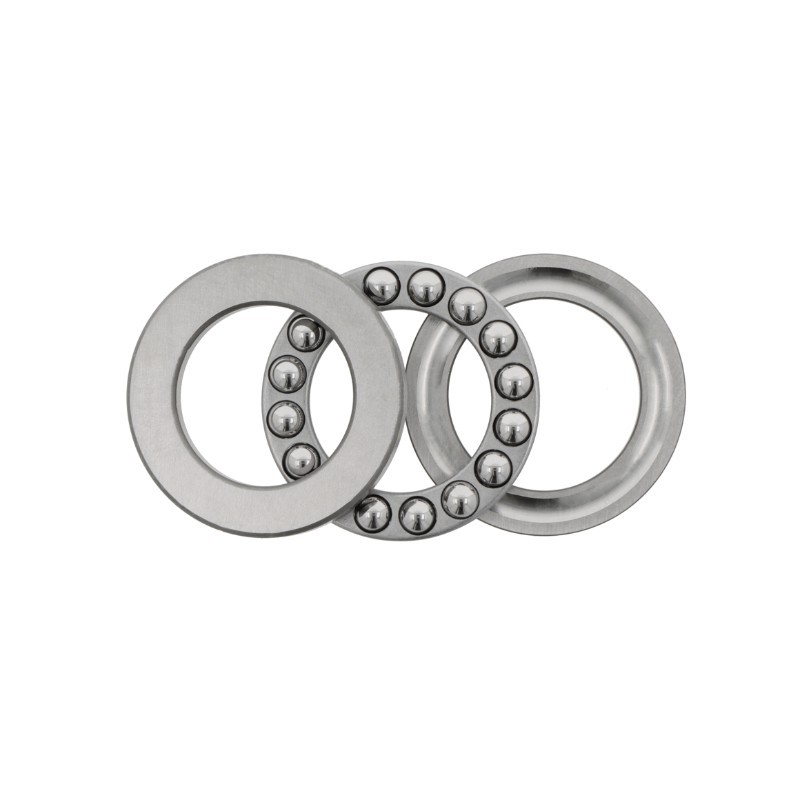
This single-direction axial deep-groove ball bearing 51320 from FAG supports axial forces in one direction. As a multi-piece bearing, the unit consists of separate bearing discs and a guided ball set. Manufactured from standard rolling-bearing steel, it ensures high dimensional stability of the raceways. Thanks to its separable design, you can fit the shaft disc and the housing disc one after the other, which facilitates installation in machine designs.
Axial deep-groove ball bearings of this design are suitable for bearing arrangements where high axial thrusts occur. As their design means they cannot accommodate radial loads, designers often combine this bearing with separate radial bearings. Typical applications include vertical shaft mountings and general mechanical engineering equipment. The flat housing flange requires a contact surface machined at right angles to the axis of rotation to prevent misalignment and to ensure even load distribution across the entire set of rolling elements.
In this design, a dimensionally stable sheet steel cage guides the rolling elements along their circular path. The component withstands thermal stresses in the range from –30 to +150°C. The steel cage withstands common lubricating oils and rolling bearing greases without material fatigue. When designing the assembly, you should ensure a sufficient minimum load. A permanent axial preload prevents harmful slippage between the balls and the raceways, which helps to extend the bearing’s service life.
This roller bearing absorbs axial compressive forces in one direction. It consists of two flat bearing discs with machined raceways and a guided ball cage. Thanks to its split design, the discs and the set of rolling elements can be fitted independently of one another.
The bearing unit has an outer diameter of 170 mm and a height of 55 mm. Thanks to these dimensions, the bearing is capable of withstanding axial forces in industrial plant engineering.
Axial deep-groove ball bearings are designed exclusively for axial loads. Radial forces may damage the component or lead to premature failure. To support transverse forces, the shaft must always be fitted with an additional radial bearing.
The bearing is designed for operating temperatures ranging from -30 to +150°C. Both the standard rolling-bearing steel and the sheet-steel cage retain their geometry within this temperature range and help to guide the rolling elements.
The sheet steel cage keeps the balls at a uniform distance apart and prevents them from coming into contact with one another. It is characterised by its strength, is fully compatible with standard lubricants and retains its dimensional stability even at higher temperatures.
During operation, a minimum axial load ensures that the balls roll in a controlled manner along the raceways. If this pressure is absent, sliding motion may occur between the ball and the disc. This leads to frictional heat, breakdown of the lubricating film and increased surface wear.
Schaeffler Technologies AG & Co. KG
Industriestraße 1-3, 91074 Herzogenaurach, Germany
info.de@schaeffler.com, https://www.schaeffler.de/de/meta/impressum/