

 Bearings
 Housings/housing Units
 Linear Technology
 V-Belts
 Seals
Seals
FAG
| Scale quantity | Your discount | Unit price |
|---|---|---|
| 2 | 94,14 € | 1.788,71 € |
| 3 | 188,28 € | 1.694,57 € |
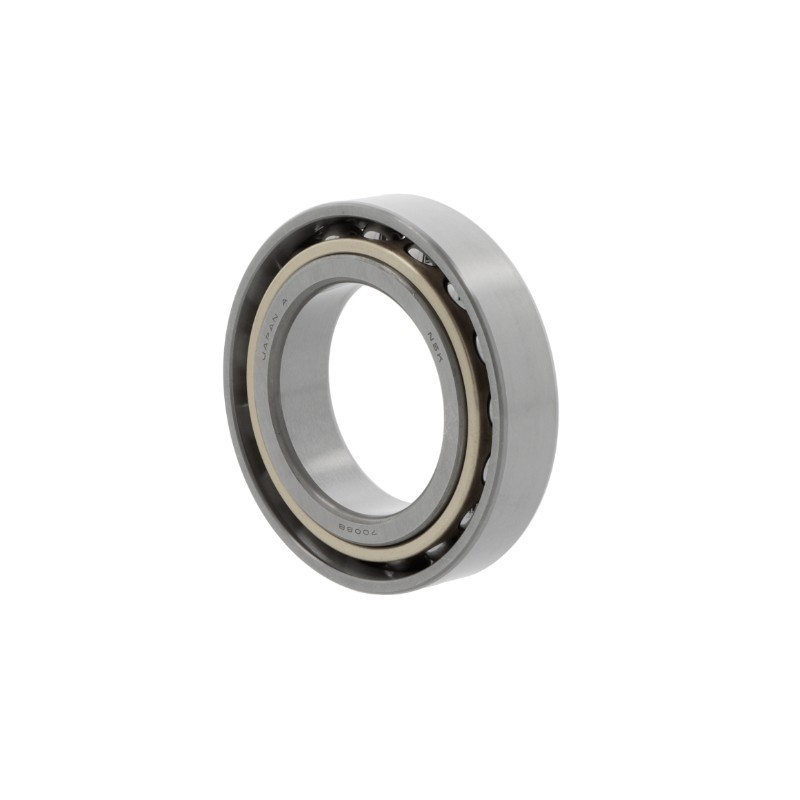
The FAG 7332 -B-MP single-row angular contact ball bearing, measuring 160 x 340 x 68 mm, reliably withstands high radial loads and unilateral axial forces.
The 7332 -B-MP angular contact ball bearing belongs to the group of radial rolling bearings and precisely supports shafts with a diameter of 160 mm. Thanks to its angularly offset raceways, this unit is suitable for combined loads where radial forces occur simultaneously with axial forces in one direction. Manufactured from standard rolling-element bearing steel (100Cr6), the bearing offers dimensionally stable running characteristics. As an open design without sealing rings, the bearing is designed for operation in a lubricated housing.
Bearings of this size transmit high radial forces as well as single-direction axial forces in demanding shaft mountings. As single-row angular contact ball bearings, by design, can only accommodate axial forces in one direction, they are usually mounted in a paired arrangement with a second bearing. The wide operating temperature range of –20 to +200 degrees allows for use in industrial environments subject to high thermal loads with a continuous supply of lubricant.
The nominal contact angle of 40 degrees ensures that the bearing can accommodate considerable axial loads in relation to the radial load. The steeper this angle, the greater the load-carrying capacity of the design in response to axial thrust. The solid brass cage guides the balls with low friction and is resistant to vibrations, shocks and lubricant additives. In conjunction with the standard radial bearing clearance and tolerance class P0/PN (ABEC 1), the component complies with current industry standards for standard fits.
The bearing has a bore of 160 mm. The outer diameter is 340 mm, with a total width of 68 mm. These dimensions correspond to the standardised main dimensions of the 7332 series. The outer ring is cylindrical in design and has neither a flange nor a ring groove.
The line of action of the forces forms an angle of 40 degrees with the radial plane. As a result, the angular contact ball bearing transfers axial forces specifically from one raceway to the other. A contact angle of 40 degrees gives the component a high axial load-carrying capacity in relation to the radial load.
Open bearings do not have integrated cover plates or sealing discs. They usually operate in enclosed housings with oil or grease lubrication. This design allows for unimpeded lubricant exchange and is suitable for operating temperatures between –20 and +200 degrees, as no temperature-sensitive elastomer sealing lips are fitted.
The brass cage guides the rolling elements along their raceway and prevents them from coming into contact with one another. Brass has good emergency running properties, is resistant to shock loads and can withstand high thermal stresses. As a result, the bearing operates with low vibration even under harsh industrial operating conditions.
Single-row designs can only accommodate axial forces in one direction. In practice, they are therefore usually fitted in pairs in an O or X configuration, facing a mirror-image counterpart bearing. This arrangement allows the desired axial clearance or preload for the entire bearing assembly to be precisely adjusted.
This specification defines the manufacturing and running accuracy in accordance with current rolling bearing standards. P0 (also known as standard tolerance or PN) corresponds to the US ABEC 1 classification. It represents the standard specification for industrial applications and ensures reliable operation in bearing seats manufactured to standard specifications.
Schaeffler Technologies AG & Co. KG
Industriestraße 1-3, 91074 Herzogenaurach, Germany
info.de@schaeffler.com, https://www.schaeffler.de/de/meta/impressum/